
One step into the Lee Center for the Arts will transport you from 12th Avenue back in time to clomping hooves kicking up dust along a dirt road, the clinking of the milkman’s deliveries and newspapers thrown against front doors. It’s 1901, and you are now one of the 2,642 citizens of fictional New Hampshire town Grover’s Corners, leaning back and watching the world go by.
“Our Town,” put on by Seattle University’s Theatre Department, will be the final production to take place in the Lee Center before its scheduled demolition in August 2026 to make way for the Seattle U Museum of Art (SUMA). The new museum, which will house a $300 million art collection donated by the Hedreen family, is set to open fall of 2028.
Written in 1938, “Our Town” by Thornton Wilder explores the lives of two families in a small town from 1901 to 1913. The play, which is running May 21-23 and 28-31, hones in on the love story between George Gibbs played by Third-year Communications and Media and Theatre Double major Ben Freeman) and Emily Webb (played by Third-year Theatre Major Lucy Johnson).
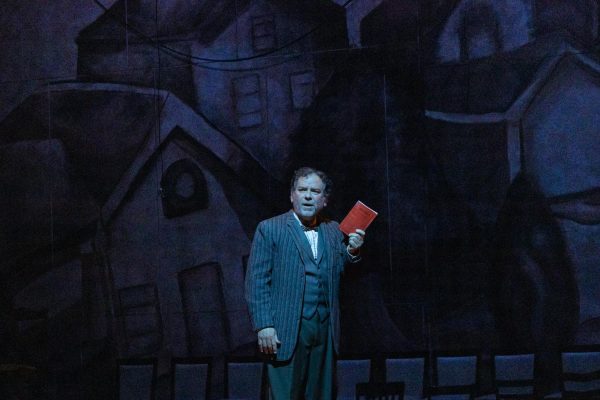
“Our Town” is a metatheatrical play, or a play that purposefully draws attention to the fact that it is a performance. The audience is introduced to the town by a “stage manager”—not the actual stage manager, but an actor who addresses the audience directly, guiding them through the time jumps and explaining the history of the town. This production’s “stage manager” was played by David Powers, professor of psychology and dean emeritus of the College of Arts & Sciences.
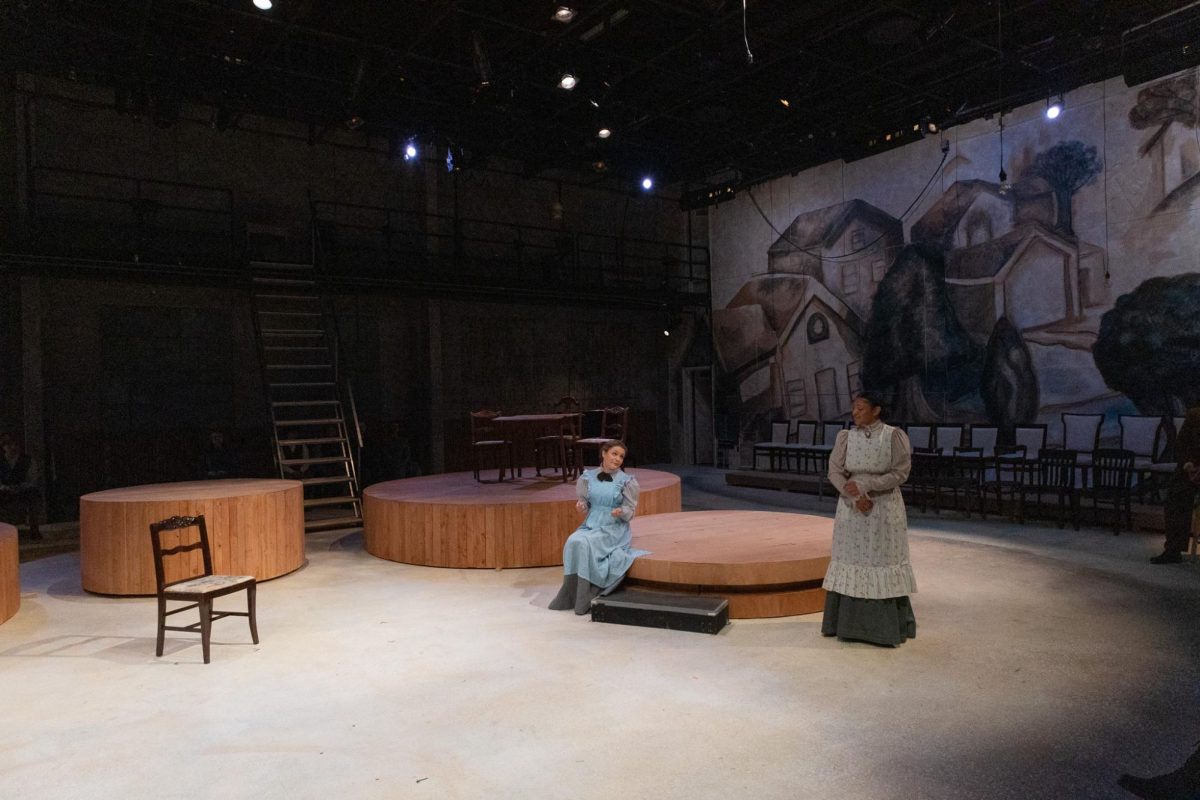
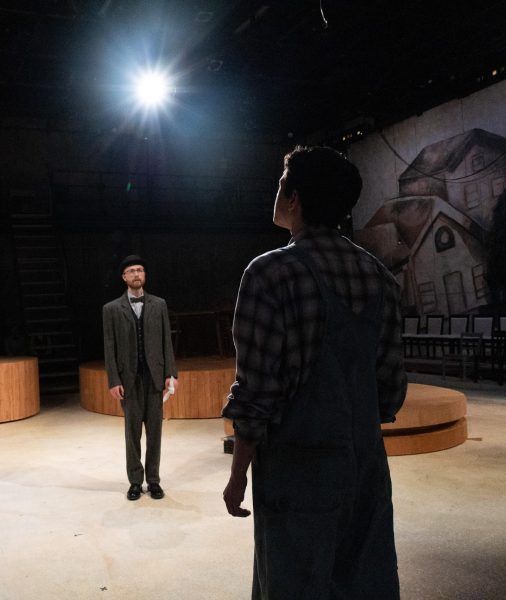
Wilder wrote “Our Town” to require minimal props, scenery and set, using absence to draw attention to the smallest details of life and the fleeting nature of memories. The play’s minimalist style not only led this cast to become proficient in pantomiming, but made the Lee Center feel more spacious and exposed than ever before. Audience seating—typically tiered rows in front of a designated stage space—was made up of single rows of ground-level mismatched vintage wooden chairs gathered around five circular wooden platforms of varying sizes.
Black curtains that previously shaped the space were removed; all four walls were instead painted with earth-toned houses, train tracks and stables that make up a small town. Characters off-stage created sound effects for characters onstage—whether it be a full coop of clucking chickens, a disgruntled horse or humming crickets—that echoed through the open space.
“This show is about life, death and everything in between, and how it’s okay to let go, and how not everything is forever,” Lily Cibene-Ingram, assistant director, assistant stage manager and co-music director, said. “That really speaks to the building itself. When you’re watching this production, you will see every inch of [the Lee Center]. I love that, because it’s the last time you get to really look at every inch of that building.”
The decision to demolish the Lee Center has received strong pushback from theatre students and faculty since it was announced February 2025, including a student-led campaign to “#SaveTheLee.” The campaign included “Scratched Out,” a production which featured scenes, songs and poetry asking the university to reconsider its decision to demolish the Lee Center, and a documentary by Shay Rutherford, a film studies alumnus who graduated in 2025, with interviews from theater students and faculty on their connection to the building.
“It’s such a shame to lose this beautiful theater in the heart of Capitol Hill when we’re losing so many things in the country, in the city, in the world, artistically—particularly with political systems that get in the way of the artist’s impact—and to take away a fully functional, beautiful space,” Director Janet Hayatshahi said. “There’s nothing like [the Lee Center] anywhere. It’s a shame, and it’s short-sighted.”
This coming academic year, Seattle U productions will move into the Vachon Gallery in the Fine Arts building. Following the acquisition, Seattle U plans to relocate theater activities to the South Lake Union campus. The facilities at the SLU campus, which include the Cornish Playhouse, two scene shops and a costume shop, will fill in for the creative space the Lee Center used to offer.
This production of “Our Town” was the first at Seattle U to feature a Cornish student in the cast—Second-year Acting and Original Works major Jade Jarrell played Simone Stimson, the town drunk.
“It’s been really beautiful to see this next year of actors and performers coming into the program,” Fourth-Year Theatre major Jarrett Magdaleno, who plays Dr. Frank Gibbs, said. “This merger with Cornish, out of nowhere as it was. Despite all the negative feelings that a lot of people within the program are feeling towards it, I can only see them going up from here. I can only see them doing greater and greater things as the years go on.”
The play also featured Costume Designer Heidi Zamora, an adjunct Cornish professor of theatre design, costume design and costume history. Zamora and the production’s wardrobe team borrowed costumes from Cornish and the University of Washington costume libraries, making small alterations to adjust to actors while maintaining the often-vintage pieces’ original integrity. The wardrobe team was also in the process of slowly getting rid of and relocating costumes to prepare for the demolition.
“We’re slowly dwindling the amount that we have, because we can’t all fit it in our new space,” Third-year Theatre and Psychology Double major, Costume Assistant and Stitcher Cece Henley said. “It’s balancing that too, like ‘how do we still make sure that this show is costumed in a way that doesn’t reflect that we’re slowly getting rid of our things?’”
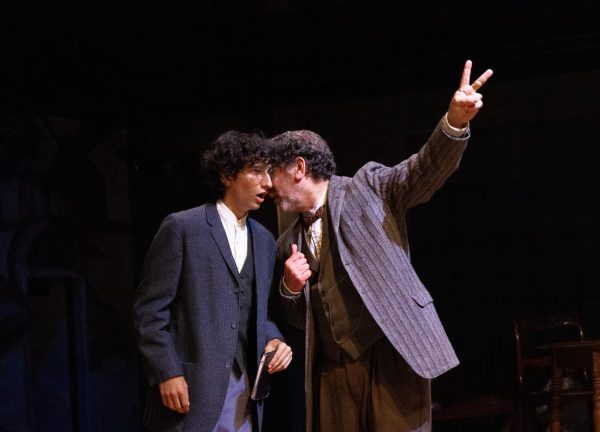
Many students involved in this production took on multiple roles to bring the show to its fullest potential and give students the opportunity to explore different areas of theatre. In addition to her roles as assistant director, assistant stage manager and co-music director, Cibene-Ingram worked in the prop, paint, and scenic departments, played the piano and multiple small roles in the play. Magdaleno, in addition to playing Dr. Gibbs, worked as lead assistant scenic director, carpenter and painter.
A sentiment shared by students and faculty was a gratitude for the camaraderie and the ease of communication throughout the production. Hayatshahi’s directorial style used the first two weeks of production to entirely analyze the script—researching historical context, definitions, pronunciations and everything in between. This production also included post-show “check ins” with the full cast to discuss how to improve the production and everyone’s experiences for the following night.
“One of the most important parts of this production has been the communication and the people who help put it together,” Lucy Johnson, third-year theatre major, said. “When everyone has a positive mindset and when everyone is aiming for a similar, if not exact same goal, it makes such a difference… I’m not burnt out from the show, which has been crazy.”
Between the bustling breakfast routines of neighboring families, late-night conversations under the glow of the moonlight with a first love and pre-wedding nerves calmed by the comforting embrace of a parent, “Our Town” revels in life’s small moments. The cast and crew’s onstage chemistry was indicative of their real-life connections, creating a sense of familiarity only an intimate, tight-knit theatre department could.
“My heart is with everyone who has touched Grover’s Corners and has been part of this tremendous process,” Hayatshahi said. “I will never have anything like this again in my life.”