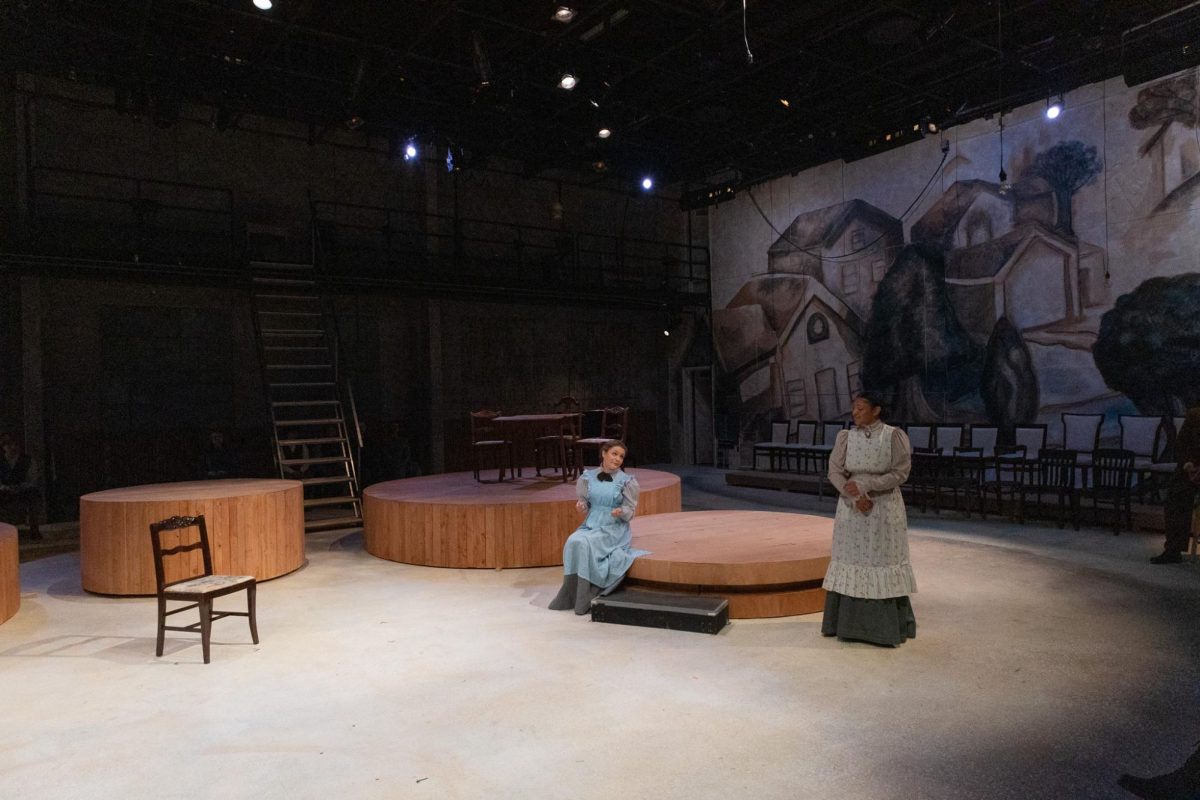


Before Cornish College of the Arts was officially acquired by Seattle University, they had seven unions on campus. Now, they have none.
Under the acquisition, in which Cornish signed an asset contribution agreement dissolving itself as an independent institution and donating all of its assets to Seattle U, the seven unions previously formed were phased out at the end of August 2025.
“Discussions regarding employment matters, including union representation, would have taken place with Cornish leadership prior to [Cornish College of the Art’s] dissolution,” Scott McLellan, vice president for university affairs, said in a written statement to The Spectator. “The focus now is on establishing a strong and sustainable future for Cornish College of the Arts at Seattle University and supporting faculty, staff and students through the ongoing integration.”
A professor of scenic design at Cornish since 2011, Matthew Smucker became president of the Cornish Federation of Teachers Union (CFT) in 2022. As president, Smucker served as the lead contract negotiator for the union and addressed employee grievances against the administration.
As soon as Smucker caught wind of the approaching merger, he doubted the union’s longevity, as he had heard about Seattle U’s past engagement with their own faculty’s unionization efforts.
“It wasn’t a complete surprise, even though it was disappointing,” Smucker said. “It was the student paper where we first saw ‘Oh, this is what their [Seattle U] relationship to a union effort was,’ […] and it definitely was something that colored our perception of the merger from the union standpoint.”
The CFT had existed at Cornish since the 80s, according to Smucker, but the last successful effort made by Cornish employees to unionize was in 2021. At the time, the institution had five other unions operating on its campus. Of a few of them, all teaching faculty, theatrical technicians and dance musicians were unionized, but the 2021 effort was made by the college’s staff: admission counselors, student success coaches, academic advisors, librarians, department coordinators, facilities and IT workers sought representation in the administrative decision-making process.
Cornish administration denied the staff recognition, arguing that the positions they wanted to include were ineligible. After a legal back-and-forth, the union filed an election petition with the National Labor Relations Board (NLRB). The NLRB ultimately ruled in the staff’s favor.
“It was quite the victory because it was so long and hard fought, and knowing that it’s no longer part of our group, that these people are no longer represented, it is disheartening,” Nallely Flores, an organizer at OPEIU Local 8, said.
Part of the Collective Bargaining Agreement (CBA) between Cornish and OPEIU Local 8 included a successor clause stating that in the event of a merger, the successor institution (in this case, Seattle U) would be bound by the CBA, preserving the union. Spectator reporting from Jan. 2025 stated that “it is unclear if any Seattle U faculty would be able to join the union in the event of a merger.”
The OPEIU union at Cornish did not include any faculty, only staff. The CBA expired in August of 2025, and when Cornish employees were rehired by Seattle U, they became part of a larger, non-unionized workforce.
The pushback that Cornish staff faced in their attempt to unionize is strikingly similar to the position taken by Seattle U’s own administration about twelve years ago, in response to a movement for a non–tenure-track faculty union under President Father Stephen Sundborg, who is currently serving as interim president.
The movement for a Seattle U union started in early 2013 when Theresa Earenfight, a Seattle U professor emerita of history,

then active at the university, was asked to meet a non-tenured colleague at a cafe near Pike Place. When she arrived, he asked that they both turn off their phones. Earenfight wondered what he wanted to discuss that required this level of caution.
“He met with me, and he really quietly said, ‘We’re thinking of unionizing. Are you with us?’ It was in that tone of voice. It had to be off campus, it had to be one-on-one,” Earenfight said. “That is a moment I will never forget.”
Faculty interested in unionization began discussions with the Service Employees International Union (SEIU) Local 295, as part of the broader Adjuncts and Contingents Together Washington (ActWA) unionization campaign. In December of 2013, while unionization efforts were spreading by word of mouth, Provost Isaiah Crawford sent an email to all non-tenure-track and adjunct faculty stating that a union would “weaken key elements of the shared-governance system that we have worked hard to develop and support.”
Some faculty, both adjunct and tenured, were surprised and disappointed at the administration’s immediate pushback against unionization. The position stood in contrast to prominent Jesuit university Georgetown’s declaration of neutrality in response to efforts to unionize adjunct faculty. This allowed faculty to organize and vote on unionization without administrative resistance.
Seattle U did not adopt a position of neutrality. They held teach-ins, sent emails, issued public statements about the threat unionization posed and challenged the union legally, requiring the adjunct faculty to petition the NLRB for a union election. After reaching the necessary signature threshold, this petition was filed in February of 2014.
In the following legal proceedings before the local branch of the NLRB, the Seattle U administration argued against unionization on the basis of the university’s religious nature.
“The issue is not whether faculty may organize,” lawyers representing Seattle U wrote in an appeal released in 2015. “Rather, the issue is whether the government can and should exercise control or influence over how a religiously-affiliated university carries out its religious mission.”
Eric Severson, an associate teaching professor of philosophy, started at Seattle U in 2014. Despite his support for unionization, he understands the pressure the administration may have been under. Just as Cornish struggled financially, Seattle U’s own budget was tight in 2014 when term faculty first pushed for unionization.
“It feels like a dangerous forfeiture of power, especially from an institutional perspective where they might be worried about the survival of the institution. Now, along comes a union rep that says, ‘We’re not gonna teach unless you pay these faculty members an amount of money that would bankrupt the institution,’” Severson said.
April 25, 2014, the regional branch of the NLRB ruled in favor of the right for adjunct faculty to unionize. The Board’s written decision, obtained by The Spectator, states that Seattle U “lacks substantial religious character,” citing that, at the time of the ruling, only 30% of the school’s student body was Catholic. The ruling also noted that the school gives no special financial assistance or admission preference to Catholic students, receives no funding from the Catholic Church or the Society of Jesus and has no religious requirements for faculty.
The NLRB decision enabled a vote among adjunct faculty on whether to unionize.
This vote concluded June 2, 2014, but its results, in favor of unionization 73-63, wouldn’t be counted for another two years. Almost immediately after the vote concluded, Seattle U appealed the NLRB’s decision, and the votes were impounded at the Federal Building downtown, blocking the count.
From June 2014 through August 2016, the university appealed decisions in favor of the union a total of four times.
Jerome Veith, a senior adjunct professor of philosophy who has been at Seattle U since 2012, testified multiple times in front of local NLRB representatives in the Federal building.
“To know that the university is taking tuition money and paying lawyers to train them to act against faculty, or at least that that’s what they were doing at the time, it’s chilling. Even to this day, recounting it, it fills me with a kind of low-level dread,” Veith said, recalling his testimonial experience.
In a 2016 interview with the Seattle Times, Sundborg declined to say how much the legal fight against the union had cost the university, other than to call it “a modest amount, overall.”
In February of 2015, an on-campus protest in favor of unionization occurred, with many chanting “count the votes” in frustration at the administration’s resistance. Earenfight, along with a group of protestors that included students, concluded their march through campus by sitting down in the middle of the intersection at 12th and Madison and eventually being arrested.
“Buses backed up. Traffic backed up. The provost at the time walked around with his cell phone taking pictures of us all, and we all smiled,” she said.
Another protest occurred in April 2016, with chants of “What’s disgusting? Union busting! What’s outrageous? Poverty wages!”
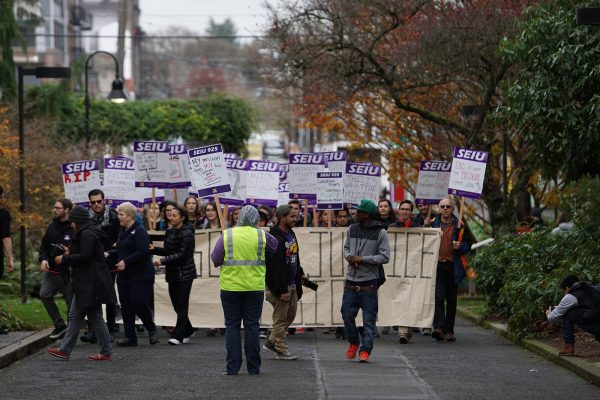
This photo originally appeared online with the article titled “Students, Faculty Keep Unionization Fight Alive” (Nick Turner)
Jodi O’Brien, professor of sociology since 1995 and senior vice president for academic affairs since 2021, sees the issue of unions in higher education as complex. While she agrees that there are for-profit educational institutions that treat faculty like a workforce underneath professional managers, that isn’t how she characterizes Seattle U. She worries that unionization would’ve introduced an unnecessary third party.
In response to the idea of a union, O’Brien helped assemble a research group of professors to improve contracts for non-tenured faculty. Professors, including those at Cornish, can now progress to Assistant Teaching Professor, Associate Teaching Professor or to Teaching Professor. These tracks, however, do not provide a pathway to tenure.
According to O’Brien, these classifications enable pathways to promotion and raises, as well as longer-term contracts. These faculty members would be full, voting members of the department, often referred to as term faculty.
“It would cost us a little more for each of those faculty members, but we figured it was the Jesuit thing to do, it was the right thing to do,” she said.
Cornish faculty now, too, can go through the promotional track. According to Smucker, the acquisition has also meant a raise for most Cornish faculty. Seattle U could get closer to meeting certain pay demands that Smucker had fought for on behalf of the union than Cornish was ever able to, given the school’s dire financial position.
O’Brien sees this reform as the core success of the interaction between faculty and administration. To Veith, the changes are insufficient.
“Yes, there are more avenues to be on committees, there are more options to have votes on things, but do those votes end up actually doing anything? The answer there is, by and large, no,” Veith said.
Term faculty, who operate on contracts that sometimes last under a year, were partially motivated to unionize by a sense of job insecurity and frustration with vague promotion pathways—issues also on the minds of Cornish faculty.
According to Smucker, although Seattle U rehired nearly all Cornish faculty, many who previously held long-term contracts are now on much shorter-term contracts, with no clear path to tenure.
“There’s been a lot of ‘We will figure that out in the future,’ or ‘It’ll be a little more complicated but we can’t tell you exactly what it is,’ so there’s not a lot of information at this point about how we’d move into a tenured position,” Smucker said.
A sense of contract instability is part of what motivated the push for unionization at Seattle U in 2014.
“This is the language the university will always use around non-tenure track labor, that it’s ‘flexible.’ ‘Oh, we love the flexibility of this.’ But the underbelly of flexibility is precarity,” Veith said.
Seattle U’s push for a faculty union occurred in the context of increasing “adjunctification” across higher education. Part-time, non-tenure track faculty currently represent 48% of the academic workforce in the nation.
Veith, Earenfight, Severson and other professors at Seattle U all said the number of tenure-track positions has decreased during their time at the university, with these positions filled by adjuncts who can be found, onboarded and let go with much less bureaucratic headache than a tenure-track employee.
Earenfight believes that the university exploited the contract system’s plausible deniability to essentially fire faculty for their involvement in the union effort. Other members of the unionization effort echoed this fear in past Spectator reporting. According to a 2015 article, around the time of the protest, multiple students and adjunct faculty shared suspicions that certain contracts were not renewed on the basis of union activity. The article refers to an unnamed faculty member who vocally supported unionization and had “received correspondence suggesting that his advancement at this university could be in danger.” The system itself creates uncertainty that, according to some, carries a chilling effect on academic freedom.
“If you’re not tenured, you can’t stand up to the president or the provost. I could. I could walk into Shane Martin’s office, and I did more than once, and say, ‘Shane, this is not working.’ If I were contract, I couldn’t. I didn’t have the standing, and I would fear for my job,” she said.
After a final ruling in favor of the union in fall of 2016, the votes were counted for the first time, and the union was legally recognized.
“When they were done, we all looked at each other like ‘Oh my god, is it true? Did we do this?’ That sense of euphoria was just so amazing,” Earenfight said.
That didn’t stop the university administration from refusing to recognize its validity or engage in any negotiations, stating that they were willing to take the case all the way to the Supreme Court. Amid a hostile federal labor climate under the first Trump administration, faculty decided to officially disband the union in 2018. They were afraid a federal decision against them would set a precedent for religious institutions and affect other unions.
Provost Shane Martin pointed to the Academic Assembly as an existing form of faculty representation.
“The Seattle University Academic Assembly (AcA) is the elected representative voice of the faculty. The Seattle University administration works closely with the AcA to facilitate shared governance. The provost regularly interacts with the AcA and its leadership on matters of importance to the faculty, including supporting term faculty,” Martin said in a written statement to The Spectator.
To multiple faculty members who took part in labor organization efforts, Seattle U’s position towards organized labor doesn’t feel very Jesuit. In 2016, Campus Ministry hosted a panel, featuring Earenfight among others, largely in favor of unionization, despite actions by the administration.
“It would be ironic and unfortunate and embarrassing to work at an institution where we’re coaching our students to have formational opportunities, to look for ways to create a just and humane world, while at the same time working under conditions which are unjust and inhumane,” Severson said.
A correction was made May. 14, 2026: This article was updated to correct Shane Martin’s title (he is the Provost, not the Vice Provost).
Corrections are made during production when errors are identified in time, so not all corrections may appear in every edition.