

100 days have passed in office for recently elected Seattle Mayor Katie Wilson and King County Executive Girmay Zahilay. Zahilay’s team focuses his work around the “four Bs:”: breaking the cycle, building for affordability, boots on the ground and better government. Each tenet aims to address a different aspect of life in King County—substance abuse and homelessness, cost of living, community presence and effective governance.
Both politicians, who ran campaigns on values of pragmatism and community collaboration, joined a trend of progressive governance throughout the nation’s cities with New York City Mayor Zohran Mamdani, Mayor of Boston Michelle Wu and Mayor of Chicago Brandon Johnson.
Acting on their intentions to stay active with Seattle communities, 200 people filled Pigott Auditorium April 14, to watch Wilson and Zahilay’s installment in Conversations, Seattle University’s quarterly Q&A-style talk series. Led by journalist and Seattle U professional in residence Joni Balter and co-hosted by graduate student Ari Winter, this quarter’s Conversation focused on the politicians’ progressive approach to policy.
-
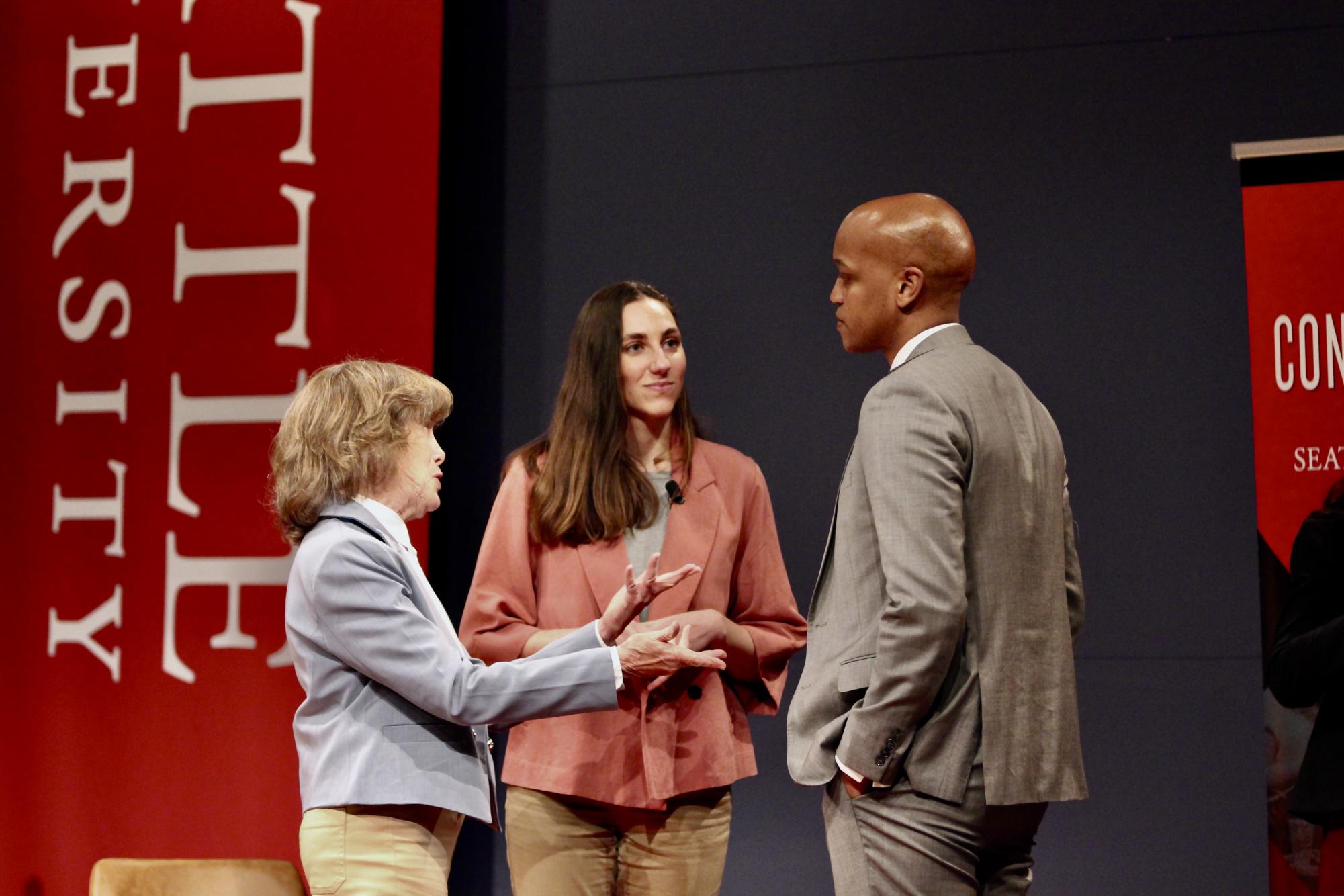
Journalist Joni Balter and Seattle University graduate student Ari Winters speak with King County Executive Girmay Zahilay.
-
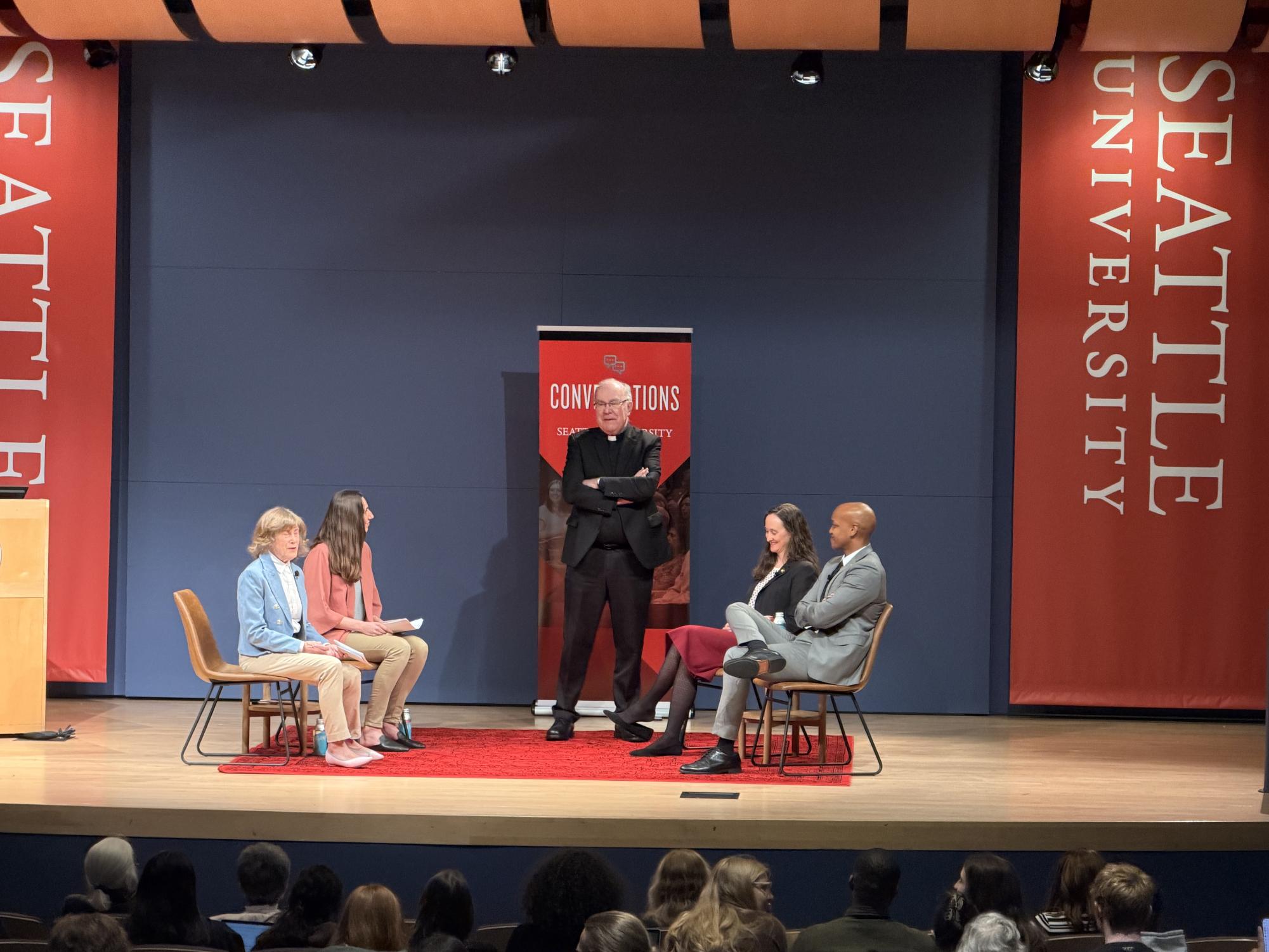
Interim President Stephen Sundborg converses with interviewers and interviewees.
-
Mayor Katie Wilson (left) and King County Executive Girmay Zahilay (right) thanks the interviewers at the end of the Conversation.
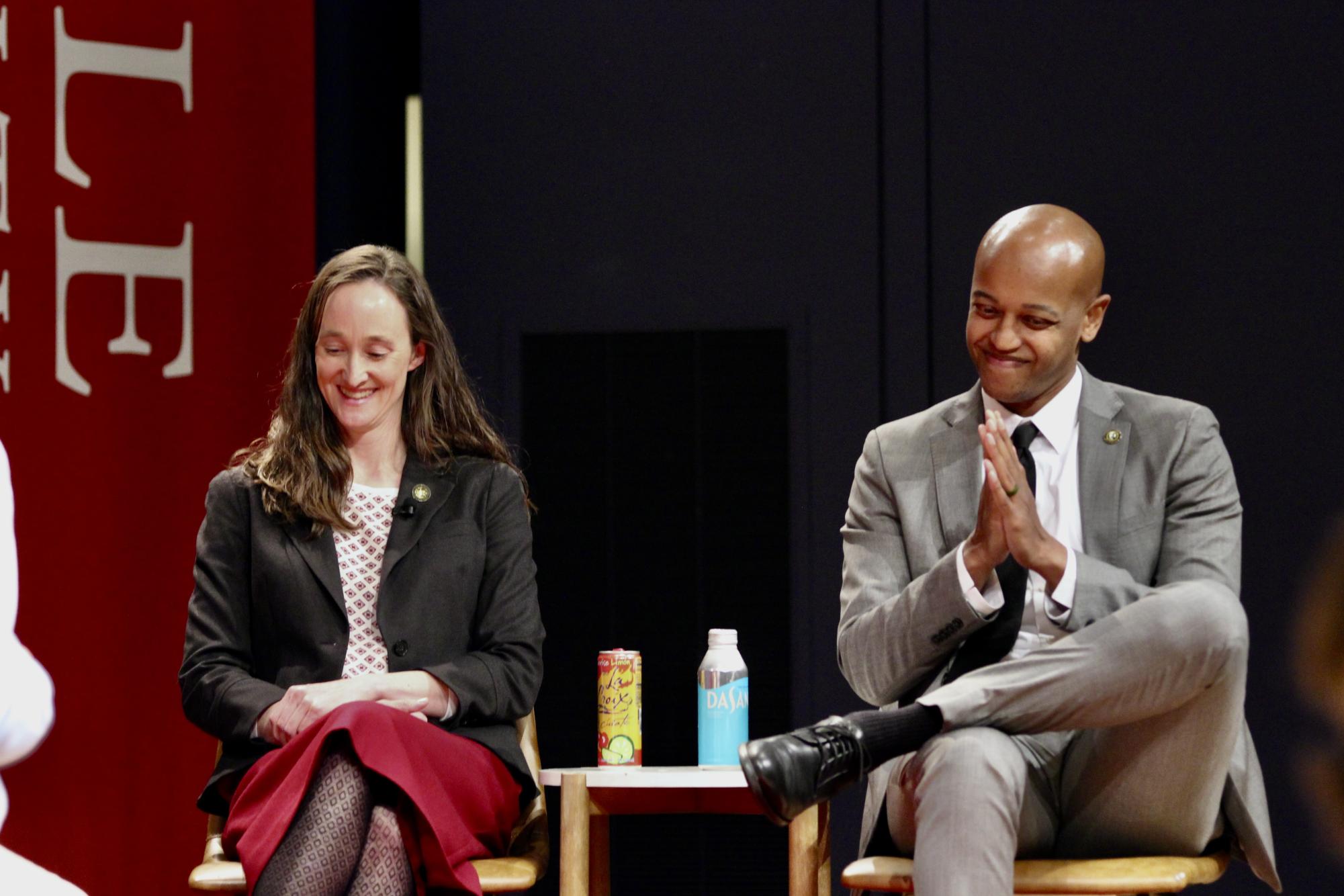

The talk was an opportunity for both politicians to show they’ve spent their first few months in office, attempting to differentiate themselves from their predecessors. For Zahilay, being progressive means taking values from both the left and right and attempting to find a middle ground that serves all his constituents. Wilson expressed a similar intent.
“Even though Seattle maybe has a stronger progressive political identity than the county as a whole, that masks an incredible amount of diversity of all kinds, including political diversity, ideological diversity, and just people and institutions coming from a lot of different perspectives,” Wilson said. “I came into office obviously running as an unabashed progressive, but at the same time recognizing that as the mayor of the city, and kind of representing the city in that sense, I really had work to do building relationships kind of across the spectrum.”
Wilson and Zahilay were elected in November 2025. Zahilay, the first new executive King County has had in 16 years, is also the first immigrant, refugee and millennial to hold the role. Wilson is a rookie politician, former community organizer and a renter herself, voicing support for policies aimed at increasing housing affordability.
“Nobody believed, myself included, that Wilson was in a position to win the mayoral race when it started. She defied expectations,” Sandeep Kaushik, a Seattle political consultant and podcaster, said. “She did it by building not just an ardent grassroots base of activist support, but by broadening out her appeal to a lot of voters that may have been turned off by left-lane candidates like her in the past.”
A self-described democratic socialist, Wilson declared that she aimed to open 4,000 units of shelter in four years, decried federal funding cuts to the city and condemned Washington’s regressive tax system (the second-most regressive in the nation). At the same time, she avoided promoting policies that have traditionally alienated mainstream voters, such as abolishing the Seattle Police Department.
Speaking to his presentation as a leader, Callie Craighead, Zahilay’s press secretary and a previous member of former Seattle Mayor Bruce Harrell’s media team, helped distinguish Zahilay as a progressive Democrat in a nonpartisan position. His goals all center on creating a more welcoming and affordable King County, as someone who lives alongside those he represents.
A refugee from Sudan, Zahilay first lived in a homeless shelter upon arriving in Seattle. After being raised in South Seattle, Zahilay attended Stanford University and the University of Pennsylvania Law School, pursuing a career focused on battling poverty and underserved communities.
“I think a lot of the attacks that we’re seeing at the federal level, related to immigrant and refugee rights and protections, he really understands what those communities are going through. He has made it a real priority to enhance local protections for them. I definitely see him falling more on the progressive spectrum,” Craighead said.
Now that they are in office, they have begun to implement those ideas. Zahilay began his term by restructuring the King County Executive’s office for the first time in sixteen years. With guidance from a transition committee of roughly 100 people, he signed an executive order meant to increase transparency and accountability within his office. He ordered a full budget analysis, established an internal auditor position for the county, and directed King County agencies to ensure that public funds were being used effectively. The final tenet in his “four B’s” list, better government, became significantly more important after an August 2025 audit of King County exposed a lack of oversight that may have enabled fraud.
According to The Seattle Times, Wilson vocalized opposition to expanding police surveillance cameras during her campaign. However, she has instead pivoted to pausing the program’s expansion pending an internal audit and shut down one set of cameras aimed at a business providing reproductive and gender-affirming healthcare, but did not shut down other cameras as promised. Her reason for changing her mind is that she is assessing decisions based on evidence and community input, an approach she and Zahilay share.
The cameras, intended for crime prevention and prosecution by law enforcement, have been a point of debate, especially in more left-leaning circles, due to concerns relating to government surveillance, which has been a big element in the current rise of immigration enforcement.
“We’re working on starting an audit that NYU Policing is going to be conducting into the data security, storage and sharing practices around our Realtime Crime Center and CCTV cameras,” Wilson said during the talk. “We’re conducting an evaluation of the ways that the cameras are being used in investigating crimes and assessing their usefulness. I’ll be making another decision once we get the results.”
Another notable move in Wilson’s mayoral career is the establishment of the Stand Together Initiative: a policy that installed signs prohibiting Immigration and Customs Enforcement Officers from approaching or entering private property without a warrant.
Alex Olson, opinion editor at The Daily, the University of Washington’s student-run newspaper, has followed Wilson’s campaign closely and feels invested in the direction of her political career. In terms of her work post-election, Olson feels that her positions are moving toward the middle ground because she hasn’t been able to create a strong grassroots community to rely on, which she had acknowledged the need for on election night.
“She doesn’t have enough people supporting her on the left. I think she has not displayed the fortitude [or stood] up to these vested interests that I would’ve liked to have seen. There’s this immense gravity, the immense pull, the immense weight on the more moderate centrist, even conservative, side of Seattle politics, and I think she just has not been able to counterbalance that and to have enough gravity on the left to be able to pull her back in this direction, and so I think she’s caved in. I think she’s sort of defaulted to these powers that be.”
For other King County communities, both Zahilay and Wilson represent a wave of politicians, similar to Mamdani, who have taken the untraditional approach of vocally including BIPOC and religious communities. The American Muslim Advancement Council (AMAC), which previously endorsed both politicians during their campaigns, has had more engagement with them than with its predecessors.
“We have seen that [approach] with our Muslim community through the appointment of community members to transition teams and soliciting community feedback,” Hyder Ali, an AMAC Board Member, said. “They are also trying to build a team that is representative of the community they govern. It is early in their administration, and we hope to see this manifest more tangibly over time.”
Wilson and Zahilay, as discussed in the Conversations talk, are determining what “progressive” means to them. The New York Times deemed that the political landscape of the United States is being torn in two directions in an article examining how Trump has remade America. Their data show Democrats building support in wealthy, highly educated counties, whereas Republicans are catering to the working class. But for Seattle’s Mayor and King County Executive, this trend does not overtly influence their own values.
“When I look at the broader community, there doesn’t seem to be an appetite for labels. They’re asking, who’s going to solve these problems? Who’s going to help me live every day?” Zahilay said during the talk. “I approach it from a perspective of, ‘I’m here to solve problems and not to signal virtue to a base’.”
The post-COVID world has been defined by financial crises, issues of housing affordability, an uncertainly rapid rise of Artificial Intelligence presence, and a constantly changing geopolitical climate. For voters across all margins, and especially younger generations, there is a shift towards politicians who will mirror their own needs and struggles. But on both sides of the coin, politicians are navigating a new political structure that they themselves are integral to building, while constituents are finding the balance they need to hold to keep them accountable.
“It’s hard to encapsulate, and it’s definitely been a shift that we’ve seen with Mamdani in New York and all throughout the country, this shift towards progressive politics,” Craighead said. “So the question now is how do they deliver on these priorities? We have to wait and see.”