
A brief struggle between the Seattle University Provost and a student during Seattle U’s commencement ceremony on Sunday quickly escalated this week into a social media firestorm over the freedom to protest for Palestinian rights and treatment of Muslim students.
Video clips of the altercation on the graduation stage at Climate Pledge Arena have amassed more than 4 million views on Instagram. The Washington chapter of the Council on American Islamic Relations (CAIR Washington), a Muslim advocacy organization, held a press conference in collaboration with the student on Wednesday, claiming that the student was “physically accosted” and demanding that the university investigate what happened.
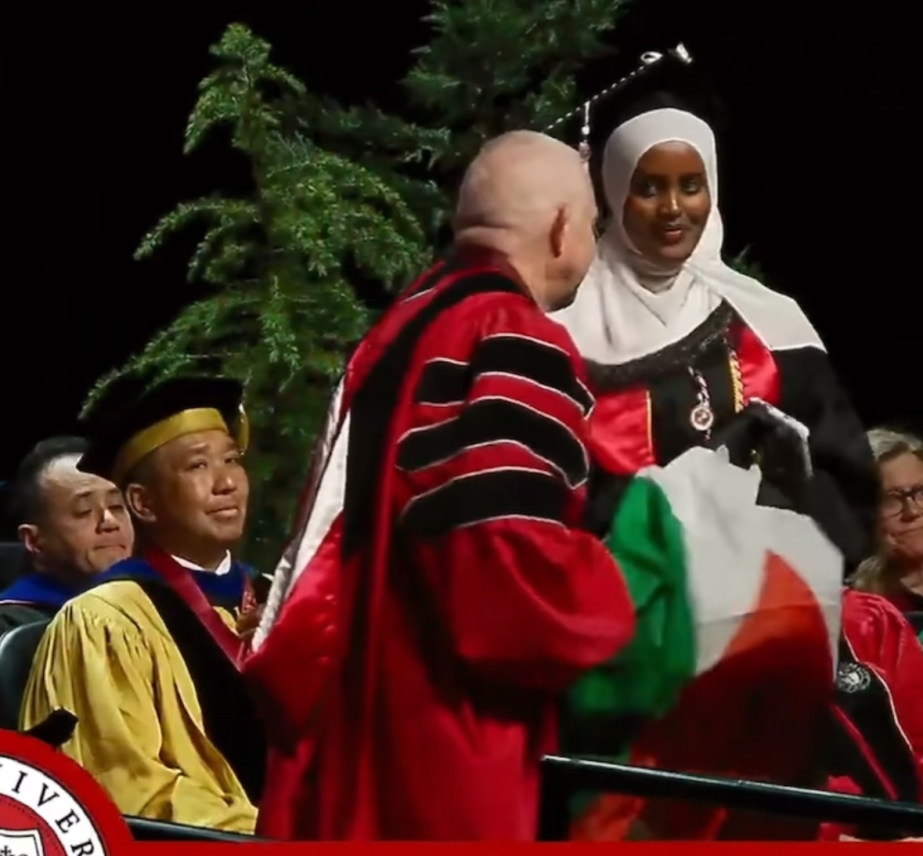
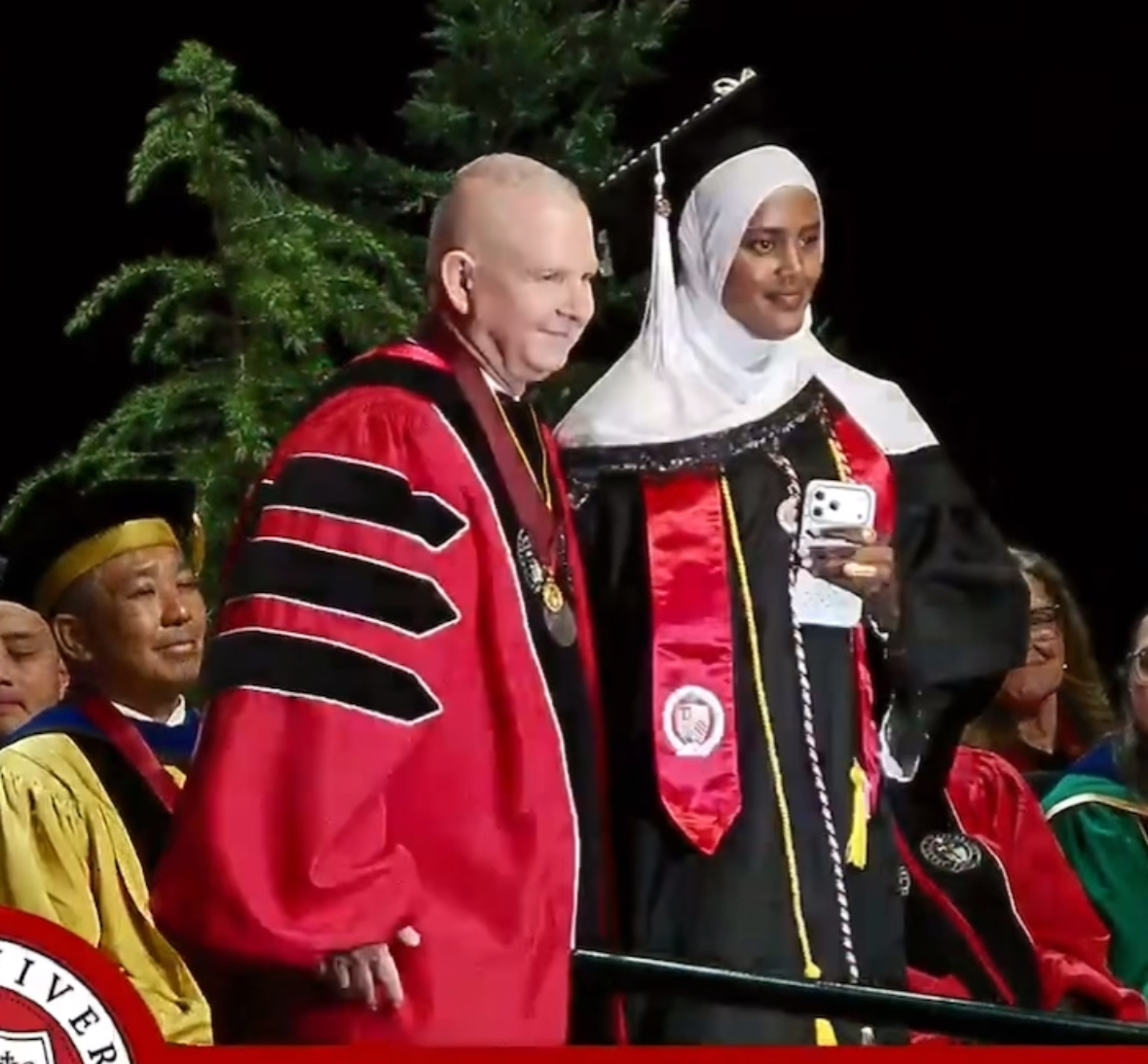
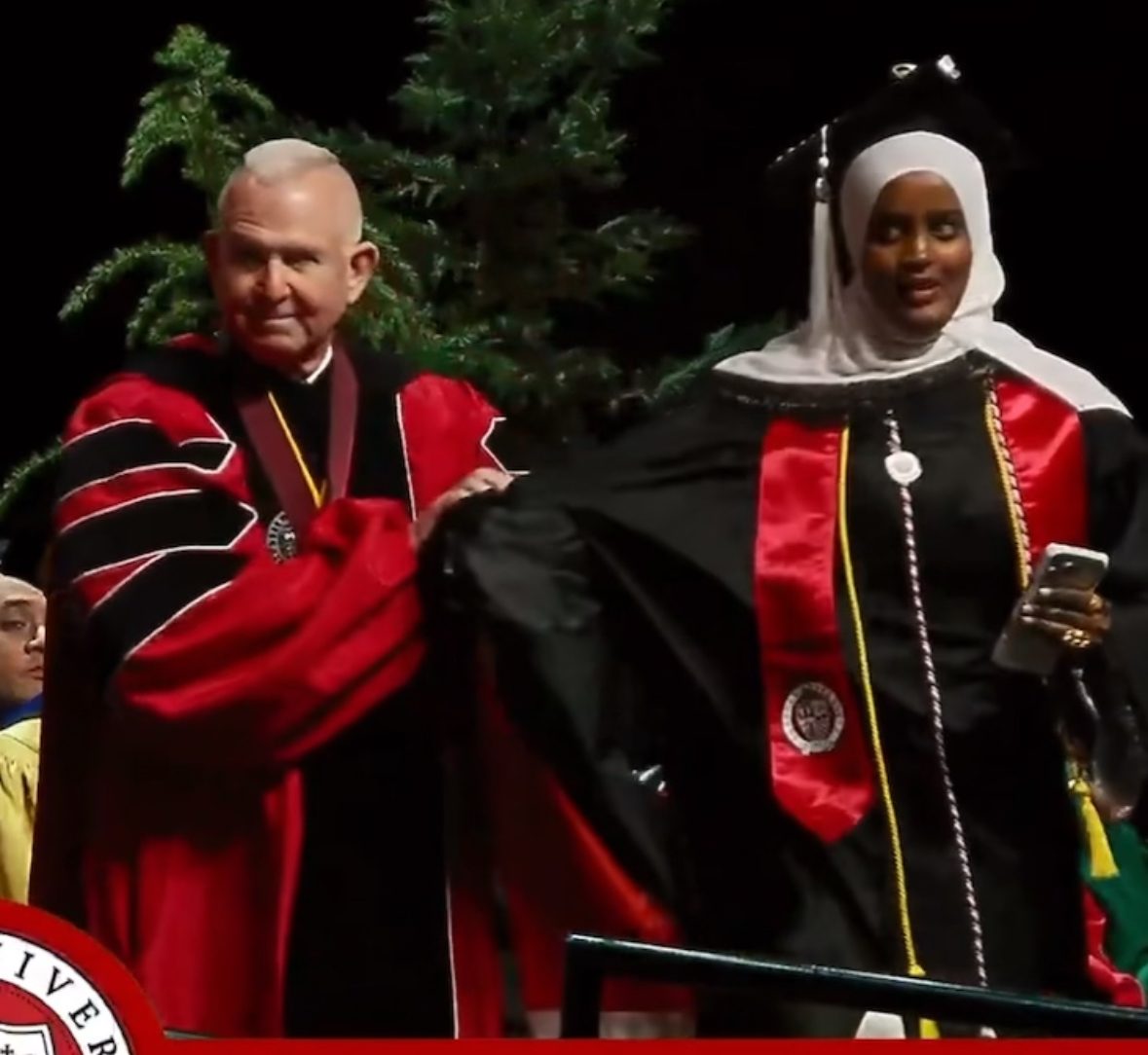
The incident, recorded in Seattle U’s official commencement livestream, was a jarring break in an otherwise celebratory event. To cheers from friends and families, students had walked the stage at the commencement ceremony without issue–until graduating psychology student Sumeyya Osman approached Provost Shane Martin for her photo and began pulling a Palestinian flag out from her graduation regalia. In livestreamed footage of the event, as Osman enters the camera window appearing to unfold the flag, Martin reaches for the flag and with some struggle pulls it behind his back before the photo is taken. Following the photo, Martin appears to have his hand gripping Osman’s arm, firmly moving her off stage as he returns the flag to her. Osman holds up the flag as she walks off stage, to audience cheers.
The Spectator was unable to locate a publicly available Seattle University policy specifically regulating the display of flags during graduation, though the university says it maintains general guidelines on graduation displays.
In a statement sent to The Spectator, the university did not promise that Osman or faculty speaking out against Martin would be free from disciplinary action.
“Whenever questions or concerns arise, they are addressed through established university policies and procedures, guided by our commitment to fairness, respect, and the standards of accountability that apply across our community,” the statement reads.
The passionate response to the incident was further fueled by news that Osman is Muslim and adheres to a religious belief forbidding physical contact, including handshakes and hugs, between unrelated men and women. Osman said that she communicated this to Provost Martin on stage. Martin issued an apology saying that he did not hear her statement and had avoided touch with a dozen other graduates who had communicated to him their adherence to the same belief.
A clip of the incident quickly circulated social media, with multiple Seattle U students and recent graduates expressing their disappointment with Martin’s handling of the situation. Versions of the clip posted by a Seattle U faculty member, the account Eye on Palestine, and the progressive clothing brand Wear the Peace, among others, quickly amassed over two million collective views on Instagram. That number is now around four million.
Hallee Graf, a newly graduated alumni, witnessed the event from the front row.
“I was shocked. I have never seen something like that from an academic professional,” Graf wrote to The Spectator. “Such a lack of care and compassion. Such a lack of what the university stands for.”
According to university officials, multiple students had other flags such as the Mexican flag confiscated in accordance with graduation policy as they waited in line to go on stage. Allegedly, Osman’s flag was not confiscated in a similar manner because she did not display the flag until she was approaching Martin for the photo.
Moments before the altercation between Martin and Osman, multiple students smiled for photographs with Martin while wearing keffiyehs draped over their shoulders, an article of clothing widely viewed as an expression of support for Palestine.
A media statement from the university explained its approach to commencement: “Seattle University maintains guidelines on what can be displayed on stage to ensure a dignified and consistent ceremony for all students and families. In keeping with those guidelines, items that are not aligned with the onstage activities are not permitted. We recognize that members of our community hold deeply felt perspectives on many pressing issues and value informed debate and critical reasoning across the university. At the same time, commencement is a formal academic ceremony designed to honor each graduate equally within a shared tradition, and we take steps to preserve an inclusive experience for all in attendance.”
CAIR Washington’s Tuesday press release condemns what they described as Martin’s “aggressive action toward a Black Muslim student at the commencement ceremony, apparently based on the student’s religious and identity expressions.” Although Martin does not appear to shake Osman’s hand when their photo is taken, he appears to have his hand on her arm as he directs her off stage after the photo is taken.
In a statement sent to The Spectator and other outlets as well as SU faculty, Martin said that he did not hear or observe any request from Osman not to be touched.
“If I had known Ms. Osman did not want to be touched, I would have honored the request just as I did for at least a dozen other graduating students who signaled clearly they did not wish to be touched. I am sorry for the misunderstanding, and regret that this event has taken attention away from the overall commencement ceremony, the achievements of all of our graduates, and especially the moving benediction that closed the ceremony,” Martin wrote.
CAIR Washington has since stated that Martin’s apology fails to adequately address the events on stage.
“Mr. Martin’s apology does not address the main issue at hand, namely that he tried to snatch the student’s Palestinian flag out of her hand very aggressively during commencement and touched her without her consent,” wrote Imraan Siddiqi, Executive Director at CAIR Washington, in a statement on the organization’s website.
A version of the clip widely circulated on social media splices the incident with a clip of the benediction speech, referenced by Martin above, given later into the ceremony by graduating Muslim student Imaan Khaki. The clip of the speech shows Khaki reference “the plights of the people in Palestine, Sudan, and more,” to audience applause. According to Khaki, this part of the speech was reviewed and approved by administration beforehand, not an improvised reaction to the events of the ceremony.
This post as well as others also originally identified Martin as the university’s interim president before later correcting the identification to provost.
-
-
-
-
The altercation on stage can be watched in full through the university’s official commencement livestream, linked at the top of the story
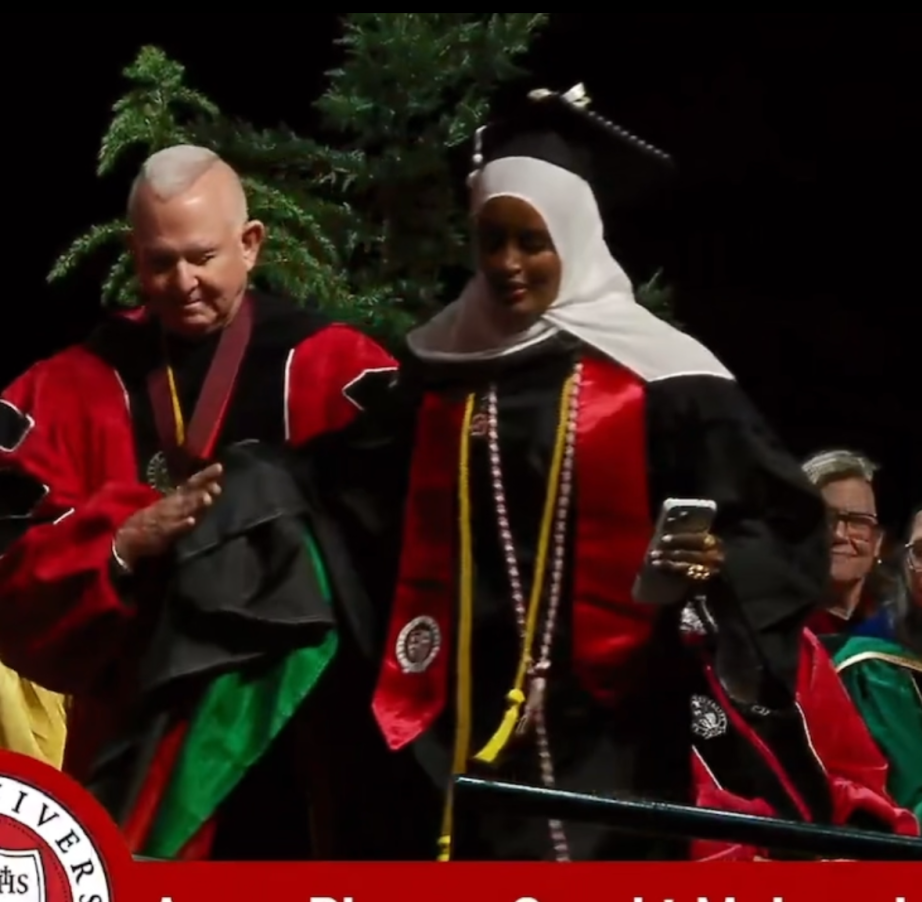
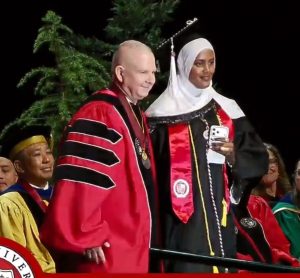
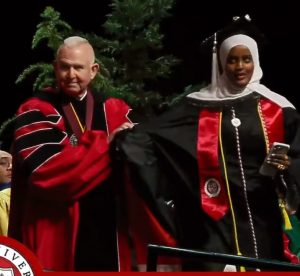
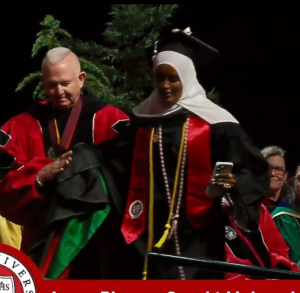
The interaction occurred for a few seconds as Martin and Osman prepared for an official graduation photo to be taken. The struggle would determine whether the picture would feature an unfurled Palestinian flag with Osman and the Provost in the foreground and other Seattle University leaders seated on stage in the background.
This incident involving a Palestinian flag comes at a precarious time for institutions of higher education. Last summer, Columbia University settled with the Trump administration for over $200 million following allegations of antisemitism in relation to their handling of pro-Palestinian student activists. The University of Pennsylvania, Harvard, UCLA and others have faced stiff financial sanctions because of federal allegations that their handling of pro-Palestinian activism had not addressed antisemitism on their campuses.
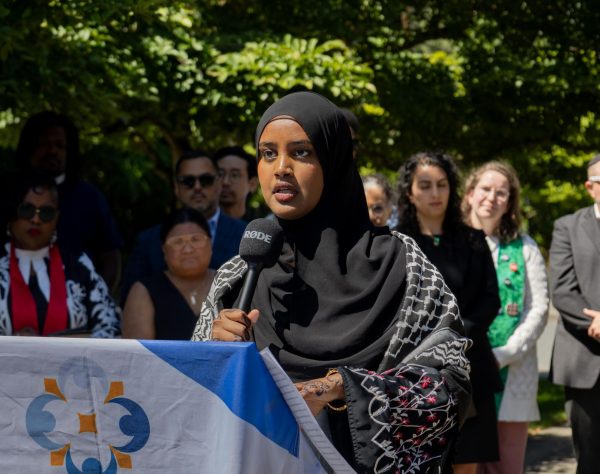
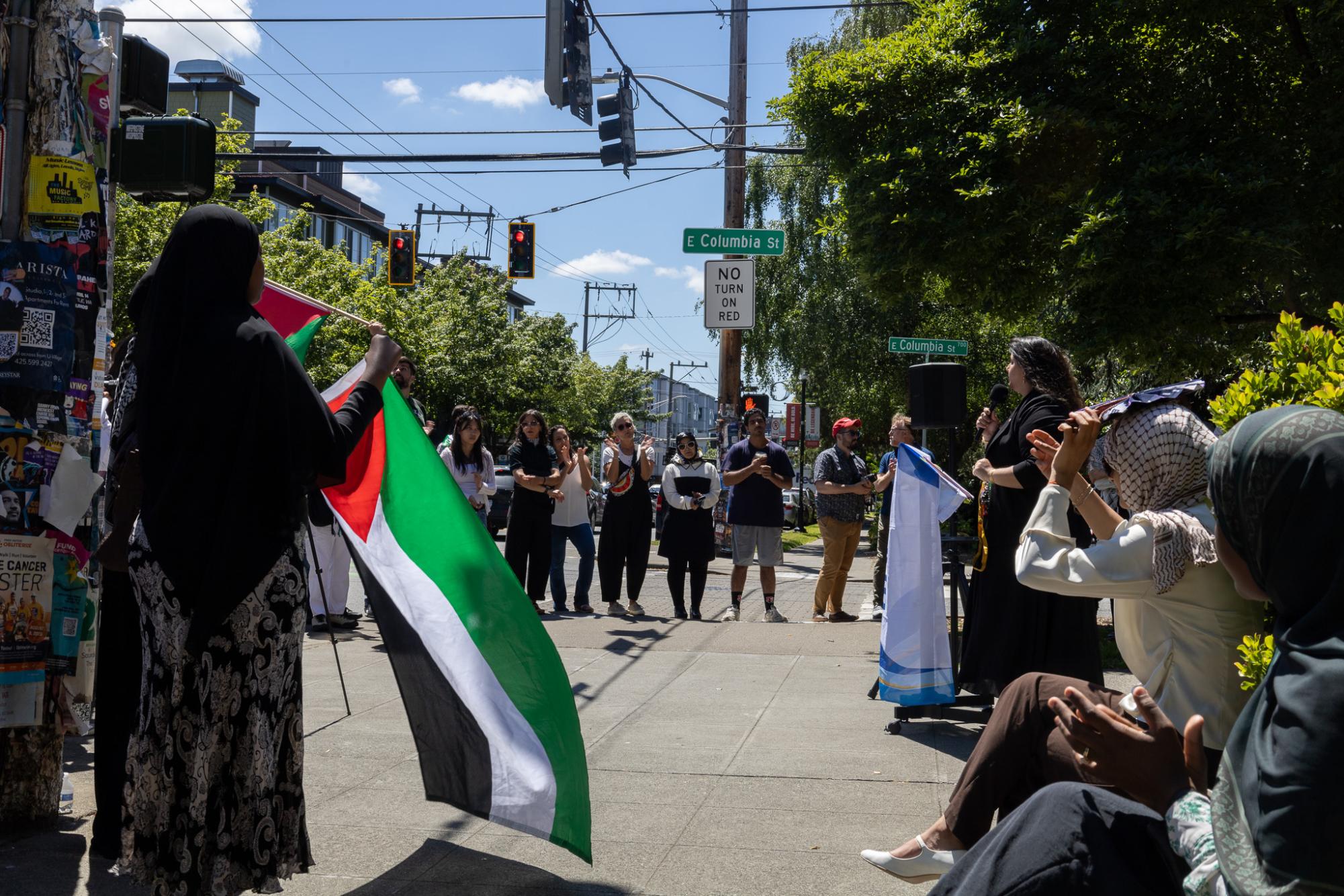
The press conference organized by CAIR Washington, which is working in support of Osman, was held on campus Wednesday morning at 11 at the turnaround space in front of Bellarmine Hall. The conference featured Osman herself, representatives of the Christian, Jewish, and Islamic faiths, a Seattle University professor, CAIR Washington representatives and multiple local and state legislators, alongside roughly 20 audience members and supporters. Many speakers identified themselves as alumni of Seattle U, calling for accountability from their alma mater.
“I know I needed to speak up for the ones who were not able to on stage,” Osman said at the press conference, characterizing her motivations for bringing the flag. “When I went up to him, I thought he was trying to shake my hand. I told him that I don’t shake hands, obviously because he’s a man and I am Muslim. But he then just proceeded to try and take the flag away from me aggressively. As I walked off the stage, I was very mad.”
Osman shared that her graduation was especially important to her as the first in her family to earn a bachelor’s degree. Osman stated that soon after the incident, in a state of agitation and fear, she and her family left graduation early out of concern for potential retaliation.
“I became very scared and anxious. I asked the person next to me, ‘Do you think anything is going to happen to me? What if the ceremony ends and they pull me to the side and something happens to me?” Osman said.
Although universities are able to rescind previously awarded degrees, the practice is rare and generally occurs in instances of severe academic misconduct or fraud.
The press conference focused around a few central demands articulated by Sabrene Odeh, Community Advocacy and Outreach Manager at CAIR Washington, at the start of the conference. These demands include a public apology from Martin, assurance that there will be no retaliation towards Osman or any faculty members who have spoken out in support of her from the administration, a full and transparent investigation into the incident and increased cultural competency training specifically related to Islam.
Odeh, in an email to The Spectator on Thursday, stated that Seattle U administration had requested a private meeting, but CAIR declined the request, citing that Seattle U had failed to provide a public apology in line with the demands at the press conference. Martin’s apology has not been posted on the university’s website, though it can be found in full on a post by TV news station Q13. The statement was sent to faculty, but not the student body. It is currently unclear exactly when the school sent an invitation to meet, and whether it was before or after the press conference.
The press conference also featured Muslim politician Osman Salahuddin, Washington’s 48th Legislative District Representative.
“A Black, visibly Muslim student was physically accosted at her own graduation, where her family came to celebrate, and they left in tears. She left without the dignity that she deserved on that graduation day,” said Salahuddin at the press conference. “No administrator, no person has the right to put their hands on a student. When an institution moves from enforcing a policy to using physical force, it has crossed a line that is both moral and constitutional.”
-
Press conference attendees, holding a Palestinian flag, listen to Sobrene Odeh, Community Advocacy and Outreach Manager at CAIR Washington.
-
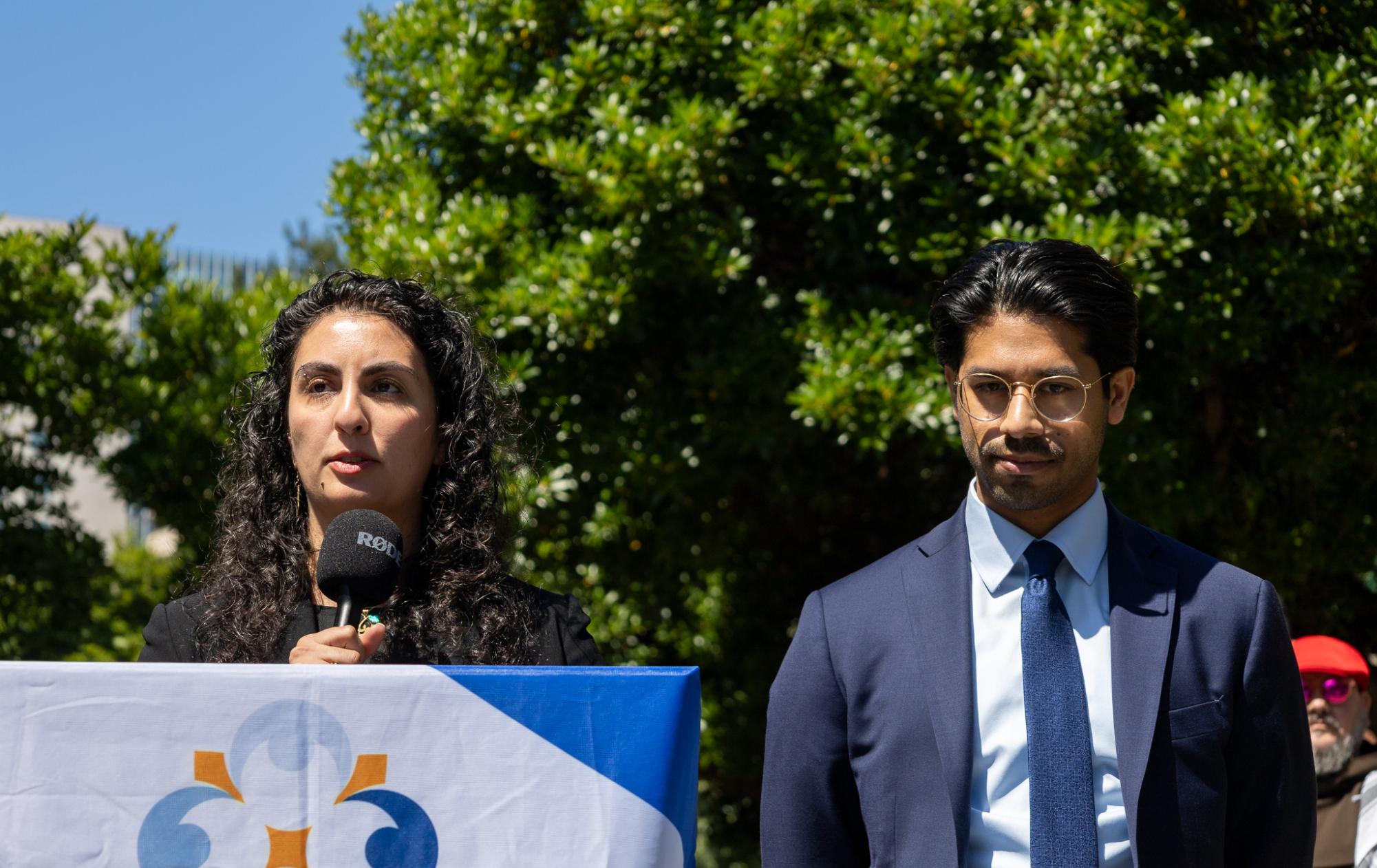
Washington State House of Representatives members Darya Farivar and Osman Salahuddin speak at the podium.
-
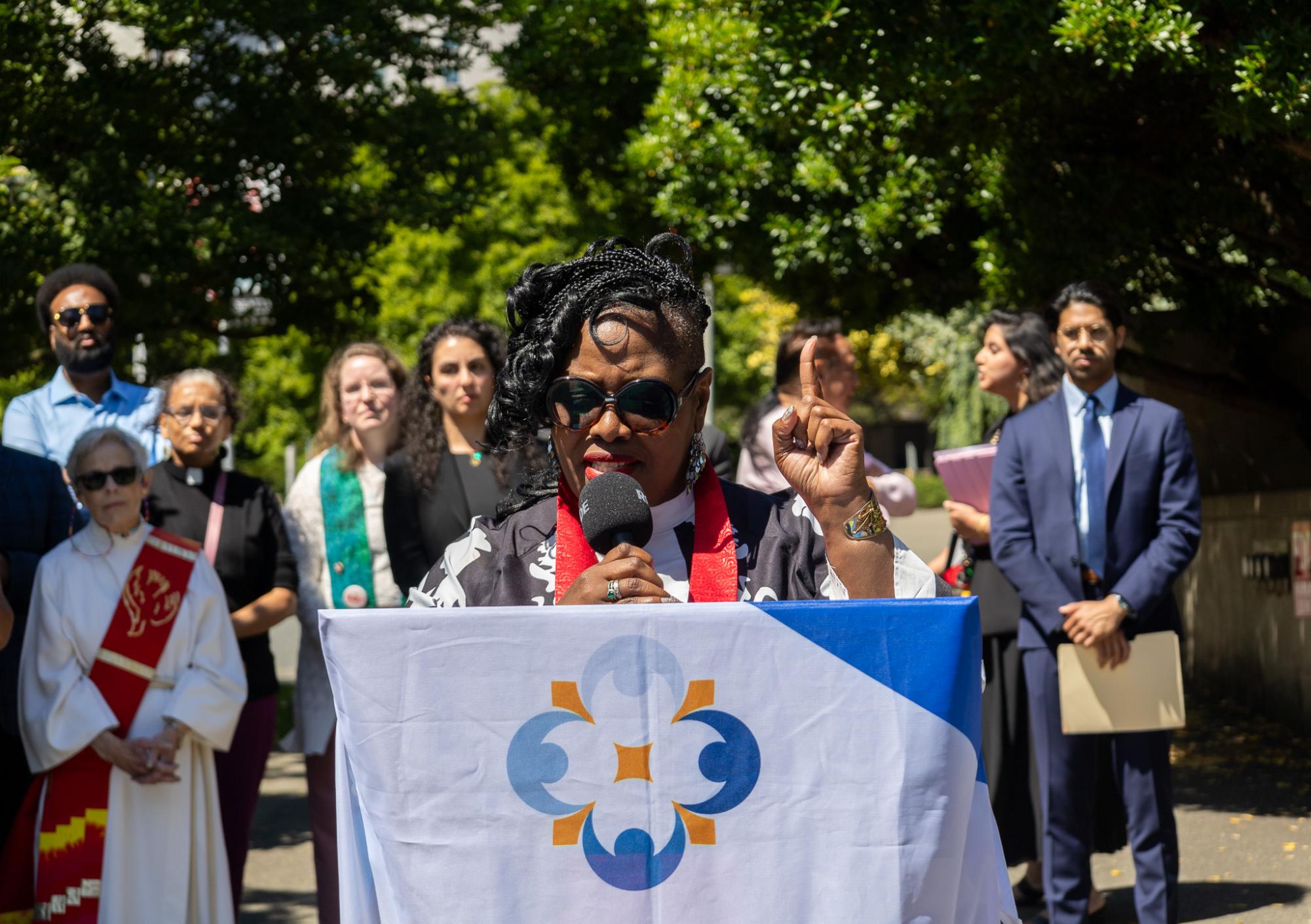
Seattle U alumna Reverend Kelly Brown decried Martin’s actions.
-
Rabbi David Basior shakes hands with Iman Abdullahi Jaranow at the press conference.


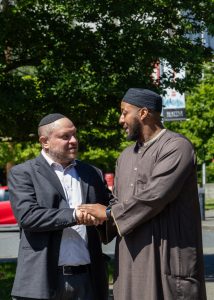
Nova Robinson, an associate history professor who specializes in the modern Middle East, spoke at the event in support of Osman. She stated that the school did not make any policy around the presence of flags at graduation clear to students, calling for clearer commencement policies. Robinson condemned Martin’s actions, and claimed she spoke for other professors who did not feel comfortable speaking out publicly.
“We are calling for a review of free speech policies on our campus. We live in a culture and climate of fear at Seattle University, and we need to be able to have our students speak freely out against the injustice that they see in our world. They do so. They take risks in doing so, and it is very sad that they are often treated poorly by this administration for taking risks to call for justice on a campus that says that it stands for social justice,” Robinson said.
The ‘Know Before You Go’ commencement email sent to graduates did not include any specifications related to flags, although it did encourage students to bring only their smartphones because there was no personal storage available at Climate Pledge. The student handbook does not contain regulations related directly to any sort of protest or political expression at graduation. The university’s official demonstration policy states that student demonstrations must maintain “the dignity and seriousness of University ceremonies and public exercises,” although it is not directly clear how or if this policy applies to an individual student unfurling a flag on stage.
In contrast, UC Berkeley, in preparation for their graduation ceremony, sent an email in May to deans and department chairs asking them to remind students not to bring items such as flags or banners.
“We recognize that participants might bring a small flag or perhaps drape a flag over their regalia; however, it is our policy that participants should not bring items that obscure people’s views, such as flags or banners. Clear, consistent communication of the rules in advance, as well as a shared understanding of how to respond when they are violated, is the best way to avoid confusion on the day and to ensure our ceremonies are everything our graduates and their families deserve,” the email, available on their university website, reads.
At Berkeley’s commencement, a student was denied their diploma until they threw their Palestinian flag to the audience rather than continue to display it on stage. A student at UW Bothell’s commencement, which took place just days before Seattle U’s ceremony, waved a Palestinian flag without any interference from those on stage.
In responses from Seattle U administration it is unclear if students were ever explicitly told not to bring flags, although it is common for universities to not allow flags at their commencement ceremonies.
“The university provides graduating students with detailed commencement information in advance, including logistics, attire, event protocols, and applicable venue guidelines,” wrote Scott McClellan, Vice President for University Affairs, in an email to The Spectator. “Like most formal academic ceremonies, commencement follows a structured format with well-established expectations for how students participate in onstage recognition. The onstage portion of the ceremony is managed to ensure a consistent and inclusive experience for all graduates and families, which is why there are expectations around how graduates participate in that moment. University staff help facilitate this process and guide graduates as they prepare to enter the stage.”