
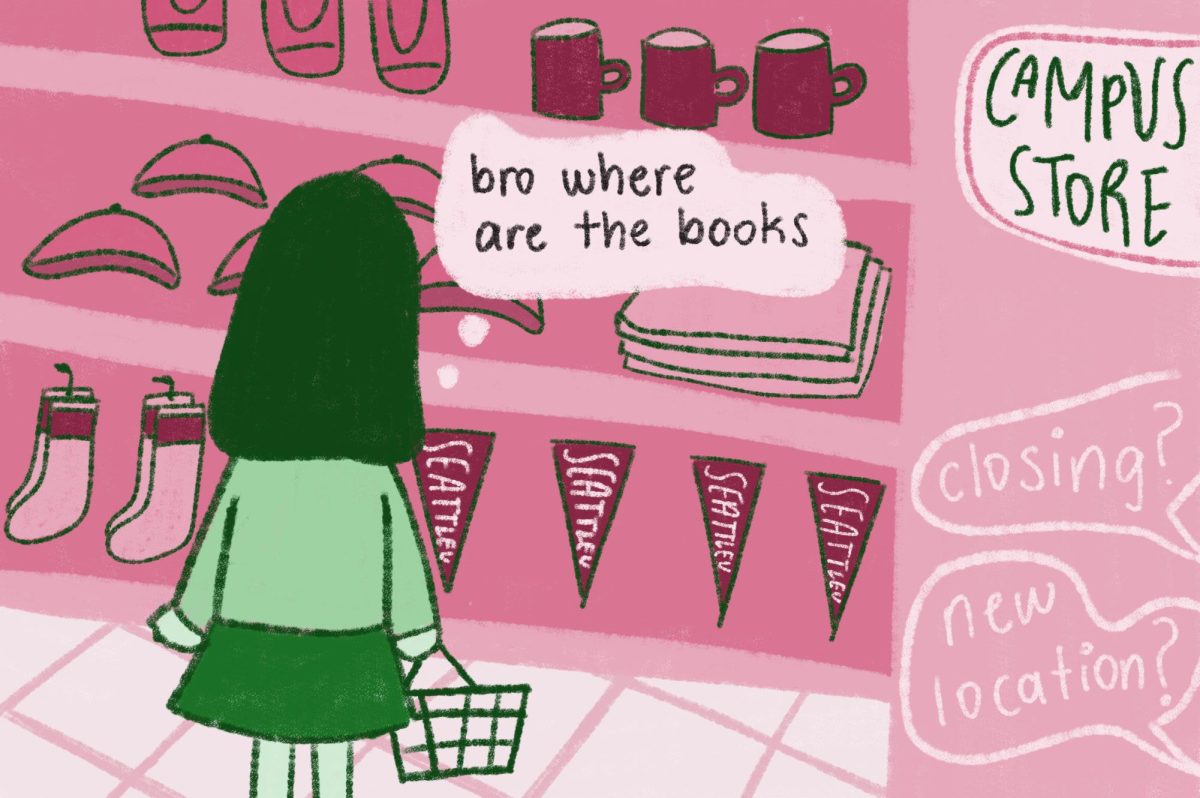
Seattle University’s campus store will indefinitely end its traditional operations at the close of this academic year, as the university parts ways with its current retail vendor, Event Network, and begins planning what comes next.
Event Network is ceasing its operations effective June 20, 2026, according to a letter from Provost Shane P. Martin.
Michelle Conklin, director of campus retail services and a 2012 Seattle U alumna, said the decision was a simple financial judgment.
“What we discovered was that the store, operated by our vendor partner Event Network, was not generating the sales needed to remain financially stable,” Conklin said. “That reality prompted us to rethink how we serve students.”
During the 2026-27 academic year, Seattle U will run an online store and host pop-up shops timed to major campus events, rather than maintaining a physical storefront. Course materials pickup will move to Supercopy, located on the lower level of the Pigott Pavilion, effective June 1, 2026. The partnership with ECampus for online textbook ordering remains unchanged.
The campus store has been undergoing a tiered transition since late 2024; an October 2024 announcement provided information about the new campus store operators for course materials, ECampus.com, as part of a shift away from providing physical books. Since winter quarter 2025, purchasing books through the university has been completely online, a notable shift from a traditional brick-and-mortar bookstore. A previous announcement in May 2024 noted the possibility of exploring a possible relocation of the campus store as they searched for a new management partner.
The decision to close the physical storefront comes less than a year after the space was fully remodeled last summer, with new merchandise and seating spaces introduced to students in September 2025. For many, these back-to-back changes were unanticipated.
Once it became clear the arrangement was financially unsustainable, campus store leaders moved quickly. For those working on the floor, the closure has arrived with little warning and few answers.
Laila Omar, a sales lead who has been with the store since it opened, said the staff have been caught in the middle throughout the process, delivering news they had no say in and did not make.
“The staff in the store, we’re just messengers,” Omar said. “We are just as frustrated as the students are.”
Tabitha Leslie, the campus store director, said she would likely need to reapply for her position as the transition unfolds. She described the moment as bittersweet, reflecting on how the store her team spent years building is changing before having a chance to settle in.
“It is definitely a little heartbreaking, but we’re also really excited to include the community and more of the school into our store,” Leslie said.
Conklin acknowledged the communications challenge and explained that the university is early in its outreach effort, prioritizing direct conversations with store employees first before spreading the news to the wider campus community through advisor emails, social media and the university website.
Her vision for what follows is expansive. Rather than rushing back into a permanent retail space, Conlin described a model with planned future growth.
This would start with a strong course materials pickup experience at Supercopy, then layering in retail through pop-up shops during Move-In Week, athletic events and the Student Involvement Fair. The plan also includes a year-round e-commerce site and vending machines stocked with everyday essentials like charging cables and notebooks.
Not every student on campus has a strong attachment to what is being lost.
Kira Hori, a first-year diagnostic ultrasound major, said she had not visited the campus store once this year.
“I haven’t gone to the campus store because I feel like the merchandise isn’t my style,” Hori said. “Recently, my diagnostic ultrasound program offered merchandise of its own, so I went for that instead.”
Her experience reflects a disconnect that the university is hoping a reimagined campus store can address.
Omar and Leslie both hope the next version of the store closes this gap. Omar called for something more affordable and functionally built around what students actually need, rather than branded merchandise.
In the meantime, the current store is worth a visit before it all closes. As of now, the future of the space currently occupied by the store is unknown. All Adidas merchandise is 25% off as the university shifts back to a Nike partnership, according to Conklin.
“Come and enjoy the space before we do our big changes, especially before graduation,” Leslie said. “Once we have it out, it’s gone.”
The university said it will spend the 2026-27 academic year gathering input from students, families, faculty, staff and alumni before making any final decision on the long-term future of campus retail.
A correction was made May 8, 2026: a previous version of this article included a sentence that said previous announcements about the campus store were only posted on SU Today, stating it as a news channel “that does not always deliver information directly to students.” The sentence has since been removed as announcements were delivered via SU Today and email communications to students, faculty and staff.