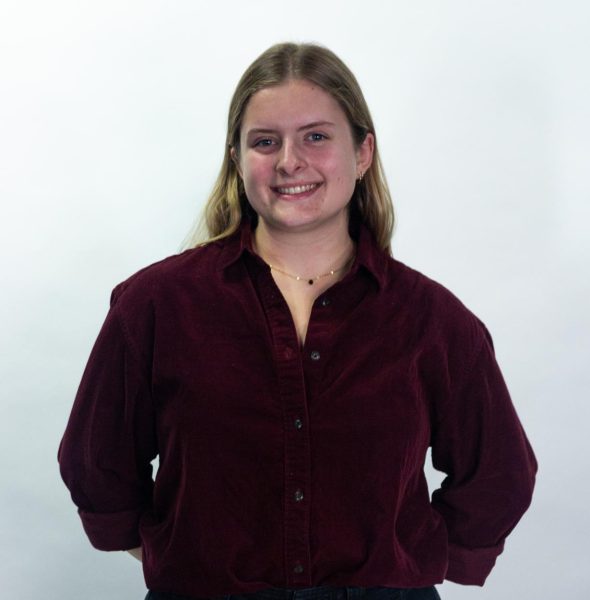

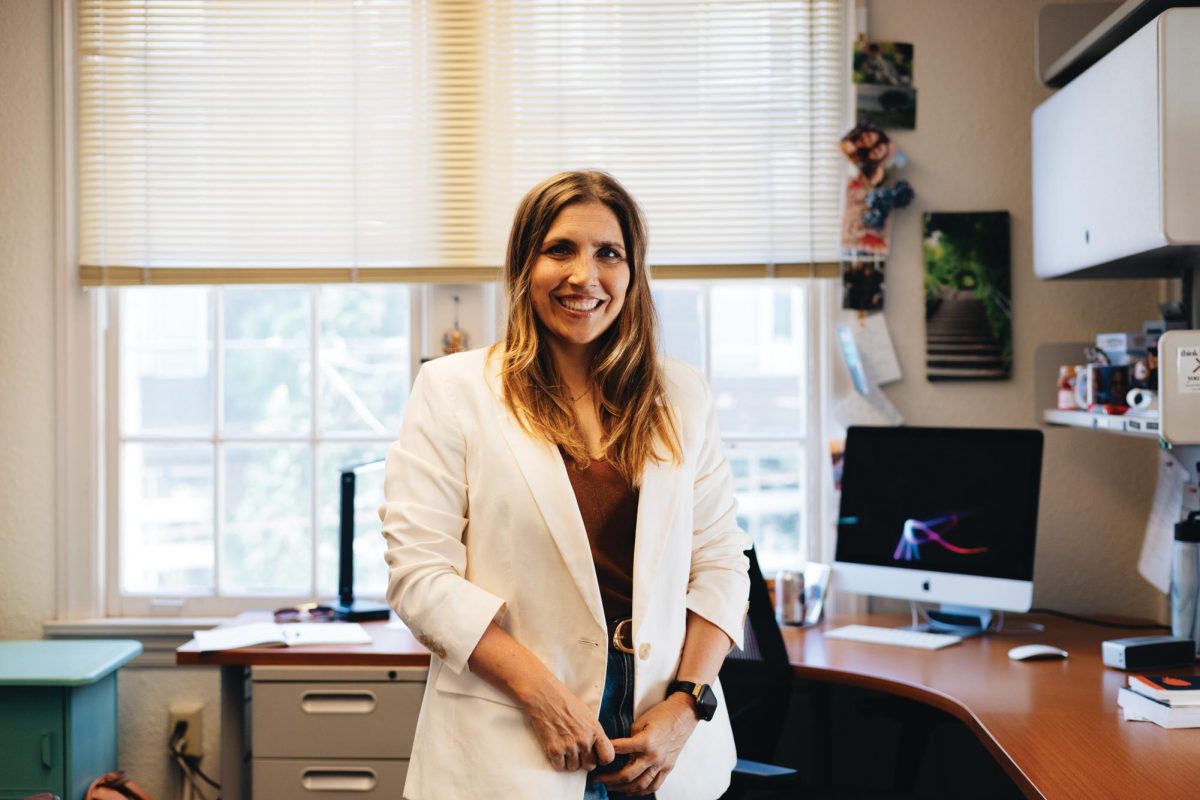
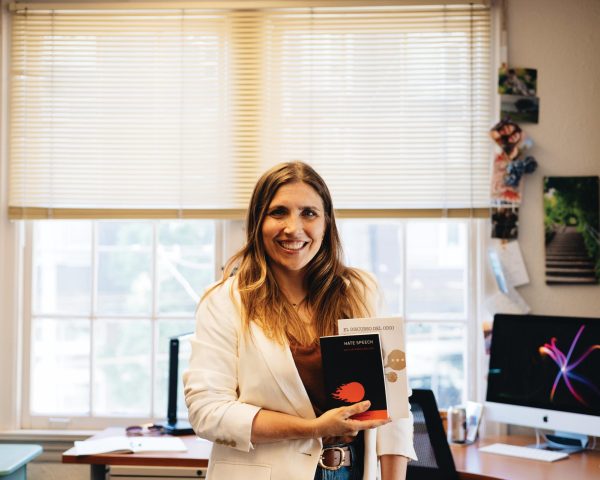
Hate speech scholar, cancer survivor and Diet Coke lover, Caitlin Ring Carlson is a beloved figure in the 1103 building at Seattle University as a Professor and Chair in the Communication and Media Department. Carlson earned her undergraduate degree in communications with a minor in journalism from Clemson University and her master’s in strategic communication from the University of Denver before starting a career in public relations.
Carlson later pursued a Ph.D in media studies at the University of Colorado Boulder with a communication law emphasis. Her research is focused on how hate speech intersects with the First Amendment and social media. She is serving her second term as chair of the communications department and teaches “Introduction to Media Studies” and “Communication Law.”
Below is an excerpt from a May 28 interview with Carlson. Initials are used to indicate the speaker.
KD: Can you tell me a bit about yourself and where you’re from?
CC: I’m originally from Maryland; Ellicott City is the town. I have one sister. My parents were both in public service; my mom worked for a nonprofit that helped people with developmental disabilities, and my dad worked for the county government doing their budget. I’m married, I have a dog, I live on the Hill, I do pottery. I love to work out. Here’s a little fun fact: I was a competitive figure skater as a kid. I am a cancer survivor, so that’s part of the reason I try to be healthy. That’s me in a nutshell.
KD: Why did you choose to study each field for undergrad, master’s, etc.?
CC: When I went into college, I thought I wanted to be a journalist, and I then started to get nervous about talking to people on what I thought was their worst day. I liked being around people, working with people and enjoyed public speaking, that sort of thing. I picked communication, minored in journalism. I had this guest professor come to Clemson, and he did one course on PR and one course on crisis communication, and I loved it. I was like, ‘This is absolutely what I want to do.’ That’s when I went and did my master’s in public relations, and I got a job at an agency.
When I went to school down south […] I kept picking up on the extent to which the way people talked in the south. People at a football game would use the N-word. Seeing all that was what sparked these questions around what is the relationship between language and the way people talk about issues around race in particular? That’s what pushed me to look at hate speech.
Doing my Ph.D, it was right around the explosion of social media. That’s part of the reason I was then questioning what role social media was playing in spreading and disseminating hate speech. I remember my mentor at the time talking about how, over time, you will get to or be required to encounter new issues and new ways of dealing with some age old questions: What is the line between conduct and expression? How does press freedom play out in today’s media environment? What does privacy look like in the age of social media, AI, etc.? It’s a fun place to live; it’s always changing, it’s evolving.
KD: How did you end up at Seattle U, and how did you become chair of the communications department?
CC: I didn’t necessarily think I’m going to go get a tenure-track job and do academia full-time. That wasn’t necessarily where my head was at, and then I got breast cancer. I was finishing my dissertation. I was on the CU Boulder grad school health plan, and I need health insurance, period. I needed a full-time, ideally tenure-track job with some stability to be able to have healthcare, not just now, but long term.
I resonated with Seattle. I remember walking around the Hill the night I was visiting, just being like, ‘Yeah, I can like see myself here.’ I was hired primarily to teach [strategic communications]. I’d been working in PR for several years, so that was what I was hired to teach. But my background, my research was in comm law. Eventually, I was able to teach that class once, twice, and kind of slipped in.
The class I love to teach the most is communication law. And that class is twofold: part of it is learning about the importance of free expression and press freedom to a functioning democracy, and then also how not to get sued at work. It’s always fun to talk to people about libel, copyright, name-image-likeness, all that.
I did not set out to be chair. We have a department where we say, everybody takes a turn, and it’s my turn. I’m happy to do it. I like being able to build a sense of community or connect students with alumni or improve the way we think about diversity and equity in our hiring, our policies.
KD: Have there been recent events or changes to communication law that you bring up in classes now?
CC: Right now, AI is changing everything. The way we think about copyright, the way we think about libel, the way we think about privacy, using people’s images, deep fakes, that’s a huge thing that has shifted. The federal administration, right now, has worked pretty hard to demonize the press and to undercut the institution. There are already issues of media consolidation and the way the industry has created fewer and fewer opportunities for journalists to do investigative work, to do all these important things a democracy requires. So the media system was already making it difficult for journalism, media outlets, etc., to be successful, and then the administration comes along and enhances the problems.
The last thing that is really new, exciting, wild, is social media regulation. There have been efforts by states to regulate content, transparency, design features. We had our first successful lawsuit of negligence against social media companies for causing harm to young people in terms of causing depression and anxiety. That is a really exciting, sometimes concerning, area of emerging law. It’s fun to get to talk about those issues with students and help them figure out how do you want to shape these things as we move into the future?
KD: With the recent events at the University of Washington, with Juniper Blessing’s murder and then the Turning Point USA speaker cancellation, I’m curious if you have any thoughts on that [regarding hate speech]?
CC: This is an extreme example of some of the things that have been happening all over the country. There is a real reckoning happening with free expression on college campuses, period. Obviously, the murder is an incredible tragedy. We have, unfortunately, seen violence by primarily men, targeting all kinds of different folks. I do think there is a relationship between people’s online information, entertainment consumption and their offline behavior.
With the Turning Point cancellation, you see people recognizing that link and wanting to act on it. This area is fraught with complications. There are concerns, and justifiably so, any time you give the government, which, in this case, is the administration at a public university like UW, the power to say yes or no to different speakers, you open the door for potential censorship.
While I want to avoid a slippery slope or would be concerned about any efforts to silence expression, I also think it’s important to recognize the potential harm and to consider that as you’re making decisions. If you want a robust, wide-open society where the government isn’t in a position to curtail expression, then oftentimes we have to at least, to some extent, deal with expression that we disagree with. Where you draw that line, that is the question.
KD: I was curious to hear your thoughts on that because, obviously you don’t know the perpetrators’ motivation, but the coincidence of the anti-trans speaker being scheduled right after a trans student was killed was of concern to a lot of people. I was actually shocked that the Turning Point chapter was the one that canceled it or postponed it.
CC: That’s free expression working. That’s the opportunity to say, ‘Not now, not this, not today.’ One of the incredible things about this particular situation is that people exercised their expression in a way, or their right to receive information, in a way that was mindful of harm to others. To me, that’s the system working perfectly.
There could potentially be violence. But that’s the tricky thing because, would we want the administration to be able to cancel a Black Lives Matter event or a pro-trans rally? No, right? So if we want to have this right to free expression, how are we going to use it? I do commend them in making that decision because they hopefully avoided potentially negative outcomes.
Bringing it back to SU, I think we’re in a unique position as a private school that the administration does have that capability, and in some of these instances has been, hopefully, pretty generous in the way they have allowed academic freedom or press freedom. If our administration wanted to, they [could] have complete oversight over The Spectator, but instead has set up a model where it really is supporting student press freedom and allowing students and the editors to make decisions about what goes in without prior review and without censorship.
KD: If you had a chance to tell people about you or what you think is important, what might you leave them with?
CC: Our department is really, and I am really, committed to helping people see how media and communication shape ideology, shape communities, and the more we do to protect those things, the better off we’ll all be. Some of the things I am interested in are the worst of the worst. How do things like extreme speech or hate speech negatively impact society? But then, on the flip side of the coin, there are these questions about how promoting free expression, promoting press freedom, committing to those ideals, improve society or community. Both of those things are worth people spending time and energy considering. I hope that students, regardless of what their major is or what they’re studying, understand the importance of their role in this community, this society, this democracy, to accurately and effectively consume information and act on it.
After embarking on a summer road trip, Carlson will be on sabbatical next fall quarter. She’ll be taking the time to work on a new book, an exploration on how gender and free expression in media impact democracy.