
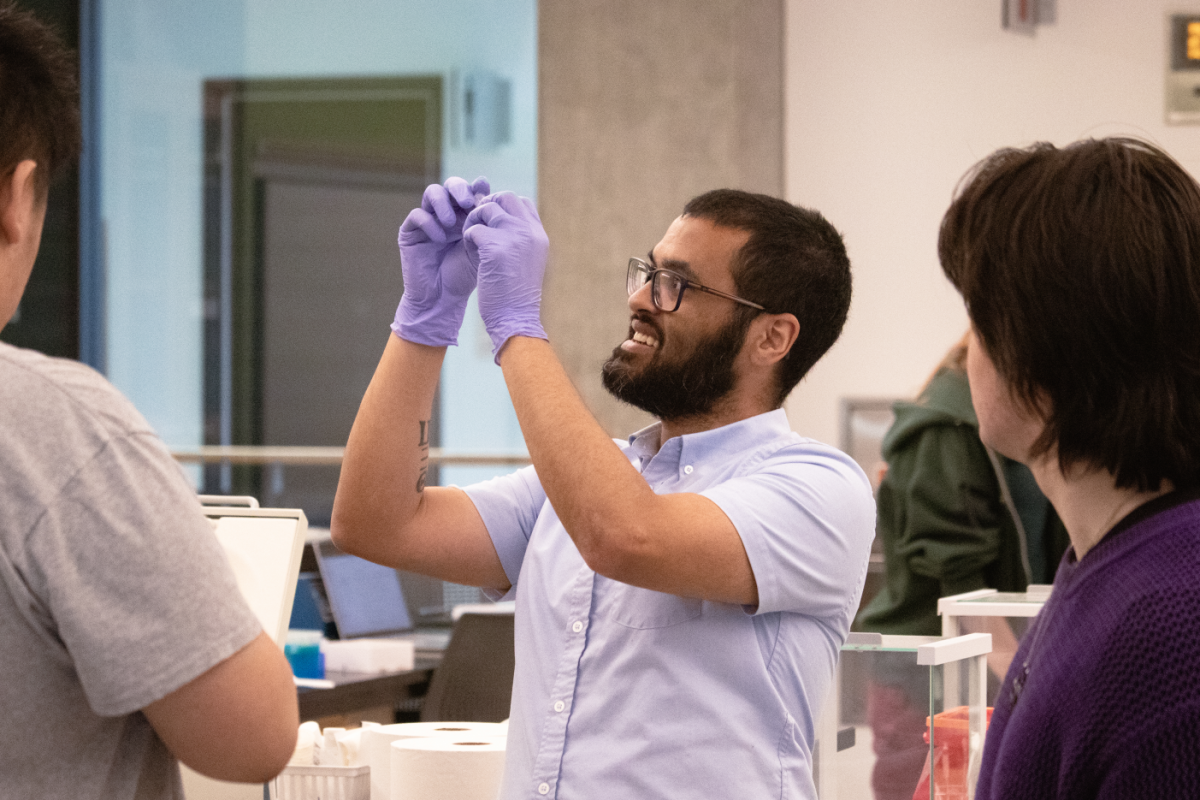
Against the backdrop of a floor-to-ceiling window overlooking 12th Avenue, student researchers process cervicovaginal fluid samples in a bio-safety cabinet. They take the provided samples, collected using menstrual disks, collect the fluid off them and spin them down to extract as much as they can from the donation. These samples become the backbone of the Whidbey Lab’s research into bacterial vaginosis.
In the northeastern corner of Sinegal’s fourth floor, the Whidbey Lab houses a lab bench, a team of undergraduate research assistants, six active projects and Chris Whidbey, Associate Professor. Whidbey has been leading his lab in microbiome research for years, receiving two very competitive awards last fall for his work.
Some of the work is directly supported by a National Institutes of Health (NIH) Academic Research Enhancement Award (R-15), which focuses on studying the vaginal microbiome, and will also support larger, more expensive projects. They are currently accepting samples of cervicovaginal fluid in order to refine experimental processes and procedures. Most of Whidbey’s recent research has been focused on various microbiomes, with this current study having been developing for multiple years.
In 2023, Whidbey and a few student researchers put out a paper detailing their research into how bacteria in the vaginal tract get their carbon and energy. They were the first to show that both the bacteria have mechanisms to extract energy and carbon from the host, and the host produces an enzyme that helps break down and provide food for the bacteria.
“That was all in healthy individuals and only in six, and there were big differences between every one of those six,” Whidbey said. “So it’s an open question: what does it look like under non-optimal health conditions, during bacterial vaginosis, or what does it look like in more samples?”
The NIH award funds the student researchers under a work-study structure and covers costs for experiments that the lab cannot perform themselves on-campus. Facilities like the Fred Hutch Instrumentation Corps will run those larger experiments that require specific instruments for a fee, sending the data back to the lab once complete.
Beyond that, the NIH funding will also pay for general supplies. With the collected cervicovaginal fluid samples, Whidbey and his team are working out the kinks in the research process before they turn to their partners at Massachusetts General Hospital to run the experiments with their samples, some of which came from individuals with bacterial vaginosis.
“In order to really get that process to work well, we want to make sure that we have all of our protocols and all of our procedures really, really set before we start messing with the precious samples that we only have one of,” Whidbey said.
Growing up between Tacoma and Seattle, Whidbey is a Washington native. Following the Running Start track in high school, Whidbey transferred from the University of Connecticut to Seattle University in winter 2008 and triple majored for his undergraduate degree in chemistry, biology and philosophy. His interest in Seattle U started out as a way to be closer to family and friends and the chance to attend college with his cousin, whom he referred to as his twin, but he quickly grew to love the Jesuit environment. Beyond the academics, Whidbey met his now-wife while living in Chardin Hall.
As an undergraduate student, Whidbey worked in Doug Latch’s lab. Latch, a professor of chemistry, expressed his respect for Whidbey as a fellow researcher who worked incredibly hard as a student and earned his place in both science and the institution.
“It was clear that he had a good trajectory for science and research and teaching,” Latch said. “He was really talented both with the physical aspects of doing lab work, but also data analysis and working with people and training other students at the time.”
Brett Kaiser, professor of biology and interim associate dean of the College of Science and Engineering, shares lab space with Whidbey in Sinegal. He has similar interests in biochemistry and molecular biology and has had experiences with the NIH R-15 award, which is related to a pool of awards meant to foster scientific interest and mentorship among students, but is still highly contested for smaller institutions.
“We very much want our faculty to be mentoring students. As much as faculty can devise their research program so they’re competitive for grants, so they can publish in peer-review journals and they can include students in the research process. There’s a very high sort of premium on that as well,” Kaiser said.
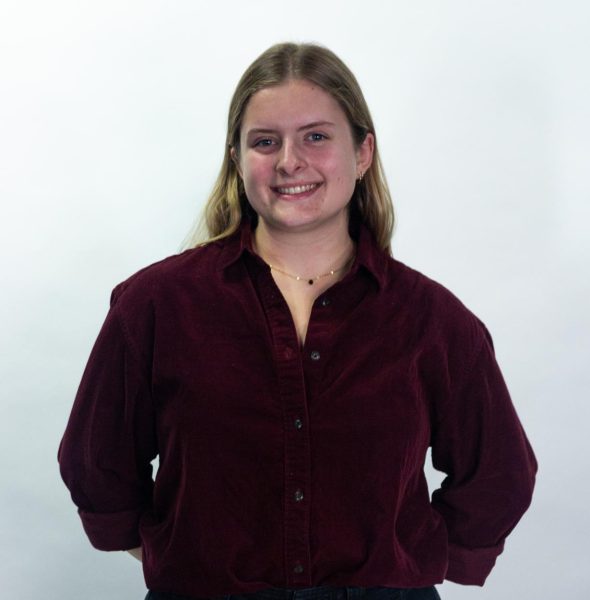
Outside of his research, Whidbey is a popular guy, a stand-out colleague and a well-liked professor. Both undergraduate student researchers Kiera Tanaputra and Zoe Jackson, who run many of the daily tasks and experiments in Whidbey’s lab—processing samples, growing microbial cells and running DNA and protein gels—praised his style of mentoring.
“I really like working with Dr. Whidbey because I think he’s a really great mentor. If we don’t know something, he’s like, don’t worry about it, we’re gonna figure it out, walk you through it,” Jackson, a third-year cellular and molecular biology major said, later adding, “Going into that and being like, ‘Oh, I’ve never worked with this person before,’ but it was really great. I really enjoyed my time.”
Tanaputra, a fourth-year biochemistry major who has been with the Whidbey Lab for almost two years and has taken classes with Whidbey, said that he is similarly available as a mentor and boss.
“He is in the lab almost every day, and he’s also very casual… He can be a bit reserved, but he’s very humble despite all of his achievements, and he’s also a fun professor, honestly,” Tanaputra said.
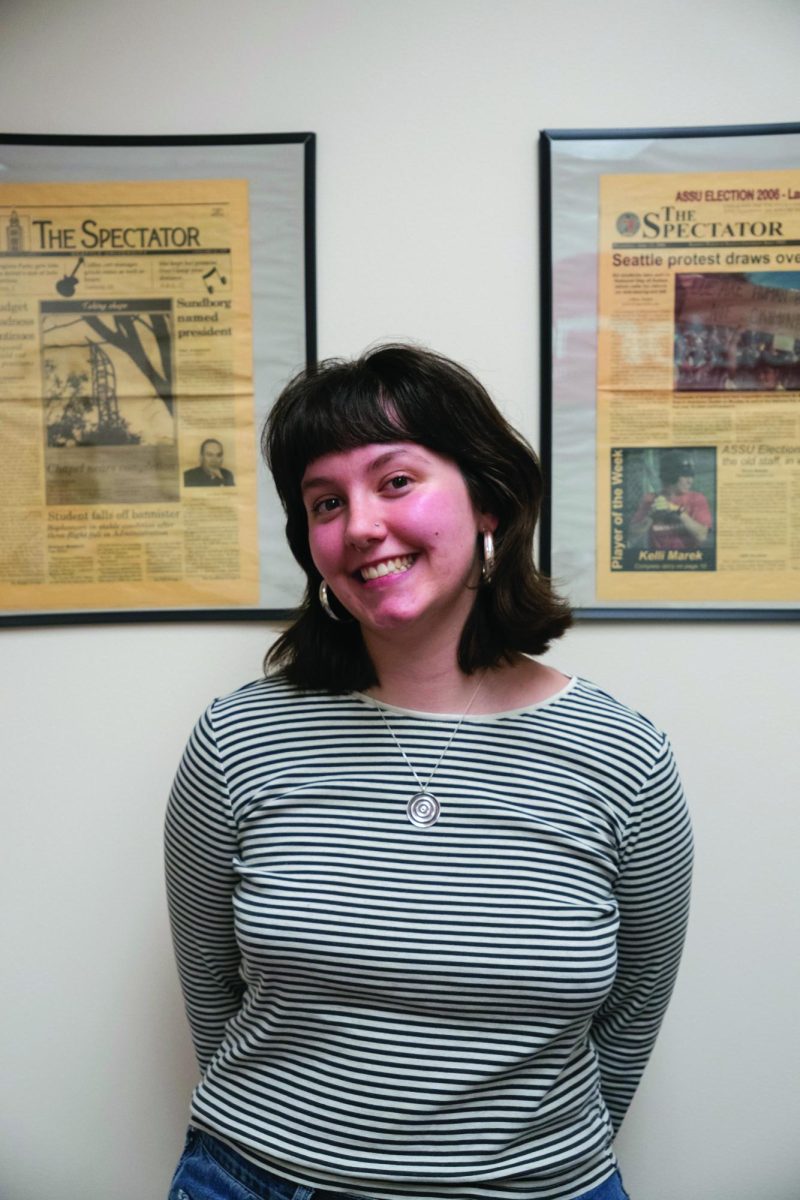
Along with professional preparation, these students all lauded their time with the Whidbey Lab for the direct scientific work they accomplished. Lab Manager and Undergraduate Research Assistant Jillian Hesse, a fourth-year cellular and molecular biology major, has been working with Whidbey and his lab for over two years and particularly loves the technical work.
“It’s not just, oh, I’m some post-doc or grad student dish girl. I am doing these experiments. I’m writing these protocols. I’m testing these protocols. My boots are on the ground doing this. I think that’s really, really cool,” Hesse said. “In addition to all the actual skills I’ve gotten, the familiarity with tools and techniques that I have, I also built up a lot of confidence in myself, in my lab skills.”
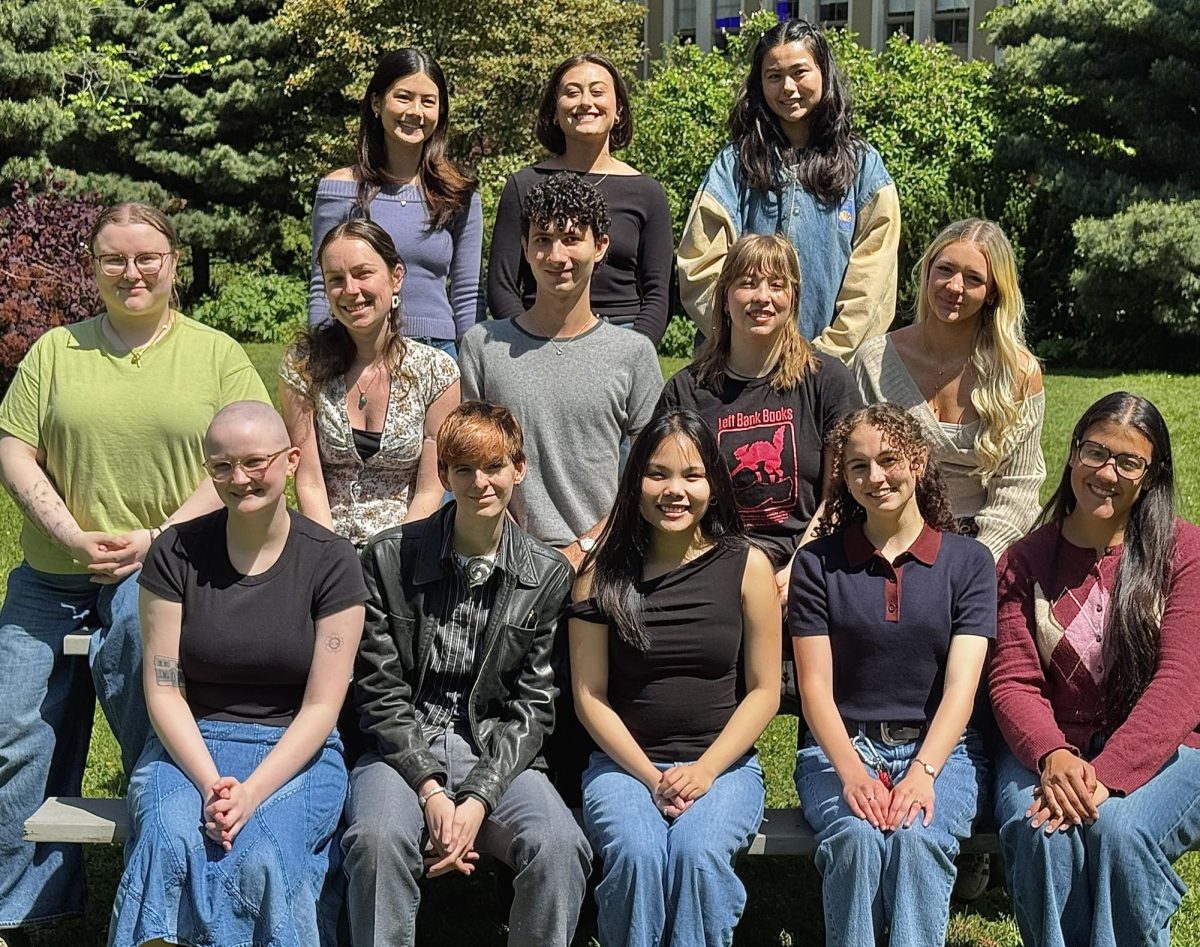
Whidbey frequently takes on large groups of students: currently, the lab has five students working in it, with two joining for the spring quarter imminently, and he plans for at least six summer workers. At one point, his lab had eight students working in it at one time.
Like all researchers at primarily undergraduate institutions (PUIs), Kaiser has also had teams of students working in his own lab, but noted how Whidbey differs from other professors.
“He’s a superman; he takes on a lot of students, and he does a great job of mentoring them,” Kaiser said. “One important component of that is he’s very generous with his time. He works very hard at research, and he’s very generous in working with students and training students.”
While he mentors numerous students, works on his research himself and teaches classes, Whidbey is also an esteemed colleague. Kaiser explains how Whidbey has helped him in his own research endeavors.
“I frequently consult him [for] advice on certain things. He knows a lot of information. He knows a lot about various different topics. He’s been a great resource for bouncing ideas off of, or getting ideas for troubleshooting,” Kaiser said.
Whidbey has become the only Seattle U professor to win the Lynwood W. Swanson Promise for Scientific Research Award from the Murdock Trust, an award given to faculty in their first 10 years as a professor. Aimed at professors who exhibit great potential in developing a sustainable and productive research program, the Swanson Promise Award grants funds that support one student researcher over the summer. A sister award for senior faculty has only been given to one Seattle U professor before: Mary Alberg, a physicist, won the award in 2016.
More notable than the money, the Swanson and Swanson Promise Awards only go to one professor annually and are sought after by faculty at PUIs across the Pacific Northwest. The Murdock Trust, sponsor of the award, provides funds to PUIs all over the region through similar awards and grants.
With these new awards supporting his research, Whidbey is already looking to the next project and thinking about where to take his research when these projects conclude.
“The vaginal microbiome is actually pretty good in breaching out to other non-white communities. But there’s a lot of work still to be done about characterizing the vaginal microbiome in diverse communities: underrepresented minority groups, trans folks, is a huge, huge gap in the knowledge,” Whidbey said.
Off campus, Whidbey lives in Seattle with his wife and enjoys distance running, reading for fun, catching up with old friends by playing video games and learning to play piano. His lab has its own logo, designed by a local scientific illustrator he partnered with, and can be seen on his office door or as a sticker around campus with his student researcher’s belongings.