
Imagine the scene: ten million dollars worth of pyrotechnics, the roar of a sold-out Santa Clara crowd, and a man at midfield who hasn’t uttered a single word of English to the 115 million people watching at home.
The country feels more divided than ever, and major cultural events like the Super Bowl are unavoidably connected to the current political climate.
From politicians showing up at championship games to protests over immigration enforcement and law enforcement tactics, the Super Bowl has become a mirror of the country itself.
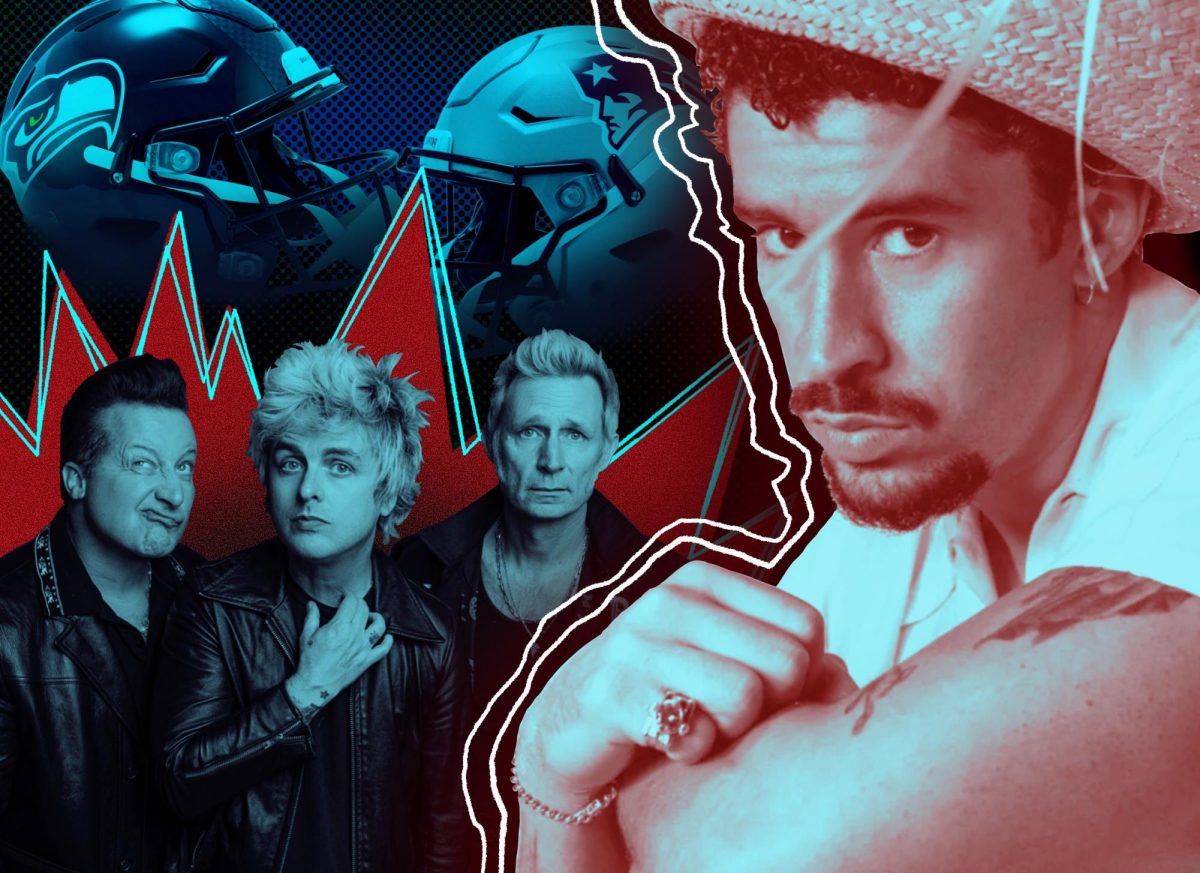
Bad Bunny’s halftime performance is a statement. He is a Puerto Rican superstar, singing entirely in Spanish, thriving on his own terms in an industry that has historically centered around English-language pop.
That alone is political. It shows that America’s biggest stages are not just for one type of performer.
Bad Bunny started his performance off with a message in Spanish encouraging audiences to believe in themselves, because believing in himself is how he got himself onto one of the most streamed performances worldwide.
He performed 12 songs under 13 minutes with multiple sets such as La Casita, a classic Puerto Rican village home that was also his set for his Puerto Rico residence, and electrical towers which Bad Bunny climbed while singing El Apagón, protesting Puerto Rico’s damaged electricity resources.
In a surprising move, the first guest appearance was by Lady Gaga, singing “Die With a Smile,” originally a duet with Bruno Mars. Gaga wore a blue Luar dress as a nod to the queen of salsa Celia Cruz.
Singing a 30-second rendition of Bad Bunny’s “Lo Que Le Paso a Hawaii,” Puerto Rican singer Ricky Martin was the second guest appearance. Sitting on a white plastic chair reminiscent of the “Debi Tirar Mas Fotos,” album cover, Martin belted out lyrics describing the parallels between the United States’s exploitation of Hawaii and Puerto Rico.
At the 2026 Grammys, Bad Bunny called out U.S. Immigrations and Customs Enforcement, saying “ICE out” and emphasizing the humanity of immigrants. This was Bad Bunny standing up and saying, “We are part of this country too.”
Conservative critics have responded as if his presence alone is a provocation, but the truth is Bad Bunny has earned the right to be on that stage.
Bad Bunny’s Super Bowl halftime show, performed almost entirely in Spanish and centered on cultural pride, quickly became another flashpoint in debates over identity and belonging.
Conservative figures, including President Donald Trump, criticized the performance on social media, calling it “absolutely terrible” and arguing that viewers “couldn’t understand a word” of it.
The performance was out of step with what many conservatives believe the Super Bowl should represent.
Organizations such as Turning Point USA even hosted a counter-event, the “All-American Halftime Show,” headlined by Kid Rock, as a protest against Bad Bunny’s show.
These alternative performers are playing it safe, sticking to a version of America that’s already comfortable with them. There’s no risk, no challenge, just a message for people who already agree with them.
During the show, screens displayed the message “The only thing more powerful than hate is love,” signaling a call for unity and inclusion.
Many fans and public figures praised it online, calling it a powerful celebration of Latino identity and representation.
For supporters, seeing a Spanish-language performance on the Super Bowl stage made them feel seen and, as many put it, proudly American.
What makes the backlash especially telling is how closely it mirrors current political fights over immigration, language and national identity.
As immigration enforcement ramps up, politicians have increasingly framed cultural visibility as a threat rather than a reflection of the country itself.
That tension doesn’t end with Bad Bunny. While his performance challenges political norms through representation, Green Day confronts them head-on.
This is a band that has spent decades turning American frustration into sound. Back in 2016, frontman Billie Joe Armstrong compared Donald Trump to Hitler, arguing that Trump preyed on the anger and fear of the working class.
That same year, at the American Music Awards, Green Day led the audience in chanting, “No Trump, no KKK, no fascist USA.” These weren’t vague metaphors or subtle critiques. They were direct, confrontational and meant to make people uncomfortable.
That approach has not softened with time.
Since 2019, Armstrong has repeatedly altered the lyrics of the band’s hit song, “American Idiot,” swapping the “redneck agenda” lyric, reminiscent of the Bush era, for “MAGA agenda” during major performances like New Years Rockin’ Eve and Coachella.
In 2025, he shifted the lyric again to mock Elon Musk, following Musk’s public support of Trump.
Later that year, during a concert in Australia, Green Day altered “Jesus of Suburbia” to target Vice President JD Vance directly.
This isn’t just about who sings at a football game. It’s about who gets to be seen, who gets to be heard, and whose stories count on the biggest stages in American culture.
Bad Bunny and Green Day are both forcing the country to confront uncomfortable truths. Not everyone fits the traditional mold of “American,” and art can’t be separated from politics.
At the end of the day, it matters because it proves something simple but powerful. Being seen is powerful. When performers challenge the norms, speak out or just exist unapologetically, they shape the conversation about identity, belonging and who gets to claim a place in American life.
That’s what makes this year’s Super Bowl more than a game, it is a statement.