

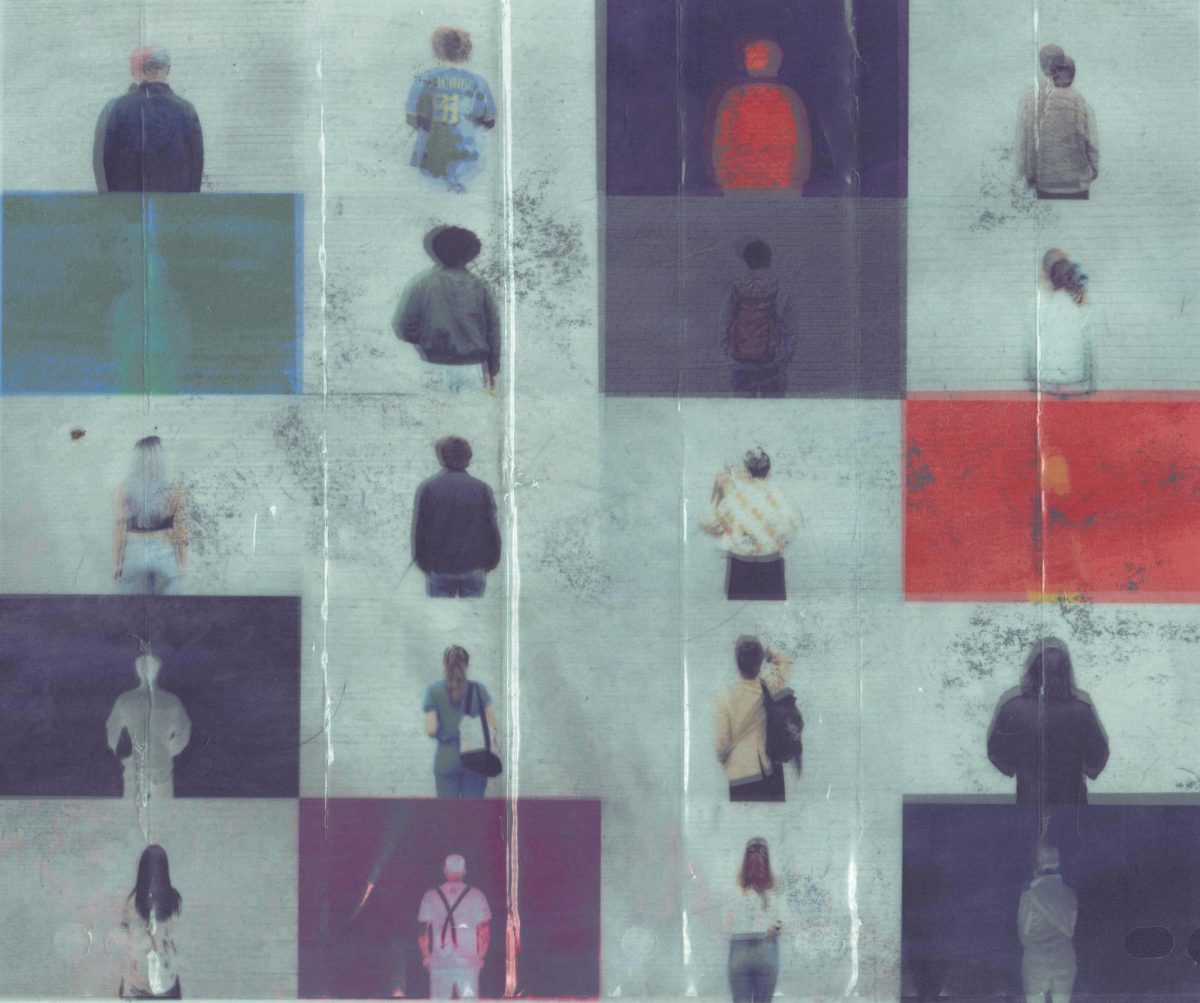
“Our desire to preserve is a form of denial about our own mortality. The fact that art can endure longer than people has lead some to seek a form of proxy-immortality through it,” – Julian Baggini, The Pig That Wants to Be Eaten
Has our relationship to photography gone too far?
The photographer, as is the case with every artist, constructs a world within a world. A duplicate, still-born, immortalization of life. Once a shutter clicks, something is simultaneously born and killed; because the second a moment is captured, it is already gone. The moment is, paradoxically, preserved and past.
I am primarily interested not in photography as preservation, but in what photography does to the person inside the frame.
Scholar and critic Susan Sontag, in her essay “On Photography,” wrote that to photograph someone is to violate them. I want to know why that feels true. I want to know what exactly is taken.
When you take a photograph of a person, what you produce is not them. It is a surface. A fragment of a single second, excerpted from the full duration of a human life: their history, their suffering, their laughter, the way they move through a room, what they want, what they’re afraid of, what they’ve survived–none of that is in the photograph. The photograph says, ‘This is who they are,’ and that is a lie. A confident, permanent, circulatable lie.
Photography involves a form of a possession. Not the possession of people nor the possession of things–photography is a different kind of hunger. It is exploitative in the precise moment the subject becomes the puppet. Where they are stripped of agency, reduced to a consumable surface, archived in an artificial display of their life that belongs, now, not to them, but to whosoever holds the image.
The photographed self detaches from the living self. It circulates independently. It gets interpreted, reproduced, possessed by strangers, by algorithms, by time. And the living person walks around with no say in what their duplicate is doing.
Think about what we choose to photograph. Children, monuments, art, friends, food. Humans have a natural proclivity to immortalize life through photography. What is this need to prolong life with the use of a photograph? Why record these things? As proof that they outlast us? And because we know that they do, that they will, is that proclivity proof that we were here? That we existed?
The camera has become, as Sontag put it in her essay, one of the “principal devices for experiencing something.” Not living it—experiencing it. The documentation has swallowed the event. We photograph the meal before we eat it, the concert before we hear it, the lover before we know them. Studies on what researchers call the photo-taking impairment effect confirm what we already feel: that people remember experiences less vividly when they outsource memory to a camera. We trade the thing itself for its image. We trade presence for proof.
Proof of what, exactly?
This is where mortality enters. The photograph is not really about the subject at all. It is about the photographer’s hunger: an ancient, animal need to hold onto something that is already leaving. And that hunger has no natural ceiling. Photography denies death and its appetite is infinite.
But here is the question that refuses to leave me alone: can the sacred be lost if infinitely reproduced? If you duplicate an image enough times does it lose the gravity that made you reach for the camera in the first place? Does the original Mona Lisa lose its power because it is infinitely reproduced?
Walter Benjamin thought so. In his essay, “The Work of Art in the Age of Mechanical Reproduction,” he wrote that mechanical reproduction such as photography drains an image of its aura.
What happens when the image being reproduced is not a painting, but a person? When it is you, your face, archived and duplicated across social media, circulated through strangers’ phones, consumed and scrolled past and forgotten. Does infinite reproduction diminish your worth as a human being?
I don’t have a clean answer. In conversation with Jason Wirth, American philosopher and department chair of philosophy at Seattle University, I have come to this: a photograph, like a hammer, is an instrument whose meaning belongs entirely to whoever holds it. Two people can pick up the same hammer–one builds a house and the other can use it as a weapon. The intention is everything.
The same photograph of the same person can be held by a lover, a stranger, an algorithm, an enemy. Each shoves their own memories, their own biases, their own worldview onto the photograph. The living person has no say. The image absorbs whoever is looking and reflects their interiority back–not the subject’s.
This is the final violence of possession. What remains after a photograph is taken is not a person. It is a surface–open, manipulable, infinitely reinterpretable. A subject without agency. Possessed by anyone. Belonging to no one.

![[incoherent screaming as I login to linkedin]](https://seattlespectator.com/wp-content/uploads/2026/05/Jobs-opinion-color-1200x798.jpeg)