

For most of my life, war has existed as a purely cognitive notion for me. It only existed in my AP European History classroom in high school or my social studies class in middle school. War meant two countries or multiple countries were bombing each other, and that citizens on all sides of a conflict were experiencing suffering. The echoes of World War I and World War II were far, far behind me, and the world learned from its mistakes, or at least, that’s what they told me.
The American education system has set us all up for failure. We are unable to understand the geopolitical meanings and movements of worldly afflictions because we have no sense of geography, culture or people outside of America. History is not a recounting of events; it is a ledger of society’s prerogative: our direction, our motives, our desires, dreams and obligations.
As easy as it is for the majority of Americans to wake up, get dressed and go to work or school, our country is actively at war. Over seven thousand miles away, Iranians are going through defense training as our counterparts in this war, while the biggest complaint in the U.S. is the rising gas prices.
February 28, 2026, the United States and Israel, in a joint effort, proclaimed active war on Iran, landing 900 strikes in just the first 12 hours. In the first hour, a direct strike was made on the Shajareh Tayyebeh Elementary School, killing 120 children. About 66 boys, 54 girls, 26 teachers and four parents were murdered in a strike which violated humanitarian laws.
I’ve been battling with the concept of duality: two things existing at once, being truthful in tandem with their juxtaposing values. That’s what life feels like right now, going to school, seeing friends, and yet, across the world elementary students, children, lie in a mass grave.
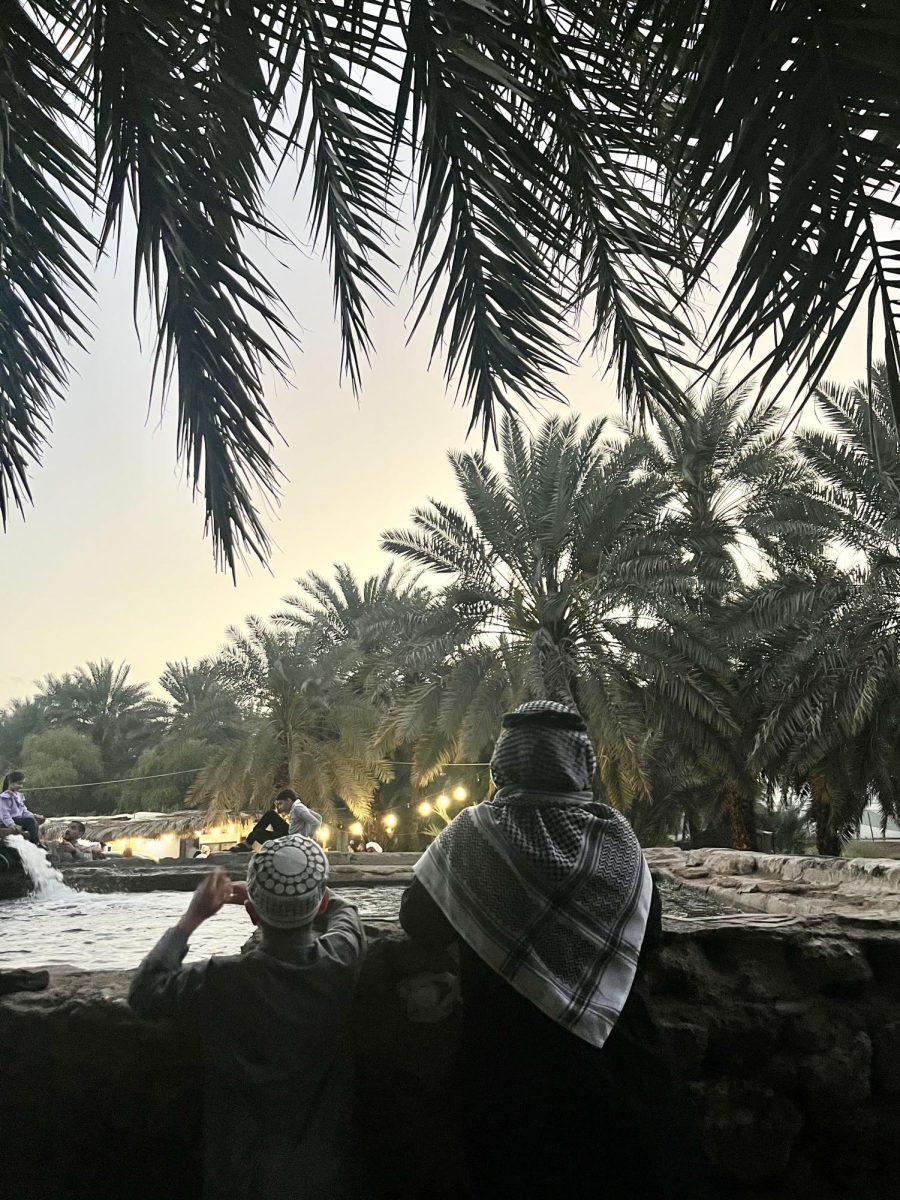
I traveled to Saudi Arabia just a month ago for Umrah. Our layover was purposefully in Turkey rather than Dubai; their airport recently suffered numerous drone and missile strikes. We flew over the Middle East, near the Strait of Hormuz, where the military blockade is threatening to tear apart worldwide economic systems, yet I was thousands of feet in the air, munching on pretzels and watching Crazy Rich Asians. During Umrah—a pilgrimage I’ve performed many times—there’s a sense of vulnerability you will never feel anywhere else. There is a collective awareness that no matter who you are, you stand shoulder-to-shoulder as equals. This time, though, there was a heavier presence, a knowledge that we stood almost as close to destruction as we did religious salvation.
For students in most Gulf countries, their realities are starkly different to ours. A high school student from Qatar told me that after the strikes from June of last year, they’ve developed PTSD. During Eid, before the U.S.-Iran war began, someone set off fireworks in their neighborhood and her family initially mistook them for bombs. She recalled her friends’ faces draining of color. Once the war started, she compared American Amber Alerts to the notifications they received in lieu of an airstrike. While now most things have gone back to normal, she is wary of the expected inflation rise which will impact those around her, following Qatar’s loss of 17% of their oil reserves.
A second-year undergraduate student in Dubai majoring in psychology told me a similar story. She was given five months off from school and got restless with the idle time. Living near one of the ports that was being targeted, she could hear the missiles and feel them shake her house. Going into Ramadan, things escalated, as strikes occurred throughout Dubai.
We are privileged to claim our only aggrievement is raised gas prices.


![[incoherent screaming as I login to linkedin]](https://seattlespectator.com/wp-content/uploads/2026/05/Jobs-opinion-color-1200x798.jpeg)
