
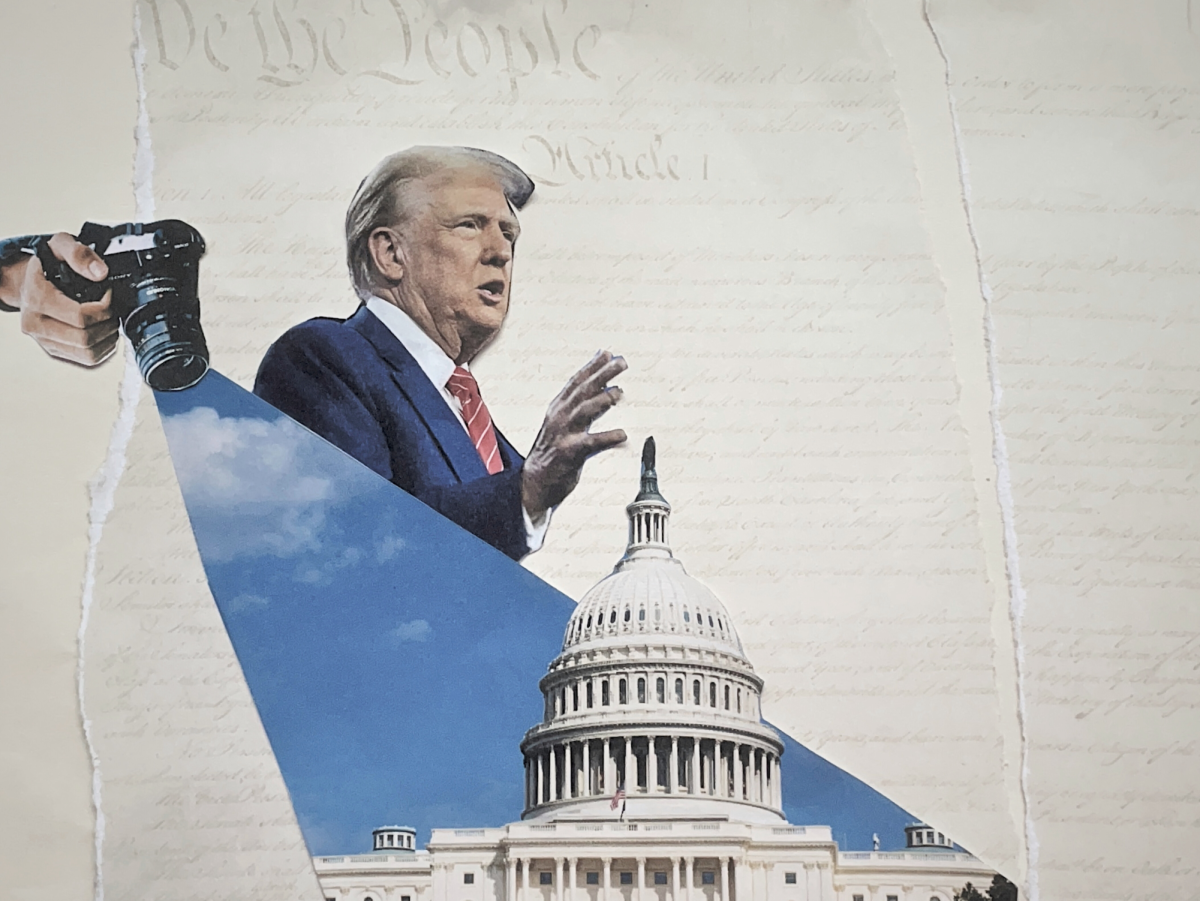
President Donald Trump has completed the first year of his second term in office as of Jan. 20, which was more contentious and more eventful than his first presidency. In the last month alone, Trump has ordered a military operation to capture Venezuelan President Nicolas Maduro; claimed he wants to seize Greenland for national security reasons; and encouraged Immigration and Customs Enforcement (ICE) operations, which led to two fatal shootings in Minneapolis.
Trump has been making headlines ever since he first entered the political scene just under a decade ago. The real estate developer-turned-president, first elected in 2016, ended his first term with two impeachments—the first for abuse of power and obstruction of Congressional proceedings, and the second for incitement of insurrection — by the House of Representatives in 2019 and 2021 (though he was acquitted both times in the Senate).
From the Department of Government Efficiency to the One Big Beautiful Bill Act, Trump has stayed busy for the past 365 days. His actions and personal conduct have drawn bipartisan scrutiny and brought the country into what some have described as a “constitutional crisis.”
Testing the Limitations of Executive Power
Trump began his second term in Jan. 2025 by signing a number of executive orders, including ones that attempted to end birthright citizenship (a constitutional guarantee), withdrew the United States from the Paris Climate Agreement and the World Health Organization, and ordered the federal government to eliminate its Diversity, Equity and Inclusion (DEI) programs. These were followed by 230 orders since Jan. 2025, compared to 220 orders in all four years of his first presidency.
“Presidents have long overstepped their powers and stretched the bounds of what is constitutional,” Thomas Mann, assistant teaching professor of political science, said. “But it seems right now that there’s no longer even a guise of trying to make things appear constitutional.”
According to Mann, when the checks and balances that usually keep the federal government in order are ignored, the Constitution becomes functionally meaningless; its power only exists when everyone in American society, including the president, at least tries to behave according to the framework it provides.
Many of President Trump’s executive orders this past year have gone forward without intervention. However, federal judges hold the power to stall them, but those who rule against him have drawn criticism from the Trump administration.
In October, Trump deployed 200 National Guard troops to Oregon, citing Title 10, which allows the president to deploy the National Guard if he deems there is a rebellion against the United States. U.S. District Court Judge Karin J. Immergut blocked Trump’s attempt to deploy a further 200 troops in November, stating that Trump’s reasoning was not sound. In response, Trump repeatedly misgendered Immergut–a cisgender woman whom he had appointed–when criticizing her: “That judge ought to be ashamed of himself.”
Increased ICE Operations
Over the past year, Trump and his administration have been increasing ICE raids across the country. ICE more than doubled its officer count in 2025, and its budget increased by $74 billion under the One Big Beautiful Bill Act. The Trump administration has come under fire for its consistent refusal to provide due process to those detained by ICE. According to Homeland Security Advisor Stephen Miller, ICE agents have “federal immunity” while they detain people they suspect to be immigrants–in practice, they will not be prosecuted for any illegal actions they take on the job.
Alex Pretti and Renee Good, both American citizens living in Minneapolis, were fatally shot in the past month by ICE agents. The Department of Homeland Security claimed Pretti had approached them with a handgun, but footage of the event directly contradicted that statement. Similarly, DHS claimed Good was attempting to “run over” ICE agents despite numerous angles that contradict this official statement.
The lack of legal repercussions for misconduct has empowered ICE employees to violate established rules, such as the Fourth Amendment, which prohibits entering private property without a warrant signed by a judge. This past week, agents tried to force entry into Ecuador’s U.S. consulate in Minneapolis.
According to Sarah Cate, an associate professor of political science at Seattle U, hatred may be only part of the motivation for the anti-immigrant sentiments the Trump administration is fostering. Immigrant detention centers are owned mostly by private organizations, meaning there is a financial incentive to detain as many people as possible.
On top of that, fear created by Trump’s public statements characterizing immigrants as “criminals” has shifted a significant number of citizens’ attention to immigration, Cate believes, more so than other topics of concern like the environment or economic instability.
“Scapegoating and vilifying the most marginalized individuals by criminalizing, arresting and incarcerating them has long sought to distract us from economic instability,” Cate said. “Rather than address crime, unemployment and poverty, both parties for many decades now have punished and locked up individuals to ‘solve’ these problems, something that’s been almost entirely unsuccessful.”
Erasure of Equity Language and Academic Freedom
The president has disparaged “radical and wasteful” Diversity, Equity and Inclusion (DEI) programs, even threatening to withhold federal funding from government-supported organizations if they choose to keep their initiatives. Other “woke” initiatives—plaques denoting the history of chattel slavery in some national parks, the implementation of critical race theory in schools and the existence of gender studies programs in higher education institutions—have also been heavily criticized by Trump’s administration.
“Current federal developments have made advancing strategic diversity and equity difficult,” Natasha Martin, Seattle U’s vice president for Diversity and Inclusion said. “They inject confusion, fear and divisiveness—all antithetical to our Jesuit educational mission—and pose risks to creating a democracy fueled by the ideas and talents represented by the range of human experiences.”
Climate Change Trade-Offs and Technology Deregulation
The Trump administration’s approach to environmental protections and regulations poses a major threat against efforts to address climate change. According to Assistant Professor of Environmental Studies John Armstrong, the United States is the world’s largest cumulative emitter of greenhouse gases, largely due to our dependence on fossil fuels and lack of clean energy infrastructure. That contribution has been exacerbated in the past year when Trump withdrew the U.S. from the Paris Climate Agreement, threatened funding for the Environmental Protection Agency and expanded access to formerly protected areas in the interest of extracting fossil fuels from them. Armstrong urged that if action is taken, those changes don’t have to be permanent.
“Every time we go backwards on climate change, we see the effects in big places like extreme storms and small places like locally polluted air,” Armstrong said. “There are really tremendous benefits of curtailing that pollution—we get a healthier future.”
Just as deregulation in the energy industry has led to the rapid growth of fossil fuel extraction and use, deregulation in the technology sector has contributed to the rapid growth of new software and artificial intelligence (AI). According to Onur Bakiner, professor of political science and director of the Technology Ethics Institute at Seattle U, this growth could negatively impact the environment and raise ethical concerns, including disinformation and copyright infringement.
“There’s this misconception that regulation is the enemy of innovation,” Bakiner said. “But historically, the technological advancements that have served human society have come with some guardrails.”
For AI, those guardrails have been significantly reduced. Trump signed an executive order in December 2025 banning local jurisdictions from regulating AI and certain parts of the technology sector. This order was intended to help American companies develop faster, but it has come with consequences—multiple concerns have arisen regarding the unregulated creation and use of generative AI.
According to Bakiner, misinformation, bias, environmental impact and the creation of illegal or inappropriate material are all areas of concern. At the moment, he stresses that it’s hard to tell how serious these concerns are and how seriously they will be taken. Some consequences are already becoming apparent with AI models like X’s Grok, which was temporarily shut down due to its generation of illegal and harmful images, including child pornography, online. In response, House Democrats like New York’s Alexandria Ocasio-Cortez have introduced the DEFIANCE Act, a bill that aims to regulate AI at the federal level and create avenues to combat deepfakes—the first bill of its kind.
The American public’s response to Trump’s presidency has shifted since his majority win; according to a survey from The New York Times, 49% of respondents said the country is “worse off” compared to a year ago. A recent Reuters poll shows that 58% of Americans think that the ICE crackdown has gone too far. Protests across the country have reflected growing frustrations with the current administration.
“Change is going to take a lot of people organizing and joining together and demanding what they want to see,” said Armstrong. “We can also contribute toward that by talking about these issues, informing people and trying to get more people to make a call to their elected officials, to join a rally or protest or march. You can go to a lobby day, you can talk to your legislators and say, ‘This is what we want to see change.’”