

For many people, puppetry is a nostalgic reminder of childhood plays and television shows such as “Sesame Street” and “The Muppets.” What many don’t know is that it has a long history as an art form with roots in political commentary.
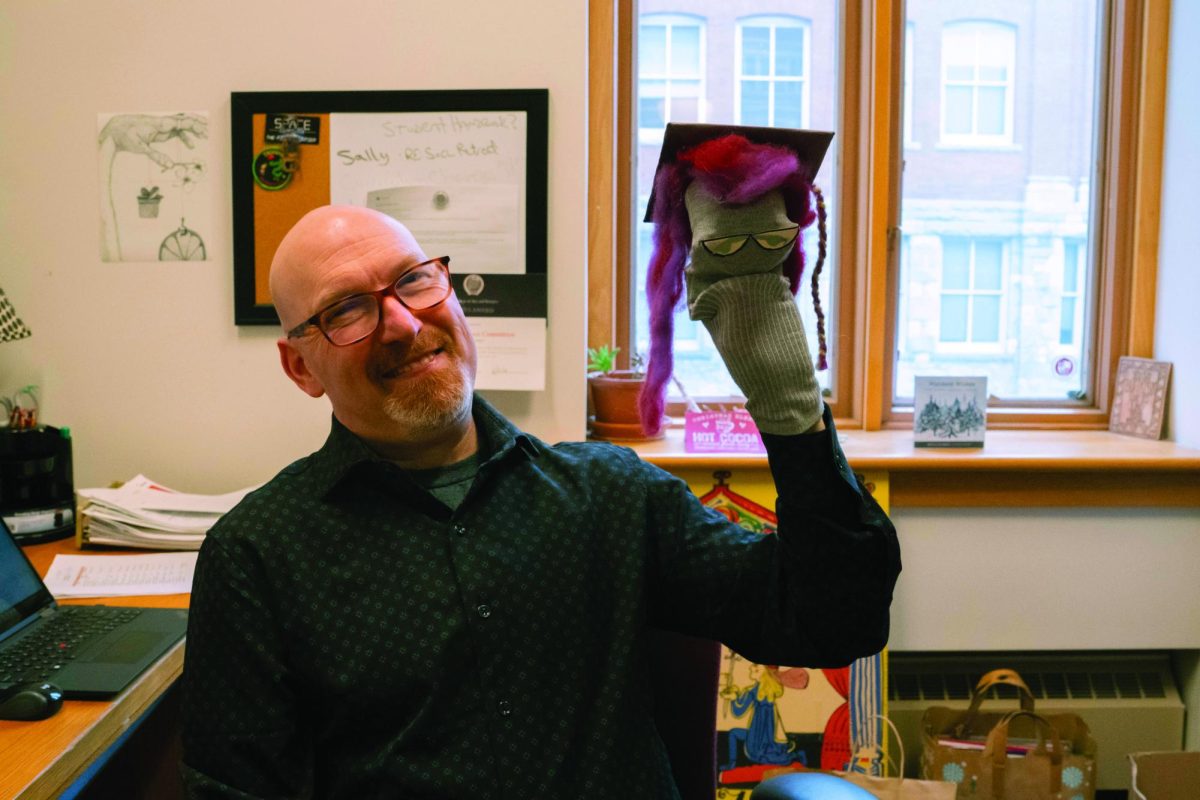
Puppets have historically had a unique link to political activism through their accessibility as a medium and their ability to serve as a form of nonverbal protest. For Sociology and Anthropology Department Chair and Associate Professor Mark Cohan, he has found a way to incorporate puppetry and its roots in resistance into the classroom. He was inspired to teach a puppetry class after visiting Taiwan’s puppet community and learning about the connections between Taoist and Confucian religious traditions and puppetry, in which people put on puppet shows to worship gods.

(Nicole Baltimore)
Since 2023, Cohan has been teaching a class called “Can Puppets Save the World?” in which he investigates the ties between puppetry and censorship. In the course, Cohan and his puppet, Maggie Nificent, teach students about the history of censorship, particularly book bans.
Since July 2021, there have been 22,810 cases of book bans across the United States, with 6,870 instances during the 2024-25 school year. Popular works such as “The Perks of Being a Wallflower” and “Wicked” were subject to restrictions in certain states.
“I thought that, given the history of puppetry, a sociological issue that would be relevant would be censorship. I had become particularly concerned about a rise in book challenges and book bans beginning in about 2020,” Cohan said. “I decided to frame the course as a study of what I call New American censorship, and I created a sort of bizarre little backstory to try to involve the puppets.”
The story, told throughout the quarter, involves a group of puppets who have banded together under the name Puppets-Censored Anonymous (PCA). The puppets of PCA love reading to children, but are unable to read some of their beloved stories because they’ve been banned at the school or public library. Thanks to social media apps like ‘FeltFacebook,’ these disappointed puppets have not only found each other, but have also been lucky enough to come into contact with Cohan. With the help of his students, he educates the puppets about censorship so they can inform the children they serve why the books they want to read are banned and try to enact change.
Iris Kim, a second-year biology major, took the class as a UCOR requirement and was interested in its unique premise. She thought Cohan offered an interesting perspective on censorship by linking it to puppetry.

“He kind of eased into it by telling us that puppetry was a way to go against authority, and then from there, he kind of went on and would talk about how censorship is a problem because of the banning and soft censorships, such as censoring professors at colleges,” Kim said.
Soft censorship refers to the means of silencing certain perspectives without resorting to a hard ban. This could involve libraries not ordering controversial books or removing them from displays. Under the Trump administration, concerns regarding censorship in higher education have increased.
Second-year Forensic Psychology Major Kaelyn Nekoba also appreciated how puppetry was tied into themes of censorship in the course.
“I like the fact that it got into censorship in a broader term, and how it was explained through art forms, because I feel like it doesn’t normally get explained through that,” Nekoba said.
As a part of their final, the students paired up to interview librarians. Cohan has built a vast network of librarians across the country who have experience with censorship and book bans.
The Seattle Public Library has partnered with puppeteers in the past, such as Rachel Jackson, who created a project that used puppetry to portray the stories of LGBTQ+ people at the height of the HIV crisis.
In the future, Cohan hopes his students will be able to participate in projects of a similar nature. He wants to gain approval to host an event for the university in which students convey what the librarians told them about censorship through their puppets.

(Nicole Baltimore)
One of the things Cohan believes makes puppetry so unique and special is its comforting effect on humans.
“Puppets lower our guard a little bit, right? We can hear things from a puppet that we wouldn’t maybe feel comfortable hearing from a human. Or a human might be comfortable saying something as a puppet that they wouldn’t say as themselves. It allows them to take on a different identity that expands who they can be,” Cohan said.
For example, in 2024, Elmo posted a tweet asking, “How is everybody doing?” His tweet received a flood of comments from people bearing their souls to a beloved childhood figure who offered them some comfort.
Cohan wanted to do something similar in his class to alleviate the stress of learning about heavy topics. To achieve this, he dedicates a class period to having students make their own puppets.
“I think [making the puppets] provides a nice break for students to do something creative in the context of an otherwise intellectual course,” Cohan said.
Both Kim and Nekoba said that creating their own puppet librarians was one of the highlights of the class for them. Kim and Nekoba took different approaches to creating their puppets. While Kim’s puppet, “Jellybean,” was more eccentric and colorful, Nekoba’s puppet mirrored a classic librarian with a neutral palette.
”It was really fun to get to talk to everybody and see their personalities shine through their puppets,” said Nekoba.

(Nicole Baltimore)
At the end of the course, each student shares in class what they had learned about censorship through the course by speaking through their puppets at a “Great Graduation Roundtable.” This course is an option for students looking to fulfill their UCOR 1600 requirement or as part of their Sociology degree requirements.





Theresa E
Jan 24, 2026 at 10:11 am
This is brilliant!!