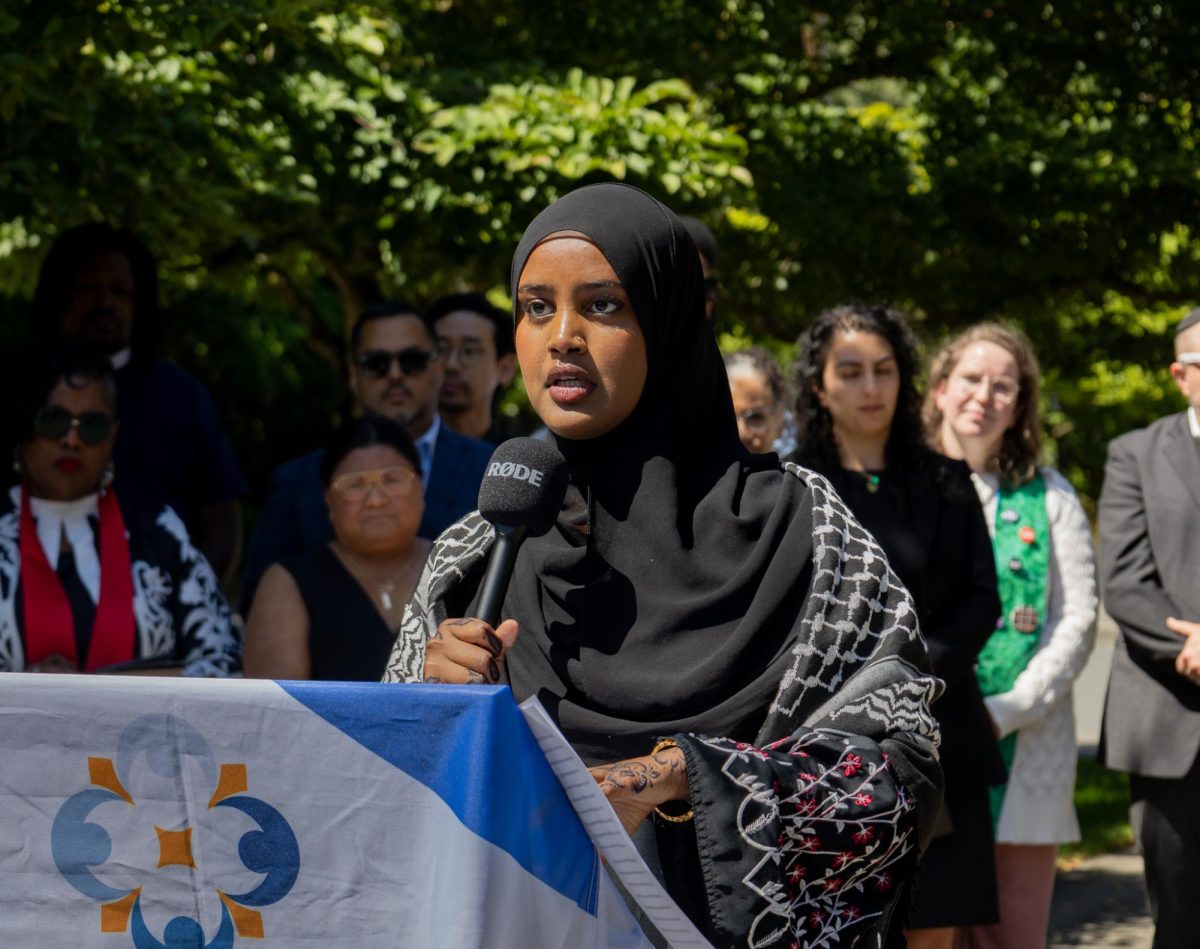


The Jesuits find themselves in the company of a new spiritual leader on campus. Starting his term this fall, Yasin Ahmed has joined Seattle University as the campus’s first Muslim Chaplain.
Ahmed has been serving higher education for the past 10 years, first as Cornell’s first Muslim Chaplain from 2017 to 2022, and then as Ithaca College’s Director of Religion and Spirituality from the fall of 2022 to the spring of 2023.
Ahmed’s involvement at Seattle U didn’t just start this year. He began volunteering with Seattle U’s Muslim Student Association (MSA) two years ago through Wasat, a Muslim-based organization dedicated to providing a space for connection, where he has been serving as the director since Feb. 2024. His involvement began shortly after he and his family moved to Seattle from upstate New York.
“I think for me, I love building community, and Seattle is becoming increasingly full of people who are coming here for work or for different reasons. They’re looking for a community, and so we need more people who are connectors in this area. I feel like being here really allows me to fulfill a lot of my passions,” Ahmed said.
Guiding Ahmed’s ambitions is the goal to build a community. He has started a handful of youth groups, more recently led a group from Wasat on a sacred hike through Seward Park, and was involved in conversations with fellow Seattle spiritual leaders about the local Washington SNAP fund impacts.
His commitment to creating opportunities for connection stems from a pivotal experience with a mentor he met during college. During his time at Rutgers University, Ahmed met Imam Abdurrahman Ahmed. Imam helped to bring the example of the Prophet Muhammad—peace be upon him—to life, and showed Ahmed and his friends the importance of finding God’s presence.
During his time at Rutgers, Ahmed spent a lot of time with the Episcopalian Chaplain, Greg Bezilla, who provided Ahmed with a judgment-free space to explore his faith.
Growing up, Ahmed was privy to a lot of religious hypocrisy. Too often, people use religion to justify harmful behaviors, and Ahmed shared that that was disillusioning for him. Overall, the practice of faith he saw felt performative rather than transformative.
Thus, meeting his mentor, Chaplain Bezilla, was a fundamental experience.
“[Bezilla] never tried to convert me. He wanted me to discover truth for myself and know I was safe while doing it. I became a chaplain because of him. I saw how powerful it is when someone simply listens, cares and holds space for you. He showed me what it means to be both a good person and a servant of Allah,” Ahmed said.
Ahmed’s journey in service began early, but through this experience, he learned an important lesson.
“Service without spirituality leads to burnout,” Ahmed said.
Now as a chaplain, which is a passion project for him, all his efforts stem from a desire to genuinely nurture and heal spiritual spaces, especially for young people. Ahmed wants to repay the service to students and accompany them on their own faith journey—not by instructing them with his own direction, but by walking alongside them and giving them the space to determine their own paths.
When asked about his position at a Jesuit University, Ahmed emphasizes the importance of his presence as a Muslim leader. The Council of American Islamic Relations (CAIR) Campus Climate Report showed that 65% of universities have failed to address the specific needs of Muslim students, and that half of all Muslim college students have experienced harassment or discrimination.
Ahmed referred to cura personalis, the Jesuit ethos of living out the values of inclusion and care for the whole person, and stated that Seattle U is modeling this concept at its best by establishing the position of a Muslim Chaplain.
“SU is saying to Muslim and BIPOC students, ‘We see you, we care about you, and you belong here,’” Ahmed said.
Ahmed expressed that, under the leadership of Luke Lavin, Seattle U’s assistant vice president of university ministry, Seattle U has demonstrated a commitment to understanding the Muslim student population.
“Everyone I’ve met here has been open-hearted and eager to learn, and that spirit of learning and empathy is what makes this place special,” Ahmed shared.
When it comes to servicing the Seattle U community as a whole, Ahmed quoted Aristotle.
“Educating the mind without educating the heart is no education at all,” he said.
Ahmed believes that Islam offers a unique intersection for people of all faiths, allowing people to look at the world differently than the way they may have been taught.
“[It] makes it easier to deal with the world as it is, and it also gives you a way to figure out how to move in this world and respond to the challenges that you face with hope,” Ahmed said.
Tarbiyya is the Islamic concept of bringing a seed to fruition. Ahmed draws from this approach, which focuses on holistically nurturing everyone’s self-development and instilling a compass for justice and truth. As chaplain, Ahmed uses Tarbiyya to discover how he can assist people and students to realize their human potential. For Ahmed, success is being able to accomplish the feat of helping someone see their own potential and convincing them to pursue it.
Ahmed also spent time in the social work field as a direct supervisor at a group home for people with special needs. His role was to help them transition into homes where they could live independently and become more self-sufficient. Ahmed says this work also translates into his chaplaincy; it has helped him understand mental security and define what self-care means for students. He shared that the mindset in America regarding self-care is to focus solely on self, which completely overlooks the need to live within a community that restores purpose.
Ahmed’s biggest takeaway from his past experiences as Chaplain for both Cornell and Ithaca College—learning that students are seeking connection with themselves, the community and to something greater.
“My experience as a chaplain has taught me how to walk with people through both joy and grief, and also how the structures of institutions impact well-being, particularly for marginalized students,” Ahmed said.
He expressed that spiritual care extends to institutional care—the need to educate administrators and faculty so that an environment of belonging can thrive through policies that reflect compassion, justice and understanding.
With his time at Seattle U, Ahmed is dedicated to being a voice for students and their needs. He hopes to create a space where Muslim students, especially, feel safe to voice their specific concerns. Already well into the fall quarter, Ahmed shared that he and campus ministry have already accomplished helping provide certain accommodations in the campus dorms and dining halls.
“When students had individual needs related to their Muslim faith, we were able to find solutions so that they could live comfortably on campus,” Ahmed said.
Something Ahmed wants to emphasize to students is his number one commitment: being a confidential caretaker. Anything that is brought to him stays confidential, and he believes that’s what makes university ministry special. His second commitment is that the space he provides is completely nonjudgmental—not to focus on students’ mistakes, but to help them determine how to improve.
“They don’t have to be religious, they don’t have to be anything in order to know that I’m here for them,” Ahmed shared.
Ahmed’s role as Muslim Chaplain for Seattle U comes from a deep desire to look beyond students’ pasts and mistakes, and act as a human to care for them in whatever ways they need. Ahmed values justice and ethical virtues, which reflect on the way he cares for others.
Beyond academics, Ahmed has a wife and young daughter, enjoys playing basketball and is thoroughly committed to caring for everyone as a human being.