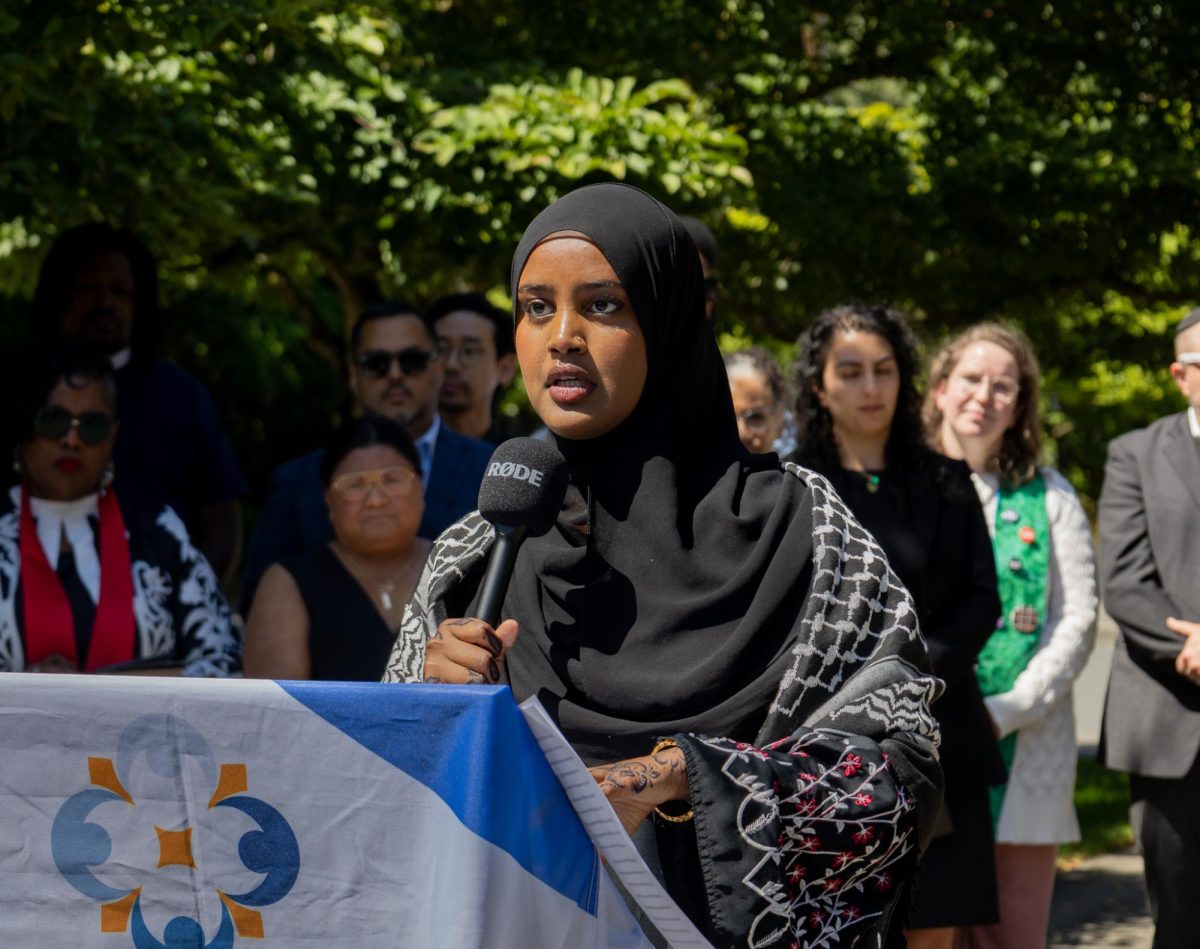

I met Motaz Azaiza on Oct. 21. I shared the space with a living symbol for Gaza, and I left with the question: how committed are we to the places and people we love?
As someone pursuing journalism as a career, I am constantly thinking, “What do I want to do for the world? How can I best apply myself at the intersection of journalism and justice?”
I asked Azaiza what long-term ideas and places we should be engaging in, and his answer was to commit to your truth. He shared that, as journalists, we have a responsibility to the path we’ve chosen; anyone entering the world of journalism will feel the pressure to adapt certain narratives. The test here is whether you will rise to the occasion and deny the forces that convert journalists into those who twist the truth. Anyone can become a tool of propaganda, but not anyone can become a journalist who fully commits to the cause they represent.
For Azaiza, that cause was—and still is—Palestine, the driving force of his work. He acknowledged that the act of committing yourself to the cause of your heart is not easy, but that’s what makes an authentic journalist—someone unshaken by the influence of greed and self-interest.
In regard to Palestine, Azaiza shared that everyone committed to the Palestinian cause should engage in a few long-term initiatives. One is committing yourself to understanding the long-standing history of Palestine before Oct. 7. The second is understanding the difference between Gaza, the West Bank and the Palestinian refugees scattered all over the Middle East— how do they differ in their thoughts and values? Education is an understated value connected to overcoming the propaganda around the genocide in Gaza; reposting on social media isn’t enough. Israel’s active eradication of the physical existence and mark of Palestine extends to the destruction of Palestine’s familial history and culture. Education is a direct act of resistance to the ethnic cleansing because increasing your knowledge defies Israel’s hold on controlling the narrative.
Despite recent criticism against Azaiza, we cannot disregard his perspective, which carries the weight of lived experience in Gaza. It would be an error to ignore his voice and the painful reality he lived. We are all humans. And humans, unfortunately, are imperfect and can make choices that are questionable to some but right for others. We can go in circles about this, but what I hope we can all agree on is that Azaiza was one of the first on the ground in Gaza to illuminate the atrocities of the genocide.
In a recent Instagram post, Azaiza admitted he may have misused his words but clarified, “I never made a mistake in showing our suffering as it is.”
We cannot disagree that he lived through a genocide, that he was presented with the destruction of homes and the mutilation of bodies, and he chose to take out his camera and stand with bravery.
As a student of journalism, I have learned that it is not my responsibility to support someone, but to learn from them. Journalism is the language of truth, and to truly act upon the truth, we have to have open ears to the world.
The lesson I share with you here is that the world we live in right now is riddled with grief and casual injustices, so stand firm in your beliefs and devote yourself to the justice of your calling. In the realm of journalism, I keep the value that to hold myself to the best of standards, I need to be willing to take the risks of holding power accountable and commit to the truth.