
Long before the vulnerability and spontaneity of blogs and social media posts, creatives and activists found zines—small batch, independently published booklets—as a way of self-expression and storytelling. That tradition is very much kept alive in AVCS 3610 — Zines: DIY Self-Publishing, an art class currently offered at Seattle University that teaches students to use a variety of mediums to create zines.
Associate Professor of Visual Art, Photography & Design Alexander Mouton teaches this course and has a history in zine making and attends zine festivals all across the Pacific Northwest.
“The form of a book allows for repetition, variation of ideas, visual themes and metaphors in a way that can be this really complex piece, that’s really different from something like an exhibition where you have just images on a wall,” Mouton said. “There’s much more intimacy and much more potential for really complex interwoven text-image relations.”
Third-year Creative Writing and Women, Gender and Sexuality Studies major Trudy Shelf greatly appreciates the openness and inclusivity that the class creates.
Shelf enrolled in the class after one of her professors recommended it, despite having no prior experience with zine-making. However, she has quickly come to love how zine-making allows her to pair her writing with visual art. Shelf has made a single-sheet zine, “Cherry,” which uses collaged images blended with a poem she originally wrote in Queer Poetic Memoir, a class taught by Associate Professor Serena Chopra. Shelf’s memoir explores a matrilineal relationship with the body and her queer identity, and she was eager to expand her work through a different discipline.
“The essence of art as a healing power is communal and collaborative,” Shelf said. “What’s beautiful about a classroom environment being an artistic and collaborative one is that you are constantly getting to learn about what other people might think about the art that you make.”
This sentiment was prevalent in the atmosphere of the classroom, with students going around the room providing insightful commentary, compliments and critiques on their peer’s zines.
Although zines were invented in the 1930s and 40s as a way for science fiction fans to discuss the content they loved, the art form didn’t gain momentum until the 60s and 70s, thanks to copy machines going commercial, and the punk movements trailblazing its popularity.
In Seattle, zine-making gained traction in the late 90s and early 2000s after the development of desktop printing, which made zines much more accessible and affordable. Today, zines are oftentimes distributed across political and cultural spaces, with a focus on creative expression and social commentary rather than profit.
Due to the medium’s punk roots and accessibility, zines have historically been a very political art form. The use of zines in artistic protest and political commentary is one of the themes that is explored in the class through course texts, such as the graphic edition of Timothy Snyder’s On Tyranny.
-
Professor Mouton and a small group of students are seen examining a zine during a class critique.

-
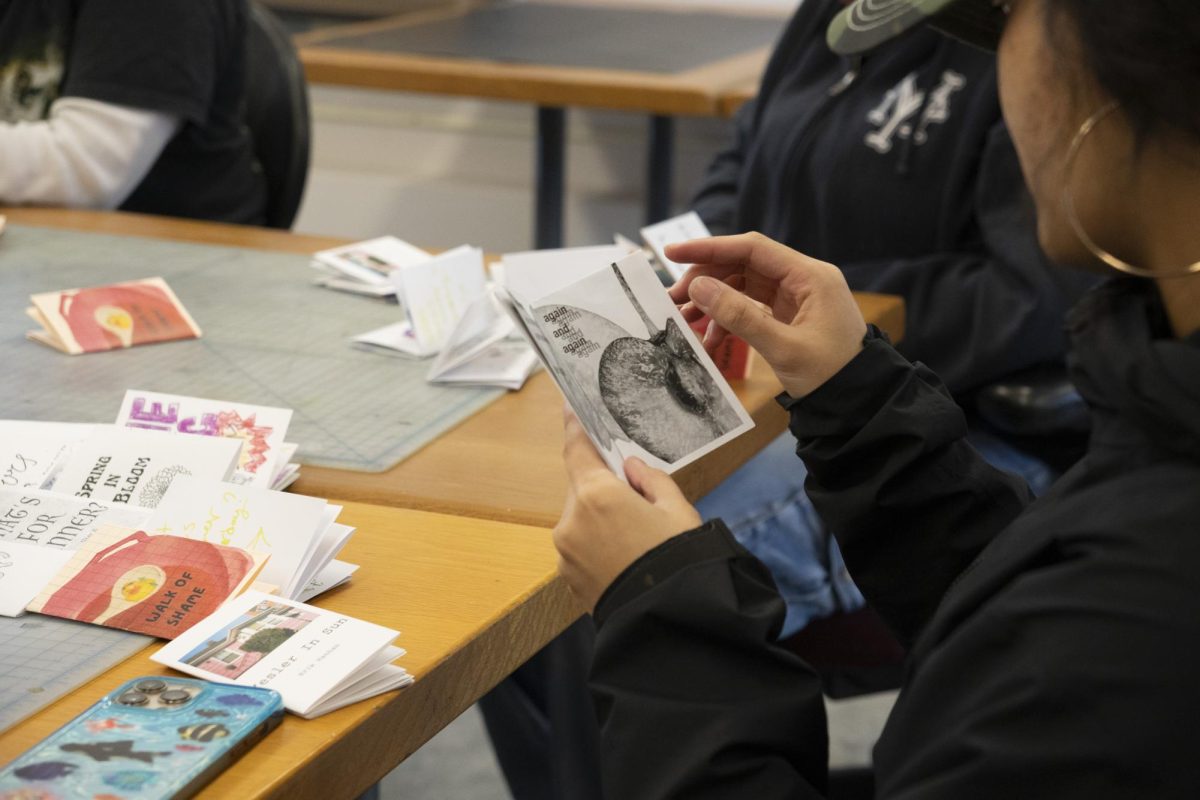
A student reads Roxie Bass’s zine called “What Comes After Sunday?”

-
Professor Alexander Mouton poses with his collections of zines that were used as examples during a lesson on different types of zines.

-
The students’ most recent zine projects sit on top of a cutting mat, awaiting critique.

-
Professor Mouton’s zinemaking class giggles and laughs as they read a humorous zine during their critique.

-
A student reaches for the next zine that will be critiqued.

-
Professor Mouton’s zinemaking class is gathered around a table, preparing to critique their most recent projects.


According to Mouton, it can oftentimes feel difficult for people to be vulnerable in their zines when their personal identities are politicized. Because of this, the focus of the class is ensuring people feel comfortable enough to produce zines in which they can be their authentic selves.
“I recognized pretty much right away the importance of creating a safe space that was very inclusive, where we could develop a sense of trust in order for people to really get at these autobiographical experiences and process them through the making of these works,” Mouton said.
While Shelf is a newcomer to zine-making, Third-year Creative Writing major Mar Bradley has been creating zines since they were in high school. Bradley discovered the class before they even began attending Seattle U, and had it on their bucket list for all of college until they were finally able to fit it into their schedule this quarter.
Bradley likes to use various forms of media to create their zines, such as collaging and crayons. While one single-sheet zine was required for the first zinemaking assignment, they created two: “Big-Hatted Blues”, following a cowboy moving around the page whose hat is too big, drawn in pen, and “Patdown”, an exploration of gender-queerness at TSA, drawn in colored pencil.
For another single-sheet zine assignment, they created “What’s for Dinner”, a digital collage of three ingredients—canned tomatoes, sardines and an apple core—folding open to reveal a large, open cat mouth. All three are entirely Bradley’s illustrations.
“I like to be funny in my zines a lot,” Bradley said. “I like to put things that make me laugh, and I like to put in a lot of my friends’ ideas into them too.”
One of the reasons that Bradley loves zine making is because of how replicable, accessible and cheap they are, a sentiment that Mouton echoed.
The class also helps students with publication and distribution of student zines, guiding them on all aspects of zinemaking, from various budgets to printing at home and in studios. Mouton pays for all students to have their final zines produced professionally at Girlie Press, a local print shop.
Mouton says that zinemaking is not only special because of how affordable it is, but also because it is very inclusive of different types of media. In the most recent rotation of zines, students used everything from photography to crayons to digital art to create their zines.
”[Zinemaking] allows for lots of different people to get at and make ideas, and it’s really simple in terms of the form. It doesn’t require a lot of money to make it, and pretty much anybody can bring their own content into it. I think it is really accessible,” Mouton said.


![Peggy, Mink and Bladee Make Good on Threats to Drop Music [REVIEW]](https://seattlespectator.com/wp-content/uploads/2026/05/unholytrio-review-web-1200x900.png)