
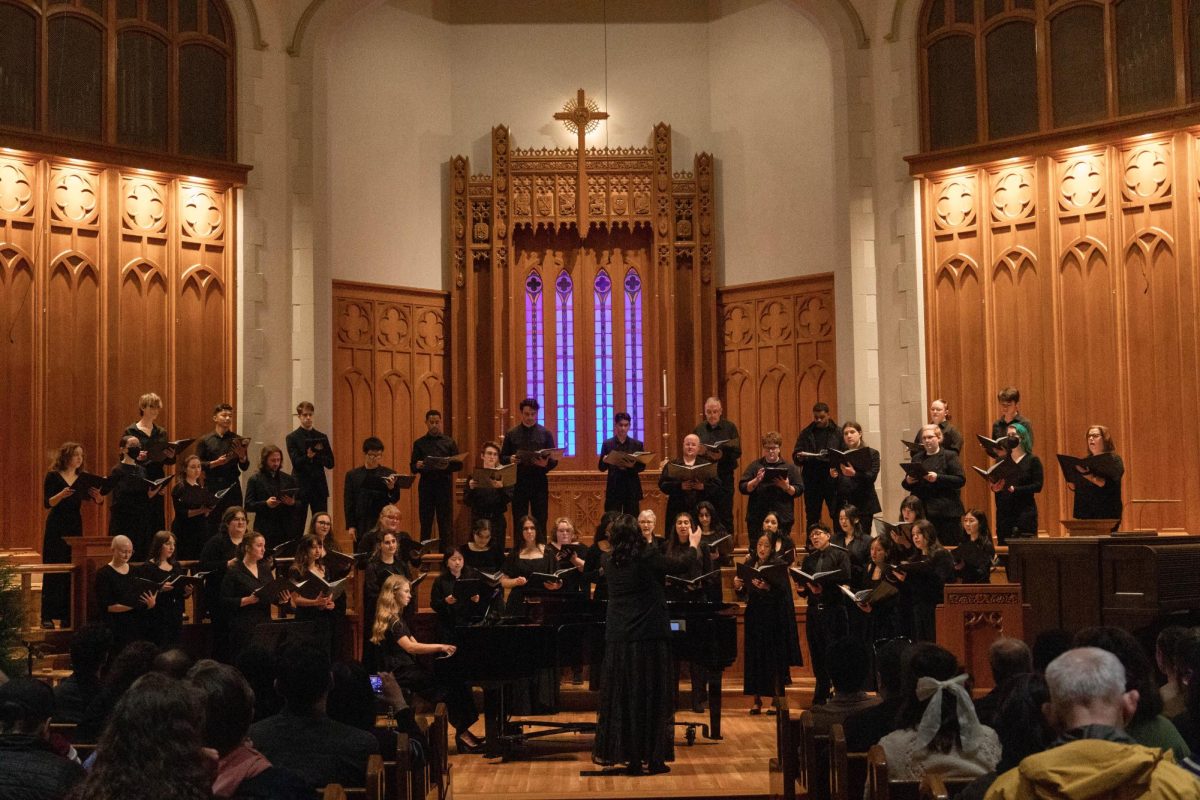
“I’m not going to tell you to sit back and relax. I’m going to tell you to sit up, to open your ears, open your minds, and open your hearts as we present I Dream A World, 250 years of American song,” Lark Witten, visiting director of choirs, said to audience members inside the Seattle First Baptist Church May 14 at 7 p.m. in her speech introducing I Dream a World, Seattle University’s annual spring choral concert.
Before a single note was sung, the choir breathed in as one. Dozens of bodies, voices, ranges and lives all drew in air at the same moment and briefly became one. This fusing is what a choir does. It asks you to surrender yourself to a sound larger than you.
I Dream a World was not a typical end-of-quarter showcase. Witten, who stepped in while director Leann Conley Holcomb was on sabbatical, built a program that moved through 250 years of American history: from the preamble to the Constitution to Paul Simon, from shape note singing to gospel, from W.E.B. Du Bois to Crosby, Stills and Nash.
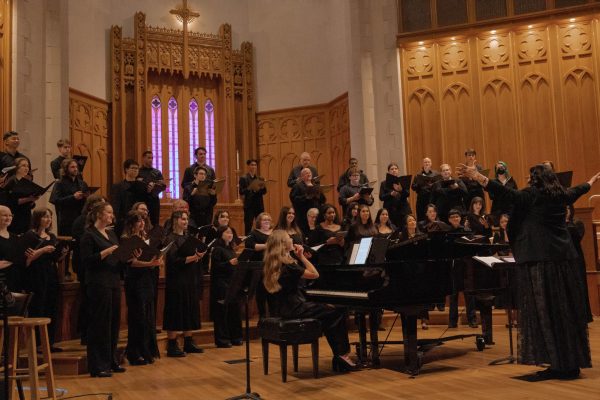
“Artists use their art as a way to sort through their surroundings, and the things that they’re going through,” Witten said,
The concert was an attempt to showcase the grief Witten has experienced over a country she grew up loving, and a present she finds deeply alarming. The concert was her attempt to hold all of that at once—the vast and tumultuous American experience delivered by a choir of more than 47 students and alumni.
The program’s most striking moment came early. Guest soloist Luke Bailey sang a version of “My Country, ‘Tis of Thee” that Witten had arranged herself—transposed from a major to minor key.
“I made sure to set it very high in his range so it sounds like he’s struggling,” Witten said.
The familiar, triumphant melody shifted and dropped a pitch to sound stranger and eerie; the immediate conjure of tragedy set the ensemble loose.
This is what choral music can do that other art forms cannot. A photograph freezes its subject, but a choir demands the opposite. Each singer brings everything they are into the sound, the emotion roaring in harmony.
Mitchie Vega, a fourth-year tenor, has been singing since childhood. However, the choir taught him something specific about disappearance.
“Even just all of us breathing together,” he said, “that inhale before the song starts, or that little moment of silence after it ends and the note is still ringing in the air… there’s something really beautiful there.”
Kendrick Magmati, a bass-baritone in the ensemble, put it plainly.
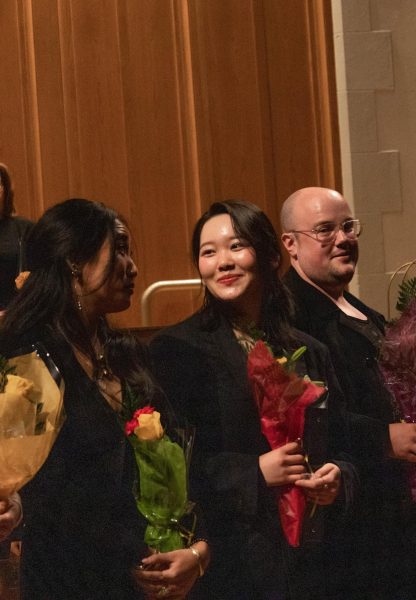
“Everyone has a unique voice, but in a choir you’re trying to blend in and you become one voice. And that in itself is very powerful,” Magmati said.
What followed was a program that refused to let the audience off easy and refused to leave them in despair. Witten juxtaposed Margaret Bonds’ setting of W.E.B. Du Bois’ pacifist manifesto—I believe in the Prince of Peace, I believe that war is murder—against “Daylight Again,” a folk-rock elegy for fallen soldiers performed on acoustic guitar by Danny Herre, a third-year environmental studies student. His guitar sounded like mourning, like grief with nowhere to go.
Each piece’s placement was intentional, with a pacifist’s manifesto and a soldier’s lament next to each other because that tension, Witten believes, was the most honest thing she could say about America. She placed Langston Hughes’ To Sit and Dream at the program’s center as a quiet instruction to imagine harder. Through all of it, she held onto something sacred.
“I do believe in humanity,” Witten said. “I believe in the beauty of parents loving their children, and of neighbors looking out for neighbors.”
Before the concert’s final songs, the ensemble observed a moment of silence for a recently murdered transgender woman at the University of Washington—someone who had shared this same stage just one quarter prior. Then they sang “Hard Times Come Again No More,” then “I’ll Be on My Way,” a Shawn Kirchner piece, then “The Road Home,” by Craig Hella Johnson, a Seattle U tradition.
“What I want people to take away from this experience is hope,” Witten said.
A choir is an ancient and specific kind of hope. Dozens of individuals marched into a cathedral that night, each carrying their own grief, their own voice, their own version of America, and for an hour and a half, they gave it all away.


![Peggy, Mink and Bladee Make Good on Threats to Drop Music [REVIEW]](https://seattlespectator.com/wp-content/uploads/2026/05/unholytrio-review-web-1200x900.png)