

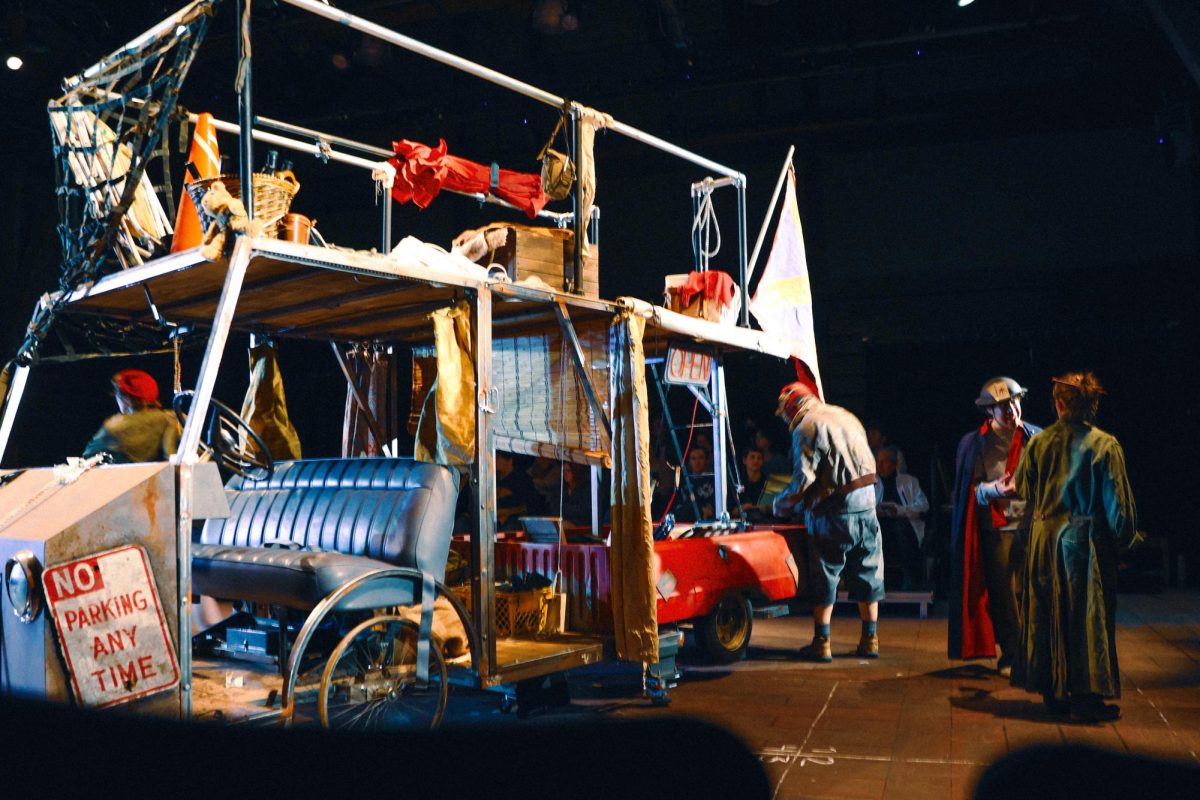
The weight of a worn-out wagon creaks across the stage, representing more than just a physical burden. In Cornish College of the Arts’ production of “Mother Courage and Her Children,” war is portrayed as something that never truly ends. There is little time to stop or reflect, and survival becomes a constant struggle.
Bertolt Brecht wrote “Mother Courage and Her Children” in about a month in 1939 as a direct response to the invasion of Poland by German armies and as an explicitly anti-war play. Set during the Thirty Years’ War, from 1618-1648, the story follows the titular Mother Courage, a traveling canteen vendor who follows the Swedish army with her kids, Swiss Cheese, Eilif and Kattrin. Instead of portraying her as completely moral or immoral, this production depicts her as someone shaped by necessity. Every choice she makes is related to her survival, even if it causes permanent loss.
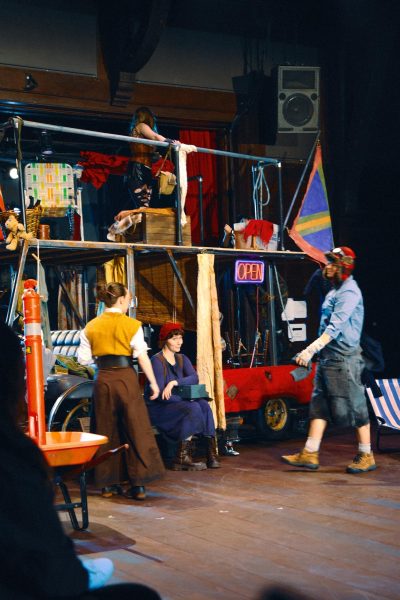
Dorian Green, a fourth-year acting and original works major who plays Mother Courage, described the character as defined by endurance.
“Mother Courage is ultimately a survivor,” Green said. “Becoming a businesswoman is how she has survived. I think she has been surrounded by war for a very long time.”
Green also drew attention to the play’s refusal to provide her character with moral clarity or a resolution. Mother Courage doesn’t have a breakthrough. Instead, she keeps going, trapped by the systems that hurt her.
“I think what I want people to get out of the production is a reflection on why war exists, why we still do it, why we put up with it, how we try to survive it, how we can stop it, how it affects everybody on an individual level, and how we can get used to it if it doesn’t affect us directly. That’s a big reason why I think you still need to retain a sense of empathy in this play, because it needs to come from a place of care for the people who are affected by the tragedies that the play shows.”
Following Brechtian style, the play focuses on making the audience think rather than feel, so the lack of clarity is intentional. The result is a character who is never allowed to “learn” in a traditional narrative sense, leaving audiences unsettled by her persistence.
Mother Courage’s son Eilif, played by Anton Bush, a third-year acting and original works major, represents a different perspective on conflict.
“Eilif is really the one that’s like ‘I want to fight in it,’” Bush said. “For this glory and this validation.”
Bush also emphasized how his view of the role was shaped through the rehearsal process. He explained that the majority came from early table work and group text analysis, in which the cast regularly stopped to examine relationships and motivations.
The play’s themes of uncertainty are supported by its structure. Movement and comedy break up moments of grief, reflecting a world where survival gives little time for emotional processing. The wagon itself, which is constantly moving, shows how war and survival keep repeating without an end.
Kattrin, the daughter of Mother Courage, is one of the few characters to escape the cycle that everyone else is caught in. She breaks the economic and survival-driven mentality that shapes the remainder of the play when she puts her life in jeopardy by climbing onto the wagon and hitting a drum to alert the town that enemy soldiers are coming.
Julie Whitaker, an audience member, pointed out that rather than healing, the play’s emotional power comes from its depiction of endurance and repeated loss.
“Everybody is just trying to find a way to survive, and some people are finding a way to profit,” Whitaker said.
Mother Courage is left on her own by the end, still pushing her wagon. Without a clear ending, the play suggests that survival is an ongoing process, driven by determination rather than success.
“[The ending] made me feel really emotional, I still feel emotional,” Whitaker said. “That human drive to persevere despite what’s happening and just to carry on.”
Cornish’s production of “Mother Courage and Her Children” provides viewers with unresolved tension rather than a clear moral lesson. The play emphasizes how people must move through systems that provide survival at a cost that is never fully paid, and how conflict lingers throughout history through its actors and structure.
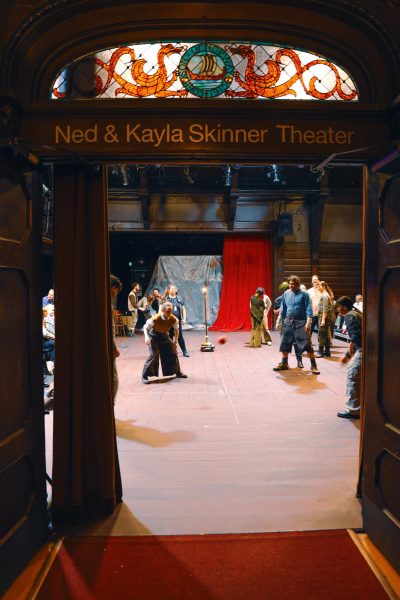
“Mother Courage and Her Children” will run through April 11 at the Skinner Theater in Raisbeck Hall.


![Peggy, Mink and Bladee Make Good on Threats to Drop Music [REVIEW]](https://seattlespectator.com/wp-content/uploads/2026/05/unholytrio-review-web-1200x900.png)







Rae
Apr 9, 2026 at 4:14 pm
The elaborate wagon was designed by Student Luna Mock and built in the Cornish scene shop with many other participants, such as Orion Cartwright and Matt Mccarren