
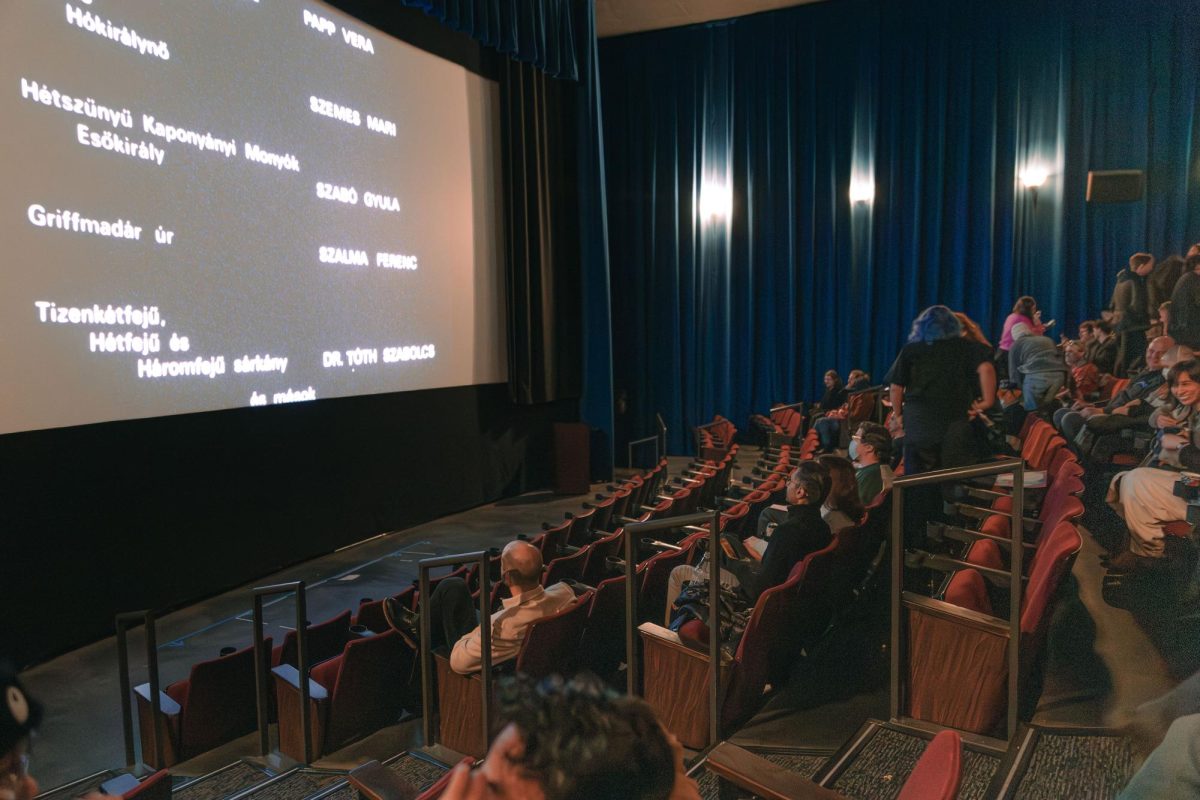
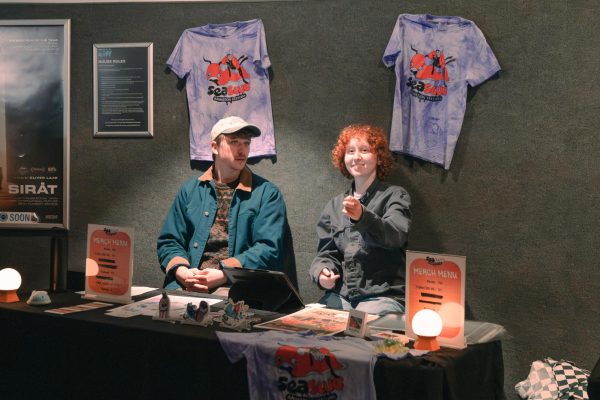
I didn’t expect to spend my Friday night agog, hand clasped over my mouth, watching an obscure, psychedelic, Hungarian arthouse film from the 80s at Siff Cinema Uptown, nor did I expect to be simultaneously disturbed and moved by such visceral and bizarre animation. Yet there I was, ensconced in the searing and swirling colors of the 1981 film Son of the White Mare. The movie was shown Feb. 28 as part of the second annual Sea Slug Animation Festival, a Seattle-based film festival featuring strange and unusual films from all over the world, with a focus on PNW-based and new animated pieces.
Kicking off Friday’s two-film “Retrospective Spotlight” was the 2025 animated short film Dédé (Ancestor), directed by Yasmine Djedje-Fisher-Azoume. The film explores her Bété ancestry in the central Ivory Coast, using folklore and reimagining traditional sculptures and masks through frame-by-frame charcoal illustrations.
This first film set the tone for my evening—I was disoriented by the flashing lights, compelled by the abstract, non-linear narrative, of which I couldn’t quite track but knew I wasn’t necessarily meant to, and found I couldn’t take my eyes off the screen. This was unlike any style of animation I had seen before.

I didn’t have much time to process what I had just seen; however, when the film ended, I was immediately thrown into the 1981 Hungarian arthouse film Son of The White Mare. Knowing nothing outside of the gorgeous illustrations I had seen of gilded creatures with abstract faces resembling the sun and mountains bathed in white light, I was completely unprepared for the first emotion I felt when the movie started—fear.
The titular white mare races through a dark forest in the snow as lightning crashes and dark shapes with gnashing teeth pursue her. Her design is relatively simple, almost childlike, but she blends seamlessly as a soft shape into a jagged, detailed and constantly moving background. It’s often unclear where her shadow begins and where the forest ends, where the snow covers her white coat and vice versa. Her yellow eyes flicker in panic, and she nearly collapses in exhaustion, before finding a safe place to rest in the warm glow of tan, unusually vaginal-shaped space—foreshadowing that I did not catch, too focused on the expressive, limb-like tendrils of her mane and tail.
I then entered into the first of many scenes throughout that made me so deeply uncomfortable that I reconsidered staying for the remaining 80 minutes of the film. The white mare lies down, calm, until a golden glow begins emanating from her womb, emitting a gentle, rhythmic hum, illuminating a small, squirming creature. The creature changes color and shape, flashing between cat, dog, fox, horse and human, as it struggles to free itself. The mare thrashes in pain, bearing her teeth with her skeleton flashing in bright yellow, her screams echoing throughout the theatre.
Yet just as I was preparing myself for more visceral and grotesque imagery, the music calmed, and the mare began rocking a golden, humanlike baby, cradling him in her mane. His glowing light cast across her face like a candle as she looked tenderly into his eyes. Her body has turned deep blue and covered in stars, and the wind slows to a soothing, mechanical drone as she whispers, “Once upon a time…”
The plot of Son of The White Mare is based on the Hungarian folktale by the same name— “Fehérlófia” in Hungarian. The story follows Treeshaker, who reunites with his two brothers, Stonecrumbler and Irontemperer, to help him venture into the underworld and save each of their respective wives and the universe from ancient forces of evil.
This film also used frame-by-frame animation, which allowed freedom of movement and a flow between scenes. Any harsh cuts between scenes were deliberate, with most objects, characters and background flowing into one another—mountains twist into creatures, the overworld shifts into the overworld, faces morph into constellations.
The parts of the movie that made me tear up seem simple when compared to the flashy and active rest of the film. The way a young Treeshaker’s hair shifts as he tries to pull a tree out of the ground, his exasperation twisting through his golden locks and flashing in quick succession, made my heart swell. Even the mischievous bearded gnome who tries to stop the trio by eating all of their porridge is given a redemption arc when the brothers shave his beard, which is the source of his power. Although he is at first only concerned about getting his power back, by the end of the film, he is helping Treeshaker, even when he doesn’t have to, leading him through the underworld and patching up his wounds after a fight.
Between a heavy-handed phallic sword metaphor, frequent nudity and constant vaginal imagery, I was admittedly on edge with my unsuspecting friends in the audience, who also went in blind.
“I’m so sorry, I didn’t know it would be like this!” I whispered to a friend on my left, who giggled along with the rest of the audience. Oh, the timelessness of the human experience! Oh, the absurdity of these things that make us human, like sexuality and corporeal forms! How can it be that such otherworldly beings can remind me of my love for humanity?


![Peggy, Mink and Bladee Make Good on Threats to Drop Music [REVIEW]](https://seattlespectator.com/wp-content/uploads/2026/05/unholytrio-review-web-1200x900.png)