
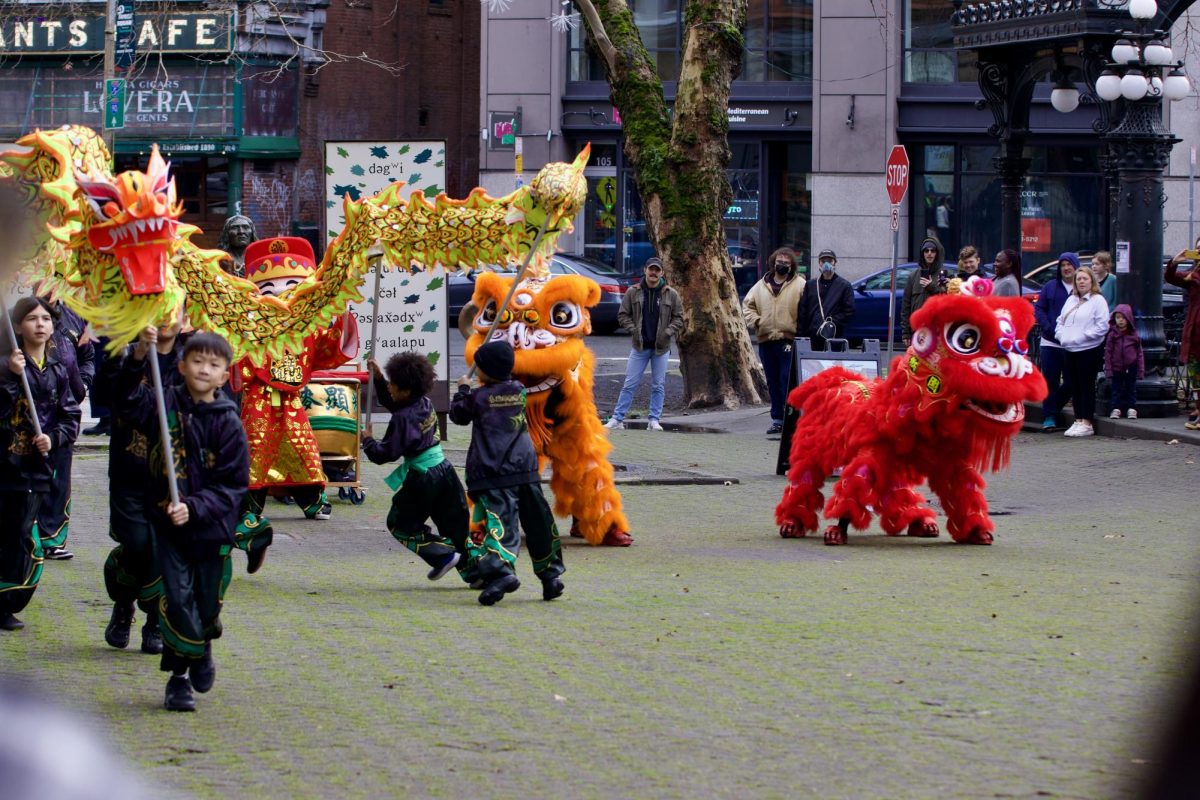
The sound of drums and cymbals filled Pioneer Park, First and Pike and Bell Street Park Sunday, Feb. 22, as a pair of colorful lions danced throughout the crowds. A team of musicians, dancers and supporters traveled to three different parks at 1, 2 and 3 p.m. as they brought luck and good fortune into the Lunar New Year.
The two lions, operated by two dancers inside each costume, began their journey in Pioneer Square on the corner of Yesler and 1st Ave, where they wandered throughout the park, interacting with spectators: one lion reared onto its back feet, while another mimed eating a baby held up by a laughing father.
The performers were members of Mak Fai Kung Fu Association, the self-described “premier lion dance troupe of Seattle,” who were hired by the Seattle Downtown Association to perform throughout the day. They are working hard—this season, they have over 173 bookings.
“It’s not as easy as it looks,” Dan Hai, who operates the tail end of one of the lions, said. “I don’t have a lot of visibility, and it’s a lot of work for my legs and back, especially when we do the lifts and my partner stands on my shoulders.”
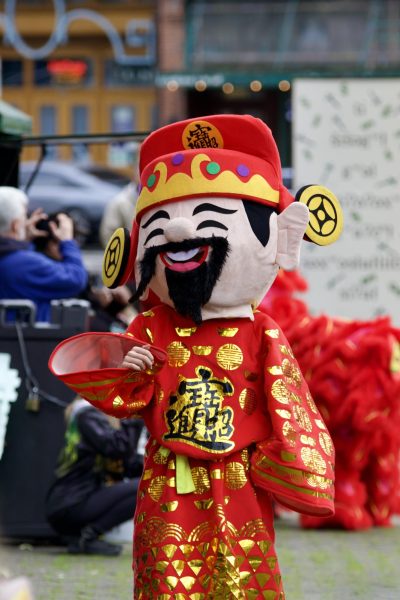
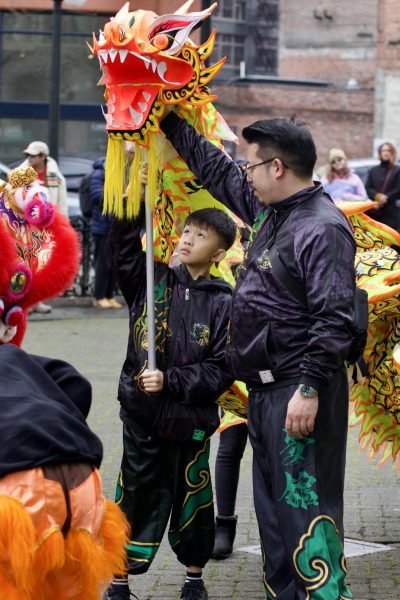
The lions were followed by a dragon and Caishen, the money god. He wore red robes adorned with gold trim and had a friendly, jovial head cartoonishly disproportionate to his body. The dragon, held up on wooden poles by a few elementary-aged children, bobbed and wove as they followed the lions, while Caishen waved and accepted money from onlookers.
Lion dances are a Lunar New Year tradition in China that dates back to at least the Han Dynasty (202 BCE-220 CE), though there is some debate over their exact origins. Lions aren’t native to China, suggesting that the idea of lion dancing may have come from a region further west via trade routes; however, the modern lion dance is a staple of Lunar New Year celebrations throughout East Asia.
A number of other countries, including Vietnam, Japan, Korea, Taiwan, Tibet and Malaysia, use variations on lion dancing to celebrate the New Year, but the best-known version outside those countries originates in China. Southern, or Guangdong-style lion dancing, is the most popular style. It is the older of the two main Chinese styles (the other being Northern), and uses a single-horned, stylized version of a lion associated with the story of Nian.
As the story goes, a fearsome monster called Nian terrorized a village every New Year. One year, a lion chased it away; seeing this, the villagers created a fake lion to scare Nian away. In a slightly different version, Nian was startled after stepping on red firecrackers some children had left on the ground and fled—the villagers, seeing this, began lighting firecrackers and decorating with red to ward Nian away.
In stories, the lions act as protectors and bring good luck; in the modern day, they’re believed to do the same. But the lions do more than usher in good fortune.
“We recruit a lot from high schools, and then they come to be more in touch with their culture,” Royal Tan, who leads Mak Fai Kung Fu Association, said. “That’s really important right now—that they are getting in touch with this culture.”
Mak Fai was invited to perform by the Downtown Seattle Association (DSA), a group who aims to create a healthy, thriving downtown for everyone. The two organizations have been working together for over a decade every Lunar New Year: Mak Fai sends performers and the DSA sends ambassadors, who help organize crowds and set up the performance spaces.
“Mak Fai has been a really, really great partner for us,” Claire Pinger, DSA’s Events and Programming Specialist, said. “We’ve been working with them since before anyone on my team even started.”
As the performance at Pike Street neared its end, the crowd—which had grown significantly as the drums, gong and cymbals attracted passersby—began to take photos and hand hong bao (red, money-filled envelopes) to performers. The Mak Fai associates smiled and posed before piling into their branded van, headed to their final dance of the day at Bell Street Park.

![Peggy, Mink and Bladee Make Good on Threats to Drop Music [REVIEW]](https://seattlespectator.com/wp-content/uploads/2026/05/unholytrio-review-web-1200x900.png)