

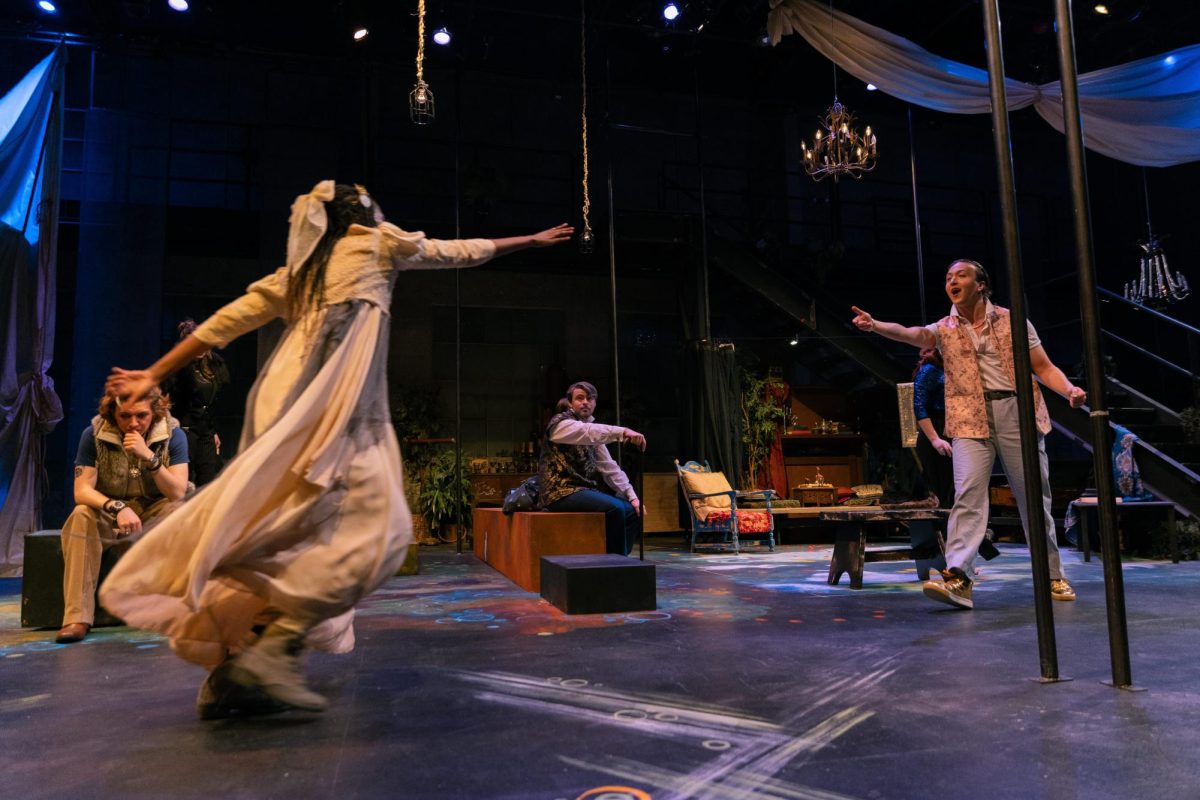
A decadent banquet of fish, sausages, bread and pastries topped with berries on silver platters is presented by masked figures to the starving survivors of a harrowing shipwreck. Just as the group decides to get a “taste of what is here,” darkness, crashing thunder and lightning explode, and the banquet vanishes.
A high, growling voice pierces through the storm as the crew draws their weapons and Ariel the harpy appears before them, spreading her glistening blue-white wings and condemning them for their sins, giving them only a formidable taste of what’s to come on this mysterious island.
The Seattle University Theatre Program’s production of The Tempest, celebrating the 20th anniversary of the Lee Center, begins with previews on Feb. 18 and 19 and performances Feb. 20-23 and Feb. 25 to March 1.
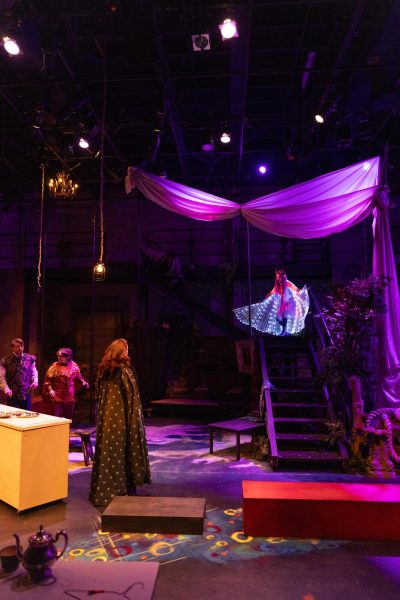
The Tempest follows Prospero, a powerful sorcerer, and his young daughter Miranda. They live on a remote island with Caliban, the only creature native to the island, and Ariel, a sprite, both of whom are enslaved by Prospero. Prospero was formerly the Duke of Milan before being usurped by his brother, Antonio, and the King of Naples, Alonso. Prospero works with Ariel to wreck a boat carrying Antonio, Alonso and his son, Ferdinand, and other court members, leaving the group stranded on the island.
Director Ki Gottberg and set designer Carol Wolfe Clay, both professors emeritus at Seattle University, returned to work on this production. Gottberg taught at Seattle U as an adjunct professor of theatre in 1984, was tenured in 2000, became a full-time professor in 2007, and taught until her retirement in December 2021. Gottberg returned to direct the Tempest in celebration of the 20th anniversary of the Lee Center.
The Lee Center is set to be demolished in August 2026 to make way for the construction of Seattle U’s Museum of Art (SUMA), an unpopular decision among the theatre department that was made without their input. Gottberg drew comparisons between the themes of vengeance and forgiveness in the Tempest and the plan to destroy the Lee Center, expressing her and the theatre community’s frustration, anger and sadness over the decision.
“For 20 years, we have consistently put on fabulous shows. We have brought in all different kinds of artists—milliners, directors, scenic painters, all kinds of people from the community. I’m here as a guest artist, a director, but of course I’m also a long-time teacher,” Gottberg said.
Fourth-year Environmental Studies major and Head of Wardrobe, Eliza Blythe, emphasized the value of this production as creating an “ecosystem” of cast, crew and technicians—all with defined roles, but with individuals often having multiple roles and working in multiple areas of production.
“I love the feeling of working hard to solve a problem, and then having there be another 12 million problems—but they’re all solvable and you enjoy doing them. That’s rewarding,” Blythe said.
Two professional actors were hired for this production: Reggie Jackson, who plays Prospero, and Cornish graduate Allison Renee, who plays Caliban. Gottberg emphasized the role of these actors as bringing a sense of professionalism, mentorship and connections to the professional world.
Shining student performances amongst an incredibly strong cast include Fourth-year Film major Bella Trevino as the compassionate but mischievous sprite Ariel, whose terrifying voice lilts and snarls throughout the theatre, contrasted with her sparkly blue boots, teal fishnet gloves and frequently bubbly demeanor.
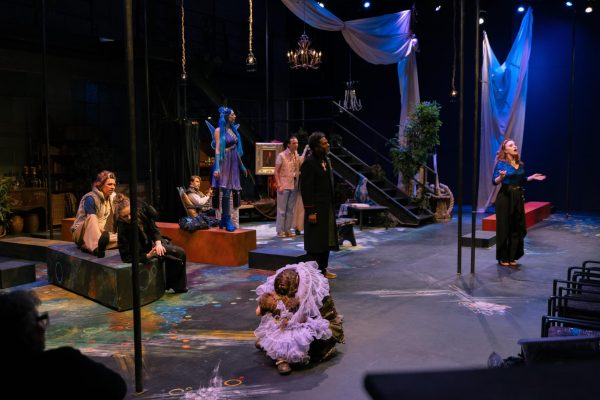
Third-year Theatre major, Theatre Communications Fellow and Props Assistant Lucy Johnson shifted seamlessly between her role as a fairy to her role as the evil Antonio in a 90-second quick change and the addition of a debonair mustache, pinstripe pants and a flamboyant but unmistakably threatening gait. Wielding a dagger in each hand at any sign of danger, Antonio provides a comedic yet deeply fearsome foe.
“I put a lot of sass into Antonio,” Johnson said. I really like making people laugh. Finding the places where I can add humor is very important to me.”
The larger scale of this production was reflected in Clay’s set design, particularly during the pivotal storm scene. With pillars crashing to the floor, flickering swinging chandeliers, and ropes and vines snaking across the stage and woven throughout the tall staircase, the audience is swept away into The Tempest.
An issue that often arises when putting on Shakespeare plays is the depiction of marginalized groups as caricatures present in many of his works. One example of this is Shylock in Merchant of Venice—a vengeful, money-hoarding and explicitly Jewish character. While some argue that The Tempest points out the evils of colonialism, others criticize Shakespere’s character Caliban as the colonizer’s idea of the “other.” The portrayal in this production, with a white actress in long braids, dreads and dark facial makeup, left me unsure about the intended message of the play.
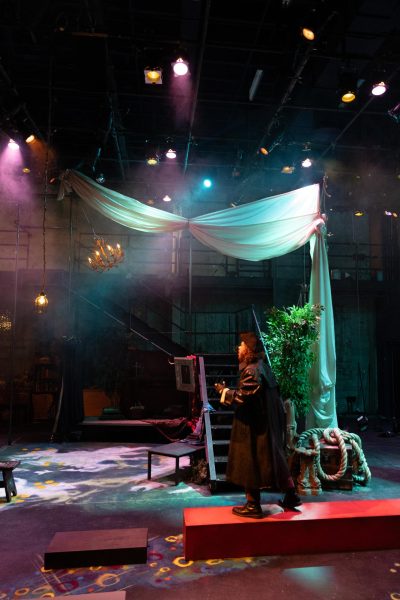
To enter the fog-shrouded scene of shelves full of books, silver chalices and dark wooden furniture that sets the scene for a storm of love, revenge and forgiveness, go see The Tempest at the Lee Center. Tickets are available online and are $12 for the general public, $10 for staff, and $6 for students.



![Peggy, Mink and Bladee Make Good on Threats to Drop Music [REVIEW]](https://seattlespectator.com/wp-content/uploads/2026/05/unholytrio-review-web-1200x900.png)










Hank
Feb 22, 2026 at 8:30 pm
I think that ultimately The Tempest is a meditation on how society proceeds in a compromised world. Everyone who has or seeks power in the play has been deeply compromised in some way.
I think the ultimate irony of this play, and the irony of colonialism im general, is that these people show up on this island HOPING and thinking that the island has no history–that the island is a blank slate. But! The dramatic and general irony is that this supposedly virgin island has this long and tortured history already. Prospero was there before Antonio. Caliban was there before Prospero. Caliban’s mother before Caliban. Ariel before all of them. Shakespeare’s play laughs at the idea that we can escape history, and then shows us the only way we actually can–through forgiveness and a recognition of our shared humanity: If we are to be free ourselves, we must release all those whom we hold in bondage; if we are to release everyone from bondage, we must release everyone from all debts, as Prospero releases everyone at tge end of the play. Listen, I don’t know which thespian hurt you, but as a matter of fact the quality of mercy IS, in fact, not strained; and we ARE, indeed, such stuff as dreams are made on.
Ki Gottberg
Feb 19, 2026 at 11:46 am
nice review! and living with ambiguity is an important aspect of careful consideration. Who is the ‘monster’ in this play? Maybe there are a few?