
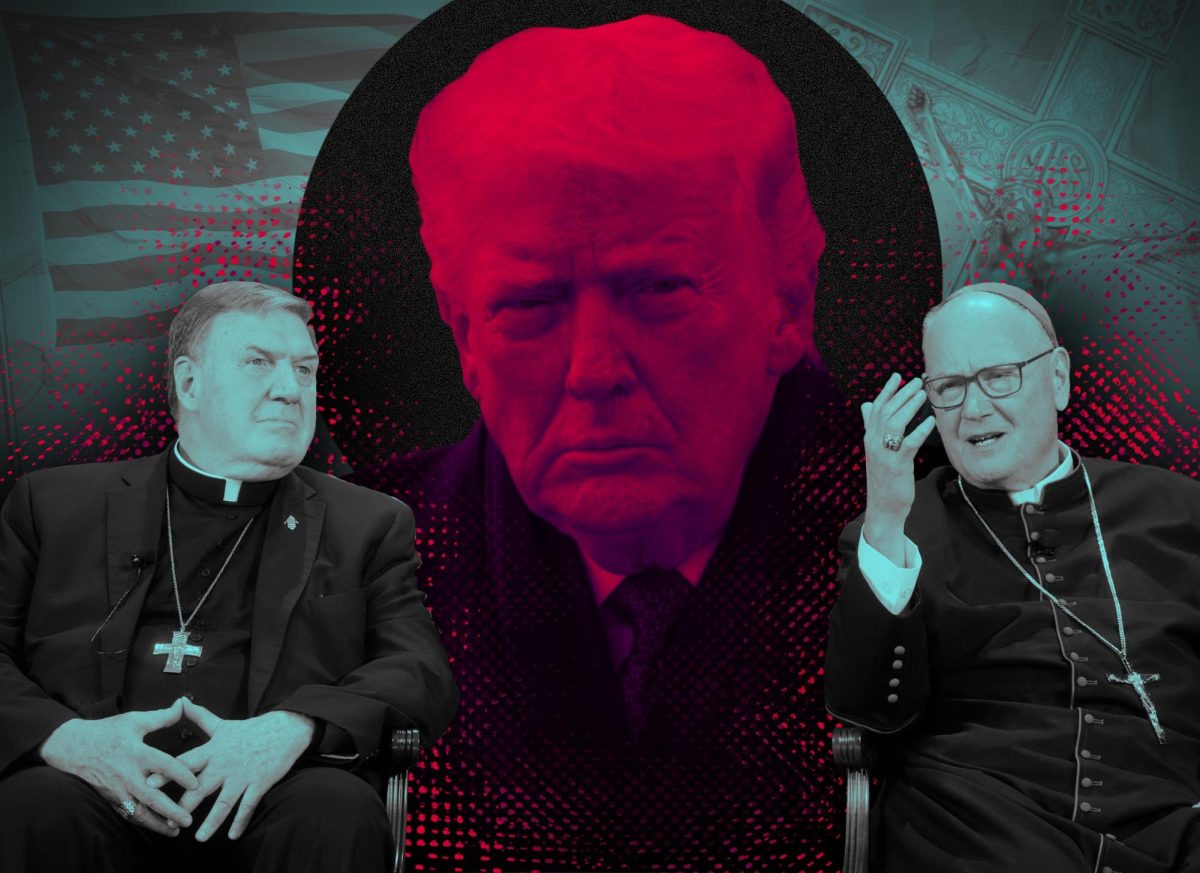
In response to the Trump administration’s threats to annex Greenland, the abduction of Venezuela’s sitting president and rapidly increasing deportation efforts through Immigration and Customs Enforcement (ICE), international and U.S. Catholic leaders have spoken out on multiple occasions against the Trump administration’s foreign policy stances and domestic immigration policy. These statements encourage Catholics everywhere, including Seattle U faculty and students, to reflect on the role of faith in national and global affairs alike.
Cardinal Blase Cupich, archbishop of Chicago, Cardinal Robert McElroy, archbishop of Washington, D.C. and Cardinal Joseph Tobin, archbishop of Newark, released a ‘rare joint statement’ last week condemning increasing pro-war sentiment and policy in the United States. They referenced Pope Leo XIV’s Jan. 9 address to the Diplomatic Corps, in which he urges the nation-states around the world to promote peace and follow humanitarian law, specifically mentioning the situation in Venezuela.
Brian Taberski, associate director for University Liturgy, Worship and Faith Formation and assistant clinical professor of theology & religious studies, approved of the joint statement and emphasized the importance of Catholic leaders speaking out in this current moment that he described as feeling “different” compared to the past.
“Scripture is pretty clear. We’re supposed to be treating the foreigner among us with hospitality. We’re supposed to be treating the immigrants among us with care and concern. Scripture doesn’t mince words, and Cardinals Cupich, McElroy and Tobin draw upon that quite well to remind us of that,” Taberski said, later adding, “When it reaches a critical moment where [Catholic leaders] feel compelled to say something, we’re likely served well to pay attention, because religious leaders tend not to be raging extroverts who publish every thought they have.”
Tobin and Cupich, Cardinals from the joint statement, have made statements in interviews condemning ICE and immigration policy in the United States. Pope Leo has referred to the treatment of migrants in the United States as “extremely disrespectful.” He has also been critical of Donald Trump and his Vice President J.D. Vance (who is the highest-ranking Catholic in the American Government) on social media, both before and after his election as Pope. Further, the U.S. Bishops overwhelmingly approved a special message that condemns U.S. immigration policy in November, their first special message since 2013.
According to a 2025 survey, more than 40% of U.S. Catholics are either immigrants or the children of immigrants.
This current period of Catholic leaders pushing back against U.S. policy doesn’t just prompt theologians to respond; it has also solicited reflection and response from Catholic students on campus.
Second-year English and Theater double major and practicing Catholic Eiryn Kilroy believes that the Catholic Church has been somewhat political and revolutionary for as long as it has existed, pointing out how Jesus was a radical who walked alongside the forgotten of the world.
“The truth is, and this has really gotten muddled by so much of what has happened in history, but the Catholic Church and the Catholic faith is deeply, deeply rooted in fighting back against what we think is unjust and what is wrong,” Kilroy said.
Kilroy said that they felt a sense of pride at the rise of Catholic leadership speaking out against Trump’s foreign policy.
“My hope is that Catholic leaders will continue to speak out against these violations of human dignity. I think that when our government or other governments’ politics harm humanity, that [Catholic leadership] not only should speak out but they must speak out,” Kilroy said.
Ivo Palazzo, a second-year political science major, also believes that it is necessary for Catholics to promote the upholding of rights that they believe people deserve based on Catholic moral principles and spiritual principles overall, though he displayed some concern that increasingly secular governments mean that Catholic moral principles have less sway on world events than they used to.
“When the state or the government strays from [Catholic moral principles], it’s the role of the Church of the bishops as caretakers or as shepherds to speak up for the rights of their people,” Palazzo said, later adding, “In the modern day, when you have governments which are secular and reject all religious authority, there’s not much religious leaders can actually do about situations like this,” Palazzo said.
While the ultimate efficacy and impact of their statements will only be clear in retrospect, it is significant that multiple religious leaders in the Catholic community, all the way up to the pope, have chosen to explicitly condemn recent actions taken by the U.S. administration.