
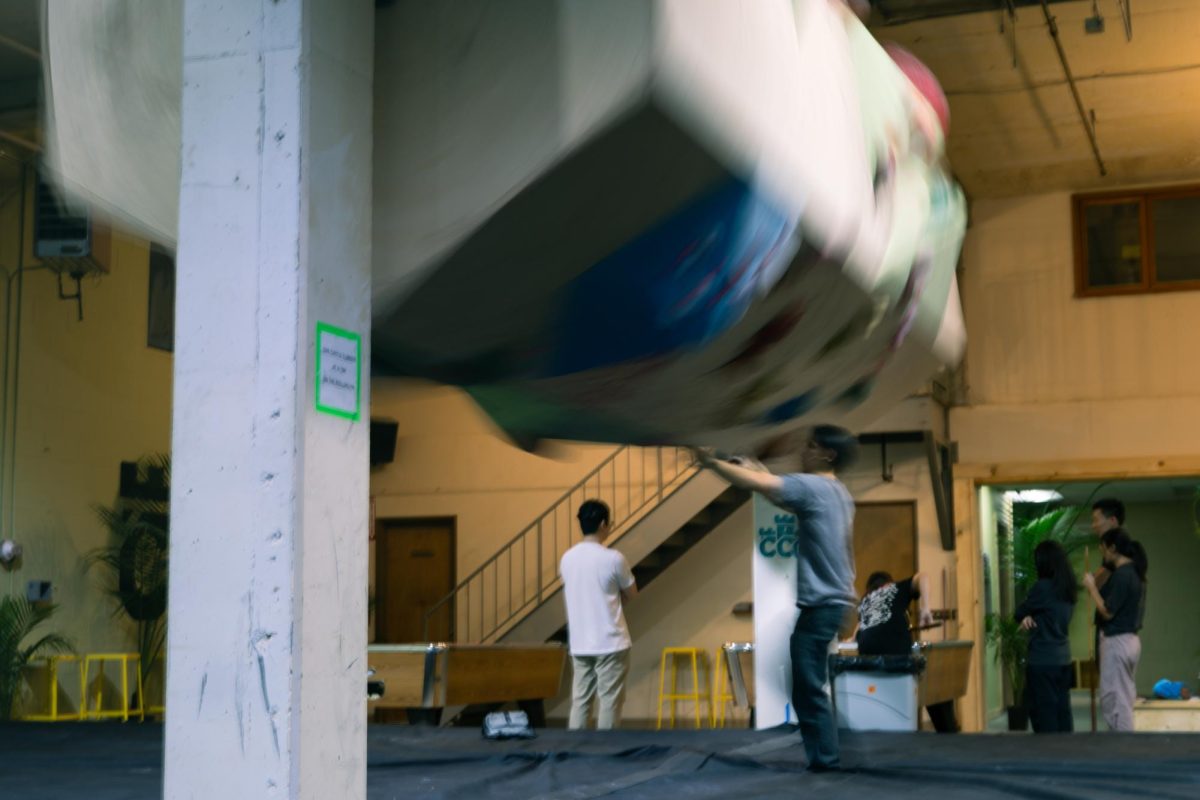
Seattle’s new climbing gym and community space Castle Climbing Club (CCC) became a social media sensation for its ‘rotisserie climbing wall,’ a rotating, wheel-like climbing challenge, garnering over 40 million views and 900K likes, but it isn’t the only thing the new space has to offer. The West Seattle gym, which had its soft opening Jan. 1, is an out-of-the-box take on both a climbing gym and an adult-centered third space.
In addition to the standard routes in their large climbing space, CCC also offers special features, including the exceedingly viral “Rolling Pin” (which they have depicted on free stickers at the front desk), a roulette-wheel climbing feature, and a climb made entirely out of skateboard parts. They also have a sauna and a cold plunge, along with adult-sized swings for resting between climbs, a board game room, pool tables and an air hockey setup.
For Kayden Kruchowski, a front-desk worker at CCC, the gym’s non-climbing fixtures are what make it special.
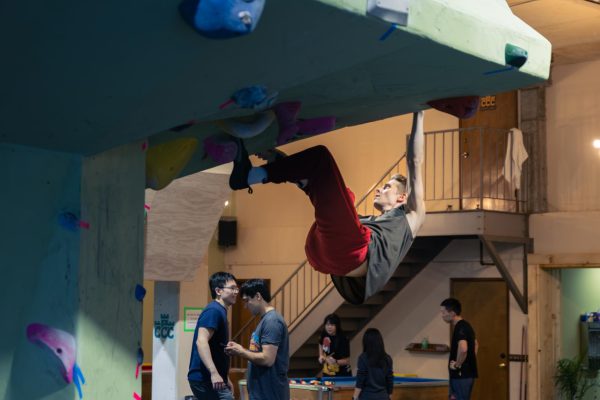
“The fact that the owners wanted it to be more of a third space and not just a workout place makes it unique. Eventually, they want to hold classes of different sorts, like art classes or just random stuff, and have it be an actual club and community, not just a gym,” Kruchowski said.
The club’s goal of being an adult-oriented third space isn’t just in name, but in policy. Many areas are closed off to kids, and no one under 18 is allowed in the gym after 8 p.m. The hours are also adult-focused, with CCC open from 9 a.m. to midnight on weekdays and noon to midnight on weekends—making it the only Seattle climbing gym to be open during late-night.
CCC’s unique approach may help it compete with the bevy of already established gyms in the Puget Sound region. Seattle is home to Vertical World, the oldest climbing gym in the United States, and is the birthplace of the extremely popular Bouldering Project chain, with three Seattle Bouldering Project (SBP) gyms currently open.
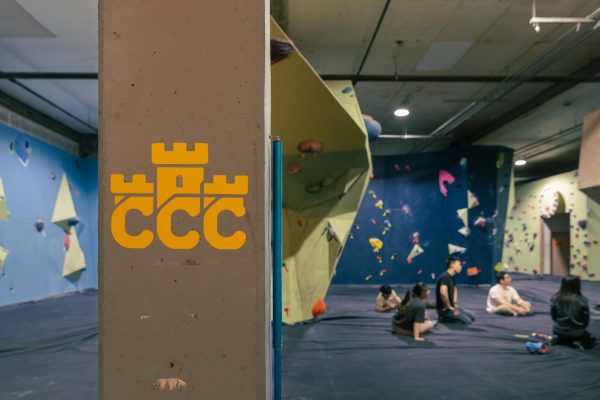
CCC uses the same grading scale as the Bouldering Projects, where colors represent grade ranges as opposed to climbs receiving an individual grade. Despite the similarity, the two gyms couldn’t be more different in style. While the Bouldering Projects use uniform hold colors and styles in their climbs, CCC’s color grading is marked by tape on the holds, allowing them to use a wide variety of colored and styled climbing holds, many of which are vintage or handmade.
For some people, the varied hold styles and colors evoke nostalgia of small, independent old-school gyms that can be hard to find in the increasing popularity of indoor climbing and commercialized, massively marketed gyms.
Kruchowski said many visitors have said that CCC reminds them of the gyms of their past, and shared her own appreciation of the eclectic, rough-around-the-edges style.
“I think it’s like a pretty old-school style gym, but I think it’s cool and a lot of people say it reminds them of their gym from home or some, their childhood,” Kruchowski said, later adding, “I like that all the climbing holes are sourced from different times and people, and a lot of them are handmade. They get really creative.”
Richard Huang, an SBP member who recently visited CCC, appreciated the facility’s creativity and how the less-inflated, more accurate, grading made the gym more fun. He also emphasized that the gym’s improvements and additions over time made him excited to revisit.
“You can tell [CCC] is soft launching; you can still smell the construction here. So, after a lot of it tapers down, I will definitely check it out again,” Huang said.
As part of their soft launch, CCC is offering discounted memberships as their ‘FOMO Sale.’ A pre-opening monthly pass is $69 and after the sale, it will increase to $110 per month, which is comparable to other gyms in the area. For a prepaid annual membership, the cost breaks down to $58 a month, which is very competitive and convinced some users to switch before the gym even opened, especially if they live in West Seattle and are far from most other gyms.
A new member at the club, James Whalen’s interest was initially piqued by the social media buzz, but it was the extremely affordable membership that hooked him in; he promptly switched to CCC.
“They were blasting the founding membership. I did the annual founder’s one, which ends up being $50 a month, and SBP is $100 a month,” Whalen said.
While day passes are normally $25, Seattle University students receive a $10 discount at the time of publishing. University Recreation is also running vans to CCC, which is otherwise out of the way for Seattle U students without cars.