
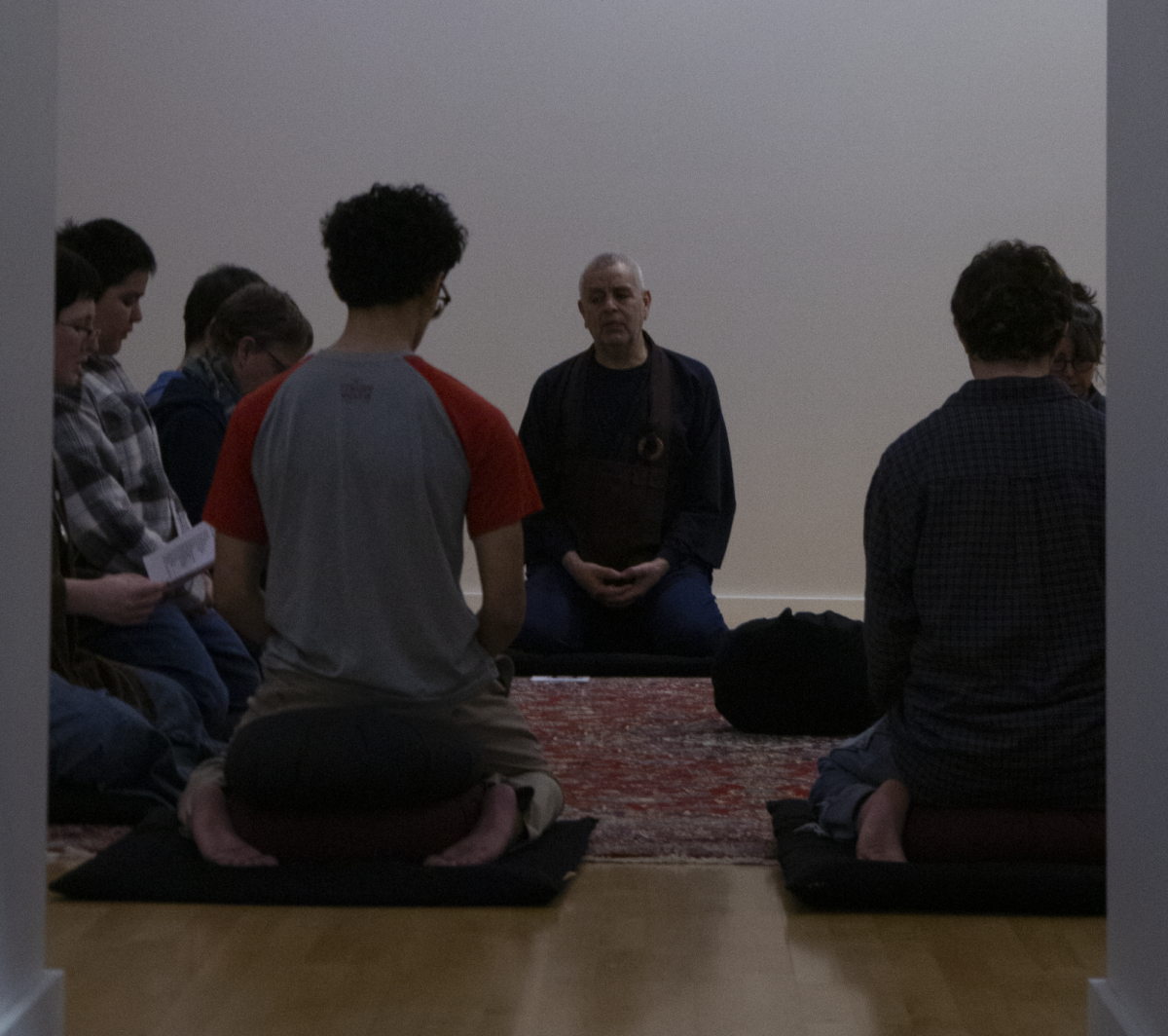
In the multi-faith prayer room located in Campion residence hall, Seattle University’s Buddhist meditation group, EcoSangha, gathers every Wednesday. The air is slightly hazy with wisps of burning incense, making the room dim. Prayer mats line the floor, and conversations slowly fade into silence.
Following a quarter-long sabbatical, on-campus club EcoSangha, a traditional Zen practice group, returns to Seattle U for its 20th year of on-campus, faculty-led group meditation sessions.
The theological borders of EcoSangha are not a barrier. In fact, none of the members of EcoSangha are Buddhists except for Professor and Chair of the Philosophy Department, Jason Wirth, and Senior Administrative Assistant in the Center for Jesuit Education, Eddie Salazar. The practice group welcomes Buddhists and non-Buddhists alike to an hour-long meditation.
EcoSangha began informally on campus in 2005, after a Buddhist Philosophy course taught by Wirth left students seeking a greater degree of involvement with the tradition.
“In the fall of 2005, I taught my Buddhist philosophy class, and for all the obvious reasons of conflict of interest, meditation is not part of it,” Wirth said. “We just read text, and we read these things as philosophical arguments. But at the end, the students came up to me and said, ‘We want to sit seriously.’”
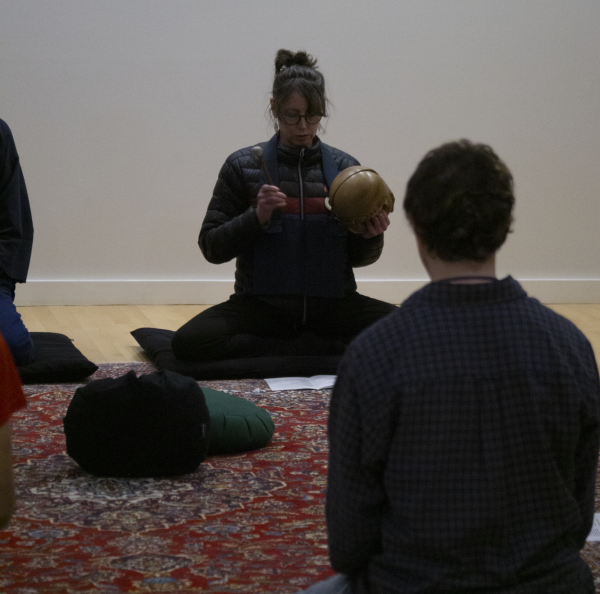
After meeting in backyards and attic apartments for a few months, Wirth, working alongside Salazar, established EcoSangha as an official on-campus club in the winter of 2006. Since then, the group has held weekly meditations aside from this previous fall, as Wirth was in temporary medical recovery for a bilateral ankle fusion.
Salazar, whose relationship with Buddhism began after falling out with the Catholic church in 1997, described the beginning of his commitment to Zen Buddhism as one influenced by the adversity he faced growing up because of his identity. As a gay Latino, his relationship to the Roman Catholic church was difficult to navigate and eventually Buddhism presented itself as a spiritual alternative.
“When my Catholic world was crashing and burning, something was calling me toward Buddhism. I started reading about Buddhism, and I started visiting temples,” Salazar said. “Especially Zen; Zen is very liturgical and ritualistic and mystical. That felt comfortable for me as a Catholic.”
For each quarter of EcoSangha, a theme is selected by student leaders to guide club members throughout their practice. Previous themes have included “doubt as a doorway,” “the beginner’s mind,” and “interbeing.”
Mira Martin, fourth-year civil and environmental engineering major and EcoSangha president, chose the club’s theme for the quarter: “What is thought without a brain?”
At their last session, Martin gave a Dharma talk introducing this theme, exploring ever-present natural intelligence and ever-growing technological intelligence. Every member and advisor of EcoSangha has the opportunity to lead the club in a Dharma talk focused on the theme each quarter.
“I really enjoyed the talk that Mira gave. She brought up a lot of really interesting concepts about plants and plant consciousness. I think meditating before hearing that talk put me in the right headspace to think about those ideas a little more deeply than I would have probably otherwise,” Third-Year Environmental Studies Major Danny Herre said, after attending his first group-meditation.
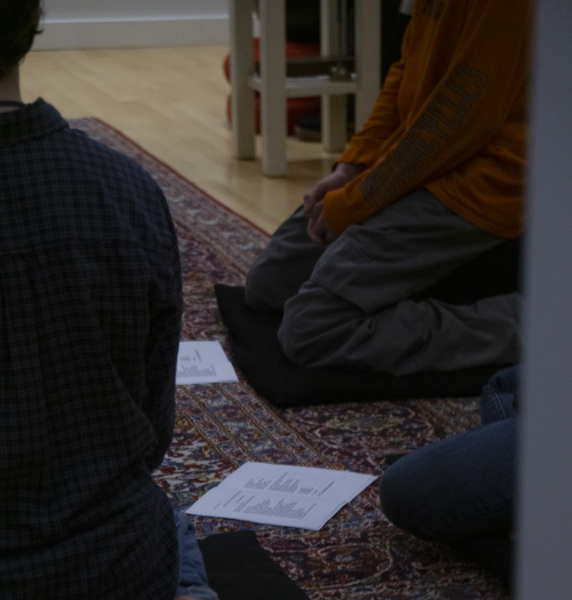
While EcoSangha values meditation for its intrinsic principles, there’s also something to be said about how EcoSangha uses meditation to reshape the relationship between humans and all other living things.
“We have to remember that Sangha has been, from the beginning, about a very different relationship with ourselves, with each other and with all things,” Wirth said. “Not only are we at war with [Earth], but we’re inseparable from it. No earth, no human beings… We need deep practice of going to the depths of our consciousness to realize more fully who we are and what it is to be here and now with all things and as all things.”
Any student who has taken a course with Wirth has likely encountered his belief that the battle against climate change is not merely a matter of politics, but a spiritual war that requires relinquishing our attachment to the life we want and embracing the life we have. As the environmental crisis becomes of increasing concern in the modern world, and political intervention continues to fall short of altering its trajectory, EcoSangha encourages students to look within for a more appropriate solution to climate change.
EcoSangha meets every Wednesday at 7 p.m. in the Campion multi-faith prayer room, and is open to all Seattle U community members.

![Peggy, Mink and Bladee Make Good on Threats to Drop Music [REVIEW]](https://seattlespectator.com/wp-content/uploads/2026/05/unholytrio-review-web-1200x900.png)