

On the top floor of King Street Station, a blue hurricane relief tarp hangs on a white wall. “Discover Puerto Rico,” a popular tourism slogan, is printed in large, flowery cursive in the center. Suddenly, UV light flickers into view across the tarp, revealing the message hidden underneath in bold lettering: “GRINGO GO HOME.”
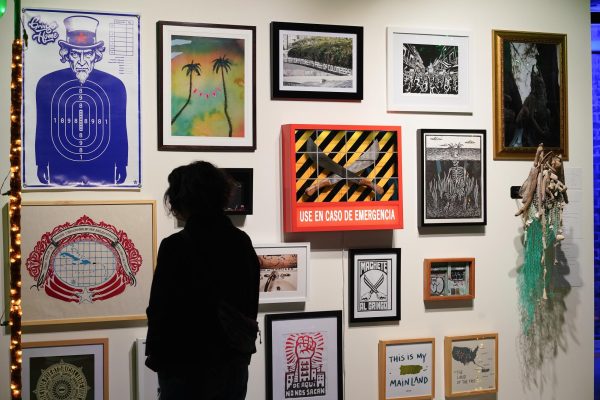
This piece, among many others, is a part of the exhibit currently on display inside the Arts at King Street Station Gallery: “Welcome to Paradise: ¡Viva Puerto Rico Libre!” Through a multimedia collection featuring the works of 31 artists from the Puerto Rican archipelago, the exhibition examines the tension between North American perceptions of Puerto Rico as a vacation destination and the reality of United States imperialism, disaster capitalism and tourist complacency.
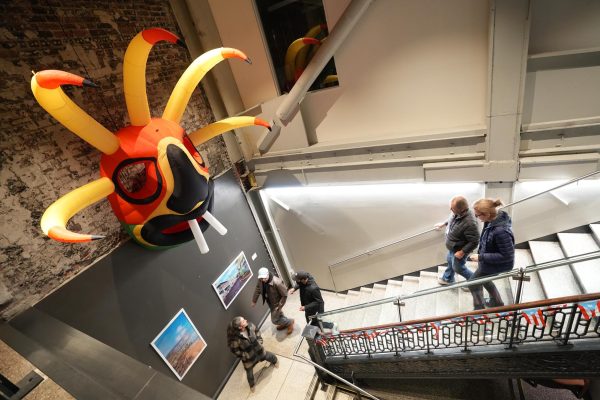
Seattle-based solo artist Jo Cosme created most of the art in the collection, as well as curated the other featured artists. After being displaced to North America from Puerto Rico following Hurricane Maria, Cosme was struck by the lack of knowledge surrounding the United States’ control and oppression of the archipelago. Using mediums ranging from lenticular prints to cyanotype to interactive performance art, Cosme has created a body of work that is both educational and emotionally impactful.
Juan Roman, one of the featured artists who goes by the artist name “NEPO,” created two silkscreen prints for the gallery. “Nadie es illegal en tierras ocupadas,” translating to “No one is illegal on occupied land,” focuses on the oppression faced by the Dominican community in Puerto Rico, particularly with recent ICE raids under the Trump administration.
Roman’s second piece, titled “Siembra,” translates to “sowing,” and depicts two young girls farming—a symbol of self-sufficiency in the face of colonialism. Typically a commissioned mural artist, Roman was eager to create work that reflected his own story.
“I was feeling like a hypocrite doing art that doesn’t have a message,” Roman said. “Just decorating these walls or making pretty pictures so people can hang at their home is the way that we make our living… Of course, you get less work because you make these stands and try to support these issues. But it’s something that I’m willing to sacrifice for having our voice.”
Another featured artist, Seattle-based Jorge Mattei, created a piece titled “Soberanía del Pueblo,” which translates to “Sovereignty of the People,” a digital illustration of a raised fist with the Puerto Rican flag painted across it.
“It’s a pro-union message advocating for justice for the working people, the working class.” Mattei said. “It has four points: ‘the beaches are for the people,’ ‘fair salary,’ ‘renewable energy’ and ‘environmental protection.’ These are all things that are not necessarily compatible with capitalist imperialism… It’s a socialist perspective.”
Cosme’s exhibit focuses on allowing audiences to learn about Puerto Rico from native voices—throughout, QR codes lead viewers to educational materials on the history of colonialism in the archipelago and links to mutual aid centers.
One of Cosme’s standout pieces, “Domi(woes) of a Caribbean Colony,” is an interactive domino game that explores relations between the U.S. government and Puerto Rico’s major political parties. The piece was created using plywood, aluminum and tarp—all materials used for relief during Hurricane Maria—highlighting the Trump administration’s slow response to the devastating disaster. The top of the table is an active hurricane symbol carved into brass, intended to grow increasingly tarnished and scratched as the game is played, demonstrating the cumulative damage sustained through centuries of imperialism.
Players will be assigned the roles representing each party: The New Progressive Party (who want statehood), the Puerto Rican Independence Party (who want independence), the Popular Democratic Party (who want to remain a U.S. territory, but with more autonomy) and the United States The game is rigged from the beginning; through no fault of the other players (representing the people of Puerto Rico), the United States will inevitably win every time.
Cosme had concerns over how this exhibition would be received in an era of mass censorship and suppression of marginalized voices. While the gallery has had an overall positive reception, Cosme acknowledges that this suppression indicates the importance of elevating Puerto Rican voices and experiences.
“I didn’t want to put anybody at risk in the gallery,” Cosme said. “But if any time should be the time to have this show, it’s right now… because maybe two years, three years from now, I can’t. Having had all this anti-Latino rhetoric coming up, Puerto Rico being re-militarized by the U.S. right now and Venezuela being targeted—I need to do this show right now, I can’t pull back.”
“Welcome to Paradise: ¡Viva Puerto Rico Libre!” will be on display through Jan. 10, 2026. Documentary screenings, domino tournaments and guided tours with Cosme will be held throughout the show’s run. Upcoming events include a domino tournament Dec. 4 from 6:00 p.m. to 8:00 p.m. and a screening of the documentary “Drills of Liberation” Dec. 6 at 3 p.m., and more can be found on Cosme’s Instagram. The gallery is free to visit.

![Peggy, Mink and Bladee Make Good on Threats to Drop Music [REVIEW]](https://seattlespectator.com/wp-content/uploads/2026/05/unholytrio-review-web-1200x900.png)