

Entering the Kraken Community Iceplex on Sundays between 2 p.m. and 4 p.m., you’ll be surrounded by the familiar sounds of pucks against ice. This isn’t your average hockey game, though: players rocket across the ice with a pair of sticks not unlike skis, steering a sit-down sled with precision. This is sled hockey, a version of the sport designed to give players with disabilities an opportunity to compete in the rink.
Sports, like a number of other hobbies, are often inaccessible to people with disabilities. Activities like hockey or basketball are not designed with disabled people in mind, and while that’s not necessarily intentional, athletes with disabilities are not often given the opportunity to participate in sports.
One organization has been working to change that. Seattle Adaptive Sports, a nonprofit founded in 1970, has been creating opportunities for such athletes to participate in sports specifically designed for them.
The organization began over half a century ago as the Spina Bifida Association of Puget Sound, a group that supported families and people with spina bifida, a congenital condition that can be disabling. Soon after, the group added adaptive sports like track & field and swimming to their offerings. Later, as the organization added more activities to their roster, they rebranded to Seattle Adaptive Sports (SAS).
SAS has introduced a variety of sports programs throughout the years and currently offers four: power soccer, wheelchair basketball, goalball and sled hockey, which is currently in season. These teams, most of which have youth and adult divisions, provide opportunities for people with different disabilities to participate in sports. SAS hosts sports for all different types of people, including but not limited to wheelchair users, people with limited mobility and blind and low vision athletes. While the sports that SAS offers have changed over time, the organization’s inspiration hasn’t.
“We’re creating outlets that don’t exist for disabled people,” Thom Youngblood, board president of Seattle Adaptive Sports, said. “We’re concentrating on creating the ability for people with disabilities to play sports.”
However, physically accessible sports are not always financially accessible. Most adaptive adult sports are prohibitively expensive to enter. A custom sled for sled hockey can cost anywhere from $600 to $1,000, and goalball balls can reach close to $100. Luckily, SAS offers opportunities for participants whose finances may be a deterrent.
“There are definitely some adaptive sports I can’t afford to do,” Amy Wiegand, sled hockey player and SAS secretary, said. “For us, we don’t want that to be a barrier.”
A $75 yearly membership fee at SAS grants members access to all of their adaptive sports, equipment, coaches and (usually weekly) practice time on the court, field,or ice. The relatively low cost of participation means that SAS has seen a fair amount of growth over the past few years. The sled hockey team grew from only six members to 21 in the last three years. According to players, that growth has greatly benefitted the team.
“It’s the only adaptive sport I’ve found that allows me to feel like anyone else,” Jonathan Plummer, a member of the adult sled hockey team, said. “It doesn’t feel like adaptive hockey—it just feels like hockey.”
Sentiments like Plummer’s have inspired SAS to continue to expand their programs. Earlier this year, they announced plans to begin a beepball team in Seattle for the 2026 season. Beepball, also called beeper ball or beep baseball, uses balls and bases that make loud “beeps,” allowing those with low vision or blindness to participate in America’s Pastime.
SAS is not going to slow down their growth. They plan to continue testing community interest in adaptive pickleball, an iteration of pickleball that allows more than one bounce and includes other court alterations, while they begin the beepball team’s season. While there are no concrete plans after that, board members have ideas. Wiegand mentioned adaptive fencing, a Paralympic sport where the athlete is secured in a wheelchair in a fixed frame, as a potential future addition to the roster.
“I would love to see Seattle Adaptive Sports grow the program more, and be able to sustain it and hopefully even add more divisions,” Wiegand said.
No matter what direction SAS chooses to take, Youngblood says that he—and everyone else in the organization—will continue to be motivated to uplift and include the disabled community in all they do. SAS continues to work towards creating an environment where everyone feels as though they can do more than belong. In adaptive sports, they can thrive.
“There’s nothing more fulfilling than getting folks out on the ice and seeing them realize, ‘Hey, I can do this,’” Youngblood said. “Seeing that joy? That’s what I do it for.”
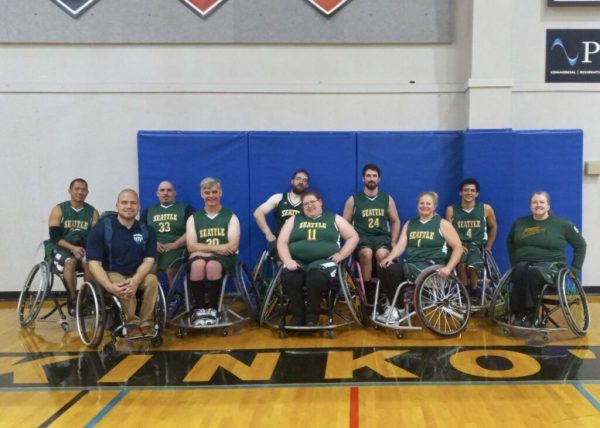
(Seattle Adaptive Sports)