
While many children create gingerbread houses during the holiday season, few have the opportunity to construct larger-than-life masterpieces designed by professional architects. However, each holiday season, a select four children diagnosed with type 1 diabetes from nonprofit Breakthrough T1D’s Pacific Northwest Chapter get to do exactly that. The children are chosen to be “elves” who help architects design and assemble candy concoctions that go on display at the Sheraton Grand Hotel for all of Seattle to see.
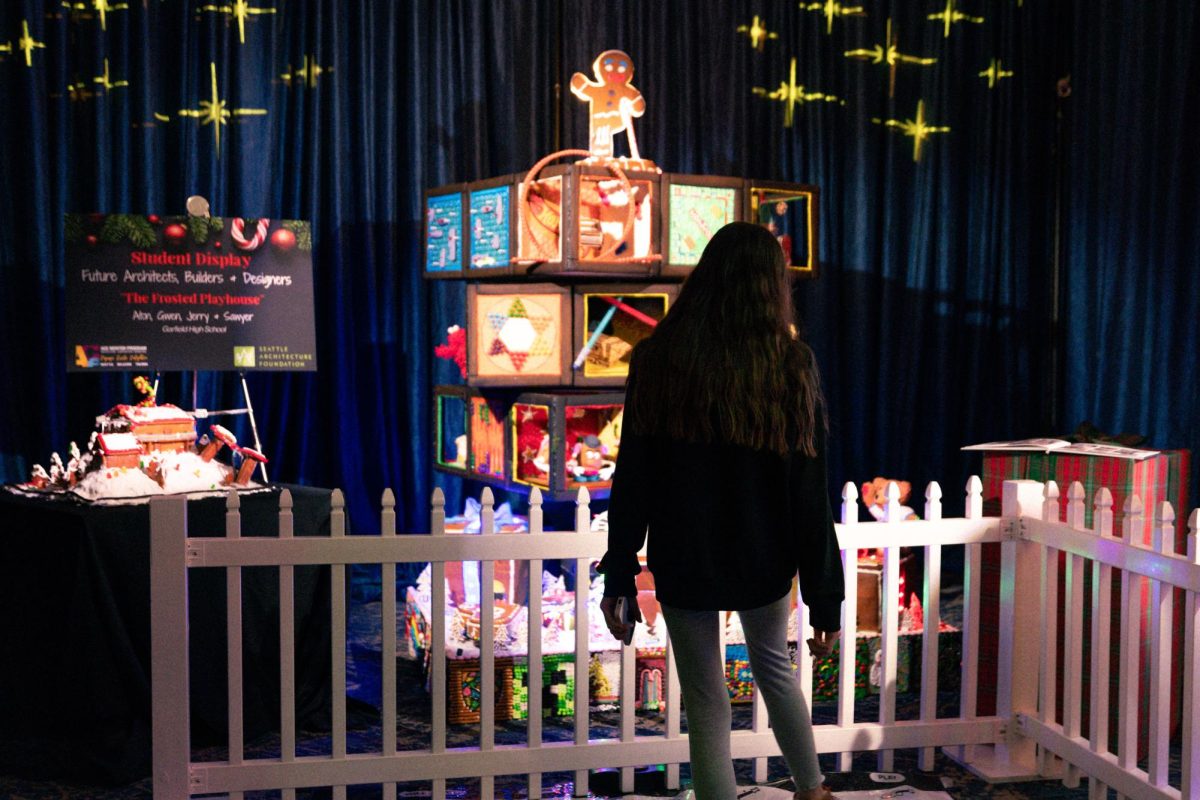
In the tradition’s 31st year, the Sheraton Grand Hotel is hosting Gingerbread Village, a fundraiser benefiting the Northwest Chapter of the Juvenile Diabetes Research Foundation. While the village originated with many small gingerbread houses, over the years it has been reduced to around four to six structures, each towering at over six feet tall. An abundance of gingerbread, cookies and candy are assembled in ways never before seen. In one structure, frosting cascades over tree branches stretching above flowers with jelly bean stems growing in graham cracker soil, while another features a winding racetrack of gummy worms and sour ropes.

Stevie Kepple, development director at Breakthrough T1D, spoke on the uniqueness of this event.
“It’s been such a staple, and it has the longevity that maybe some other holiday events in the area don’t quite have,” Kepple said.
The process of creating this display is long. Children apply to be elves in May, and they meet the architects they work with in June or July. Kepple said that when choosing elves, the directors try to find children with diverse experiences with T1D.
“Type one diabetes looks different for all sorts of people,” Kepple said. “Some of these kids were just diagnosed in the past year, and some have had type 1 diabetes for a number of years.”
The participating architecture firms in the 2025 Gingerbread Village included Arcadis, MG2 and 4D, with Milbrandt Architects joining for the first time. Although the overall theme for this year’s village is “Toy Shop Time Machine,” Milbrandt was specifically assigned “Pop Culture Explosion” for their display’s theme. Other creation titles include “Doll Revolution,” “Tech Toy Takeover” and “Timeless Treasures.” “Pop Culture Explosion” features a large rotating Rubik’s Cube, and showcases various childhood games and toys in each square, ranging from classic board games like Chutes and Ladders to iconic franchises like Star Wars.

Milbrant’s managing principals, Anna Thompson and Jim Lawler, oversaw and executed the vision for their display. The pair enjoyed the Rubik’s Cube design because it allowed each person to have their own part of the project.
“We each get to showcase our own little creative world in this little small piece that comes together as one big whole, and we get to put everybody’s creative juices to work,” Lawler said. “The most exciting part was to see other interests and skills that [architects] don’t use in the day-to-day.”
Lawler also said that one of the most impactful parts of his involvement in the program was seeing the kids’ reactions to the final product.
Sure enough, plenty of children were milling around the gingerbread-scented hotel, admiring the elaborate village with mouths open in awe. Some creations even had moving aspects, such as a Barbie Dreamhouse with its moving elevator and a gingerbread Thomas the Train chugging along licorice tracks.
One of these young spectators was named Thad, who coincidentally happened to be the son of an architect. His favorite of the designed structures was the one created by Milbrandt, specifically the square dedicated to the movie “Gremlins.”
Lawler and Thompson also emphasized the impact that working with children diagnosed with T1D had on them. Thompson, whose cousin has T1D, was grateful for the opportunity to help a cause so close to home.
“It’s a vast difference in progress they’ve made in the past 30, 35 years, which is exciting to see now that we’re able to help them in their fundraising goals in this really fun way,” Thompson said.

Breakthrough T1D recently funded a clinical trial that confirmed the theory that Tzield—the first T1D therapy to be disease-modifying—can slow the progression of T1D.
Lawler showed immense appreciation for working directly with children who have T1D, saying it helped him return to the reason that they were doing the project in the first place.
”[People] may have gone there to see a gingerbread village thinking of the holidays, and they walk away with an understanding of, ‘Oh, there’s this thing that’s out there that a lot of people are dealing with, and they have to overcome all these difficulties to have a normal life,’” Lawler said.
The Gingerbread Village is located at the Sheraton Grand Hotel on 1400 6th Ave, Seattle. It is open for visitors until Jan 1. 2026, and hours are 9 a.m. to 9 p.m. Sunday through Thursday and 9 a.m. to 11 p.m. Friday and Saturday. Entry is free, but donations are encouraged.

![Peggy, Mink and Bladee Make Good on Threats to Drop Music [REVIEW]](https://seattlespectator.com/wp-content/uploads/2026/05/unholytrio-review-web-1200x900.png)