

Since its inception, rock climbing has been a sport of extremes. Training in secluded basements, venturing into remote wilderness and climbing alone on sheer cliff faces gave climbers and the sport an exclusive reputation. Boulderfest, the flagship event of the Bouldering Project climbing gyms, is part of their push to change that. This year, Seattle’s Boulderfest took place at the Poplar location Nov. 7-8.
Seattle Bouldering Project (SBP) was the first of the Bouldering Project’s chain. Started at Poplar in 2011, they were the first gym to exclusively offer bouldering (non-roped climbing), lowering the entry barriers for prospective climbers. The chain has since expanded to 13 national locations, with three in the Seattle area.
Boulderfest is a hybrid community event and climbing competition held every year in various Bouldering Project locations. The main element of Boulderfest is the competition, though they also host community vendors, a hot spring and cold plunge, raffles and flash tattoos.
The competitions were split into four divisions, with each division featuring men’s, women’s and non-binary categories. Climbers attempted to climb 30 boulders within their difficulty grade range, completing as many as possible and tracking their attempts. Volunteer judges acted as witnesses and confirmed when a climber completed a route.
Open division, which featured the hardest boulders, allowed climbers to qualify for the event finals and compete for cash prizes. There were also Beginner, Intermediate and Advanced divisions, where climbers competed for raffle tickets and the chance to win prizes, including climbing gear, Yeti coolers and Arc’teryx jackets.
Gabrielle Grimm, the event coordinator for Boulderfest, emphasized that the accessibility of the community sessions and competition format is tied to the Bouldering Project’s revolutionary approach to the sport.
“We’re kind of known in the climbing space as being incredibly beginner-friendly and accessible. Boulderfest itself as a competition is unique in the way that it is not about how you can compete against other competitors… it’s not about podiuming or placing, as much as just having fun and celebrating climbing itself,” Grimm said.
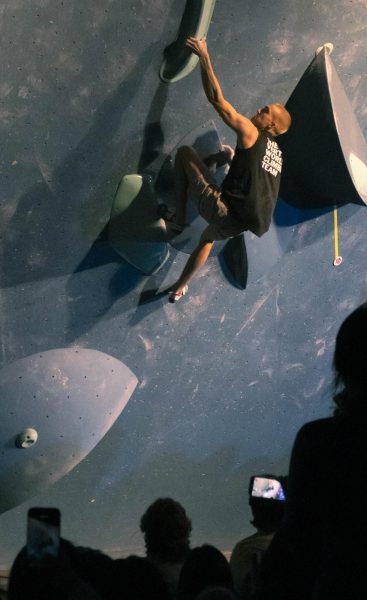
For climbers at the event, this goal was certainly successful. Sarah Nasson, a member of the adult climbing team at SBP and competitor in the Saturday afternoon community session, raved about her Boulderfest experience.
“The community aspect was so critical and the positivity was really important for me, and I ended up feeling really good,” Nasson said, later adding, “That sort of culture is so critical for me in my adult life, as I played D3 soccer in college and did not do anything competitive afterward because I just had this weird relationship with sport.”
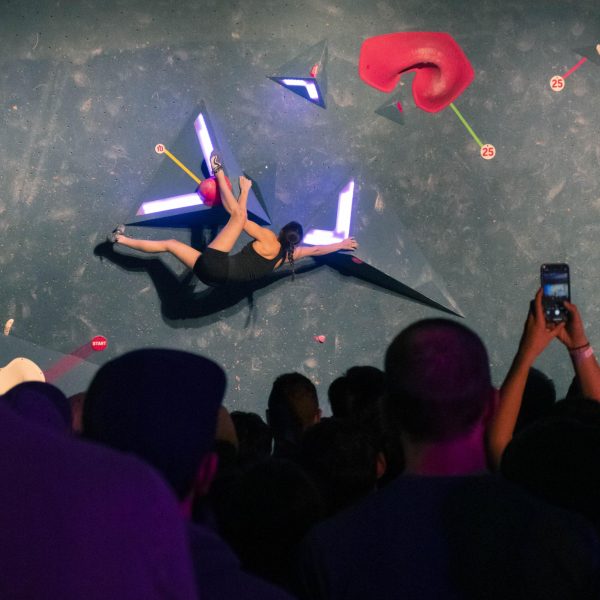
The Open division brought a more traditional climbing competition feel. They had their own qualifier on Friday, and the top six climbers in each category advanced to the finals on Saturday night. In the finals, competitors had four minutes per boulder to climb three different boulders, with points earned through starting, reaching a designated hold and completing.
Morgan Young, SBP’s head routesetter, said that Boulderfest is one of the highlights of the year for routesetters. The competition requires a limited set of boulders that include a variety of styles and movement patterns, offering routesetters an opportunity to be extra intentional.
Some of the strongest climbers in Washington come up to the competition, so setters need to use their full toolkit to design quality climbs that they themselves can’t do.
“Routesetters in their own nature are really good at doing singular moves and knowing what people are capable of,” Young said. “We can feel the holds in our own capacity, and watch someone stronger and go, oh, they did that easily. We kind of put those things together.”
Saturday night, a crowd rushed up to the main room where spotlights and music set the stage for the final showdown. The crowd reacted to each of the climbers’ successes and failures, encouraging them to top the boulders through yells and cheers.
At the end of the event, the top three climbers in each category received their prizes. First place won $1500 , second won $600 and third took $300. Each also received a handmade climbing-wall-themed mug that an SBP staff member made.
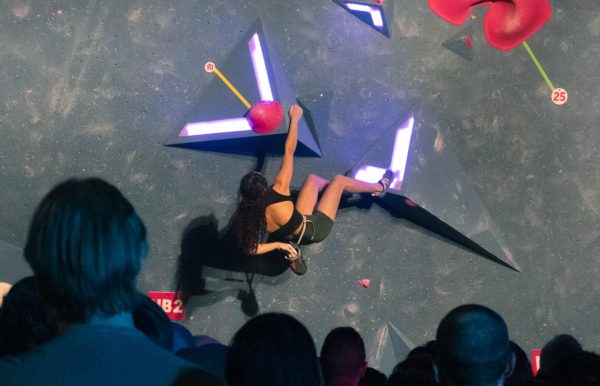
Sergey Lakhno, winner of the men’s competition, was happy to see that three of his teammates on the Vertical World climbing team made it to the finals with him.
“It’s probably the local comp that I care the most about, because I grew up watching it, watching the finals and being psyched, and now I’m competing in it,” Lakhno said.
Alex Johnson, a former World Cup winner, accomplished professional climber and Boulderfest regular, shared how positive the finals experience was. In addition to making the finals, she coaches the first and third-place Women’s finalists, Melina Costanza and Ava Kovtunovich.
“Every girl that we compete with here is a friend, and it’s super fun, and so everyone’s in the back high-fiving and it’s a really cool vibe,” Johnson said.
From the Open to the Beginner divisions, the vendor showcases to community events and everything in between, Boulderfest was a moment to experience the joys of climbing, no matter who you are.