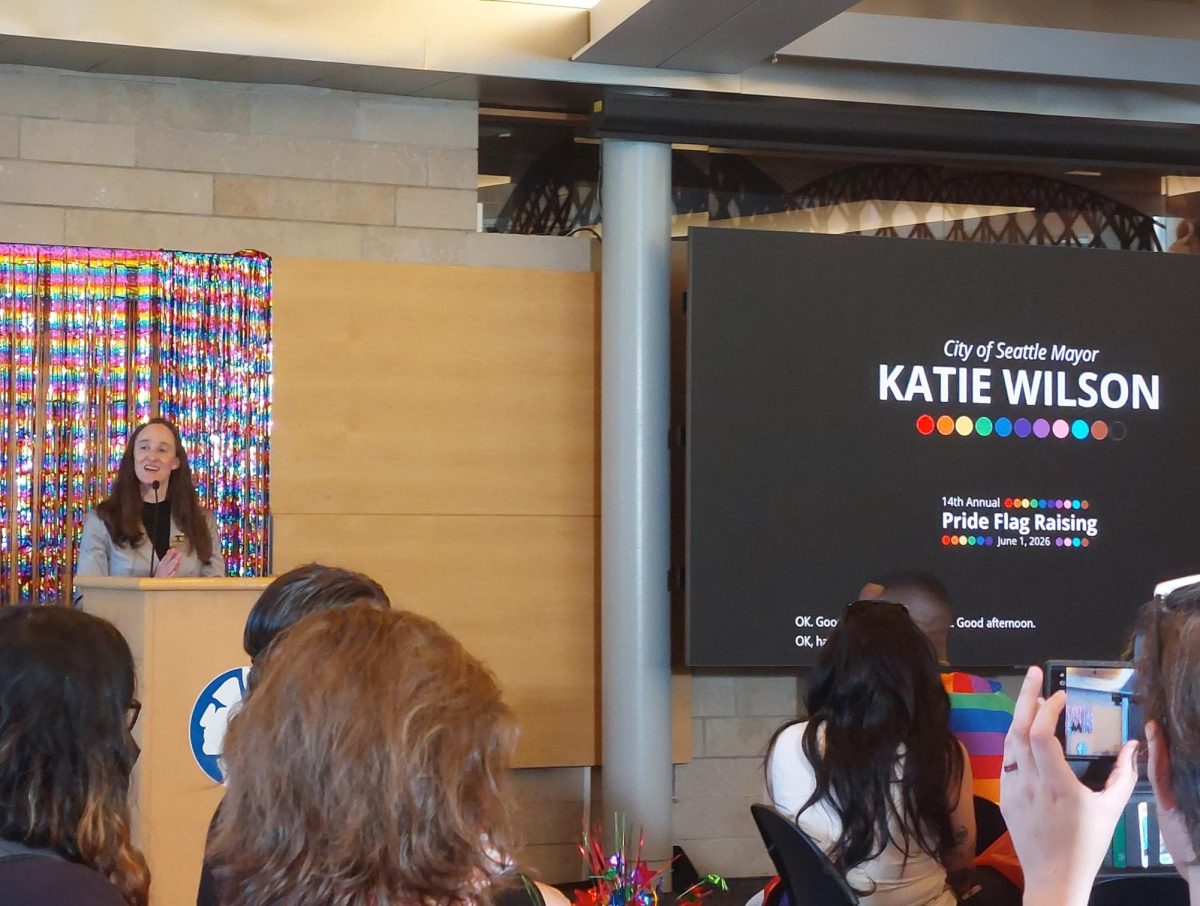


As part of Seattle University’s “Conversations” series, mayoral candidates Bruce Harrell and Katie Wilson met in the Pigott Auditorium Wednesday, Oct. 8 to pitch their cause to students and local professionals alike.
The debate comes in the wake of an August primary that firmly placed challenger, former labor organizer and anti-establishment progressive Wilson ahead of moderate incumbent mayor Harrell, with Wilson taking 50.8% of the vote to Harrell’s 41.2%.
The debate was co-moderated by Seattle U Professional-in-Residence Joni Balter, KOMO TV Senior Reporter and Lead Political Journalist Chris Daniels and Seattle U Fourth-year International Studies Major Diego Borromeo. It took the format of eleven rounds of questions, with each candidate allotted one minute for a response, along with any number of thirty-second responses to the other candidate’s statements.
The candidates covered a variety of topics, many of which have been consistent focal points throughout the campaign cycle. These include public safety and policing, homelessness and drug abuse, housing affordability and the cost of goods, hiring personnel, taxation and transportation.
One of the most contentious issues in the debate was centered on public safety and homelessness. Harrell advocated for strengthening the police force in conjunction with social services and existing housing programs to keep homeless people off the streets, while Wilson argued for rapid expansion to emergency housing and transitioning as many resources as possible to civilianized roles, isolating armed officer responses to crime.

This was exemplified in a discussion about a local issue, the former Polyclinic building on Broadway, which is slated to house a crisis care center that will provide accessible urgent mental health care and substance abuse treatment. The project was approved for construction as of Oct. 7. While both candidates support the center, Harrell’s support is conditional upon the center not being disruptive to the surrounding businesses.
“We want to make sure that they sign what we call a ‘Good Neighbor Agreement’, so they actually know exactly what cleanliness in terms of trash and pickup and everything else looks like in that area,” Harrell said.
A Good Neighbor Agreement is an expectation between residents and service providers in a neighborhood that outlines safety concerns, supported by community members and programs.
Wilson, on the other hand, wants policy around the center to focus on rehabilitating the people within it and keeping them off the streets.
“Once someone is discharged from that center, what do we have for them in the way of longer-term case management, care, shelter, housing? Those are the concerns that I’ve heard, and I’m not sure that those have been adequately addressed. I think that we need to work on that. But, I absolutely support the center,” Wilson said.
For some debate viewers, like Second-year Diagnostic Ultrasound Major Emily Cortes-Gonzalez, Wilson’s prioritization of social work and support over armed response solidified their support for the candidate.
“I think that Katie Wilson did a good job in describing homelessness and the shelters, and not just having [unhoused people] be swept away and pushed away, especially when there’s big events coming up. That was a big thing I’ve noticed, and so I think she did a good job talking about that,” Cortes-Gonzalez said.
Another issue where the candidates significantly differed in policy is taxation. While they both argued in support of Seattle’s business and occupation tax, Wilson supported significantly expanding tax programs to fund her ambitious policies; however, both she and Harrell acknowledged the risk of business flight and the danger to small businesses. Harrell instead highlighted existing policies designed to provide tax breaks to small businesses and individuals.
More so than any singular policy, the meat and potatoes of the debate centered around ideological differences. Harrell aimed to establish authority and experience, blaming regional and national entities for worsening conditions in Seattle and claiming that existing policies, with continued support, would sustain the city through rough times.
Wilson instead posits that mismanagement and establishment policies are currently exacerbating the city’s condition, and that active, progressive policies are necessary to spark change and reverse the direction the city has been headed.
The candidates themselves doubled down on these stances. After the debate, in an interview with The Spectator, Harrell expressed confidence that his leadership experience would sway voters.
“Once again, I tried to make sure that the voters are aware of who I am and who my opponent is, and I think we made a strong case,” Harrell asserted.
Multiple viewers felt that the debate was a strong showing for the incumbent and that he was effective in promoting his current platform while establishing his credibility as a leader.
“He did a good job of staying professional. [The debate] was good, but he obviously knows more. I feel like, especially with where we’re at politically, we need more experience in office right now,” Zoe Bakas, a first-year political science major, shared.
“Now, I am very sure I’m going to vote for [Harrell] because of some of the questions regarding housing and some of the things he already has planned. He’s very expansive, he answered very well, and I think I feel safe having him in this situation,” Joseph Ayele, a member of the community, said.
Other Harrell supporters, like Kenny Ouedraogo, voiced that while they saw their candidate as reinforcing his case as the superior option, they doubted that the debate performance would sway many undecided voters.
“We haven’t reelected a mayor in over 20 years, and I think that’s played a role in how city policies [are] implemented with the high turnover rate of theirs and other people on the executive teams,” Ouedraogo said. “I feel like people already don’t pay enough attention to local politics… for people who are undecided, or aren’t focusing on the race 100% of the time, it may not have answered their questions.”
Following the debate, Wilson reiterated the importance of her dynamic and progressive platform, particularly for young voters.
“These are the people who are coming up in our world and who we need to be fighting for, and these are the people who either will have a chance to build a life in Seattle or won’t depending on the actions that we take right now,” Wilson reiterated.
In multiple moments during the debate, the audience loudly showed their support for Wilson. One such incident was when she responded to Harrell’s claim of fighting corporations by saying they were spending an “awful lot of money” to get him reelected. In a similar vein, Harrell got heckled when he claimed that he “wasn’t disingenuous” by Wilson supporters, which prompted some loud clapping from a few Harrell fans.
Despite the wide breadth of issues covered in the debate, some hoped for more. In addition to sentiments that neither performance particularly moved voters, some issues felt like they weren’t given the attention they deserved.
“Regarding immigrants, and how we are really scared right now… it was not addressed, and both mayors forgot to give us some safety nets and what to do,” Ayele said.
In addition to immigrants, Bakas felt that the perspective of unhoused people was inadequately represented.
“If [unhoused people] are people too, like both [candidates] want to say, their answers didn’t seem to come from those people, if that makes sense,” Bakas added.
While both candidates left the debate confident about their performances, they also turned their sights to the final month–long stretch leading up to the Nov. 5 election.
Wilson, while confident in her near ten-point lead and already anticipating the pre-transition process, shared some tension about Harrell’s final campaign efforts in the post-debate interview.
“There’s an independent expenditure, a [Political Action Committee] for the incumbent that’s raised over a million dollars, and so I’m about to be attacked with a million dollars of negative advertising, so I’m trying to brace myself personally for that and hope that voters see through it,” Wilson said.
Harrell, on the other hand, doubled down on the importance of experienced leadership, trusting that it would close the gap.
“You have to hit the ground running. I think experience is going to be the determining factor when voters make their decision. This is not time to experiment or have a learning curve because the issues are too huge right now,” Harrell said.
The Seattle U and greater Capitol Hill community will join the rest of Seattle in deciding the city’s mayoral leadership on Nov. 5. To register to vote, go to voteWA.gov or visit a local county election office.