

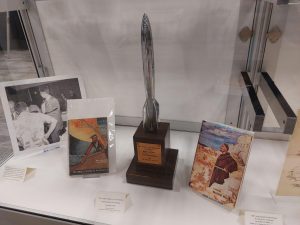
For the first time since 1961, the city of Seattle found itself preparing to host the prestigious Hugo Awards: a recognition of the best literary contributions to the science fiction and fantasy genres. The awards ceremony and accompanying five-day convention (aptly named Worldcon) is held annually all over the world, from Chengdu, China, in 2023 to Helsinki, Finland, in 2017. This year, authors, artists and organizations traveled from far and wide, with representatives from as far as the Czech Republic in attendance to fill the Seattle Convention Center from Aug. 13-17.
“Worldcon San Jose in 2002 was the first convention I ever attended, and I was just blown away. Little-grad-student me biked over in a ball gown and backpack of survival rations and attended two panels every hour. I didn’t want to miss a moment,” Valerie Frankel, a California-based author, said. This year, Frankel had the opportunity to speak on a number of Worldcon panels relating to her work exploring the roles of women, LGBTQ folks and Jewish identity in pop culture.
“My final panel was on Holocaust comics,” Frankel said. “Sounds dismal, but I’ve compiled a list of 100 Holocaust Graphic Novels on Goodreads, so I had lots of cool new projects to share. Paneling with me were Selena A. Naumoff from the U of Denver Holocaust Awareness Institute, atrocity prevention policy advisor D. Wes Rist and Hugo-Award-winner and blind-deaf activist Elsa Sjunneson…We were all quite lively pooling resources beforehand.”
With hundreds of hours of panels from authors and experts, there was truly something to interest everyone. Topics ranged from educational to creative to entertaining, or somewhere in between. Seattle-based author Diana Ma experienced this intersection firsthand through speaking on a wide variety of panels.
Ma primarily writes novels aimed at teens and young adults, having broken into the sci-fi genre recently with “Force of Chaos: A Mighty Morphin Power Rangers Novel.” Her work landed her on panels like “Writing Commercial IP for Fun and Profit” and “Skibidi What? How Teens Talk.”
“I realized when I found out that I had been assigned it that I didn’t really know what Skibidi meant…So I actually asked a couple of tweens, and one of them was able to tell me that it was not so much slang, but more a meme,” Ma recounted. “I think that’s teens these days, they reference memes rather than actual words that have a concrete meaning. That was really helpful for me, and it didn’t change my response to the question of how you write teen dialogue, which is you don’t. You don’t try to incorporate any of the slang or the memes, because you’ll always come off sounding out of touch.”
For both Ma and Frankel, the experience of being surrounded by fellow creatives in a welcoming environment made their time at Worldcon extremely positive.
“My colleagues are all lovely, but they just don’t understand the excitement I have around speculative science fiction and fantasy,” Ma said. “I remember I had said something on a panel, and then one of the authors said, ‘Oh, I was going to say the same thing, but I didn’t want to sound too nerdy.’ We all looked at her and said, ‘Where do you think you are?’ This is one place where you can nerd out, and everyone else is doing the same.”
While Worldcon primarily focuses on writing and literature, there was no shortage of visual artists in attendance. Each year, the convention hosts an art show with various awards for exceptional art. This year, the Judge’s Choice Award for Best in Show was given to Seattle-based artist Brittany Otto for her piece “Roots.” Made up of intricate, hand-cut layers of paper and backlit with a shadowbox frame, “Roots” depicts a tree with an intricate tangle of roots that house a coiled, sleeping dragon. Otto has been practicing this layered paper technique, creating pieces she calls “Oneiroframes,” since 2016. “Roots” and other pieces like it can take her upwards of 30 hours from sketch to final product.
“For me, I do a lot of thought about how fantasy and mythology are closely linked, of how and why stories that we tell come to be…Kind of this whole thing of how society and stories and myth and reality intertwine, it just comes back to them feeding each other,” Otto said. “I wanted [the dragon] to feel like it was slumbering and giving life to this tree and then the life giving back, essentially, and the magic that that creates.”
Winning Best in Show came as a shock to Otto, who had entered the Worldcon show on a whim after hearing about it through Norwescon, a local sci-fi and fantasy convention she had attended.
“It felt incredible to kind of get that recognition,” Otto said. “Especially in a world where so many cons are so commercial, being at a con that was far more focused on the literary and the appreciation of the work and the artwork and creativity that goes into that was so refreshing by comparison. It was just really nice. It just felt like a good scale, like a more human scale.”
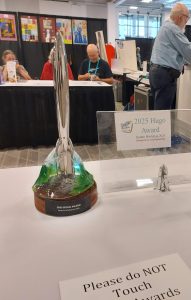
The convention closed with the official Hugo Awards Ceremony, where author Robert Jackson Bennett took home the Best Novel award for his book “The Tainted Cup.” A number of other authors and creators were recognized for exceptional work in poetry, writing and visual media. Next year, the awards will travel to Anaheim, California.

![Peggy, Mink and Bladee Make Good on Threats to Drop Music [REVIEW]](https://seattlespectator.com/wp-content/uploads/2026/05/unholytrio-review-web-1200x900.png)