
Earlier this week, a 19-year-old transgender woman who was a student at the University of Washington was killed in the laundry room of her place of residence, Nordheim Court. This tragedy has harshly reminded the people of Seattle that, while the city is largely viewed as a safe bubble for LGBTQ+ individuals, American political leaders advocating for the eradication of transgender people have normalized senseless violence. This act of violence shows where rhetoric turns to action, where hate becomes deadly and horrific, where words warp beyond mere cruelty and cause irreversible harm.
While Washington state helped lead the legal fight against Donald Trump’s executive order blocking gender-affirming care and has passed bills to protect the right to such medical services in the state, national anti-trans rhetoric from far-right groups continues to impact the lived experiences of the transgender community.
Beyond the indescribable horror of the murder, this potential hate crime is compounded by the now-canceled anti-trans Turning Point USA-UW event that was scheduled for this week. This follows just weeks after the previous TPUSA “Prove Me Wrong” event ended in arrests for student protestors and calls for UW administration to take action against the organization that promotes such violent rhetoric and prejudicial thinking.
But can the two events truly be disconnected? Can the murder of a transgender student be fully separated from an event designed to advocate against the existence of trans people?
When hateful ideology is given legitimacy, it leads to the perpetuation of violence. UW’s decision to allow their chapter of TPUSA to platform outspoken transphobe Chloe Cole provides a clear message to transgender students: you are not safe here, and your voices are equally as valid as the voices of those who want to exterminate you. While the TPUSA chapter made the decision to cancel the event in light of the tragedy, Cole’s statements blaming the cancellation on threats from a “militia” assembled by “Antifa” do not soothe student fears—they continue to stoke division and anger.
In their 2026 Counterterrorism Strategy announcement published this May, the United States government included “radically pro-transgender” groups in their list of targets for national counterterrorism activities. The Presidential Forward to this document ends with a chilling statement: “We Will Find You and We Will Kill You.”
“In addition to cartels and Islamist terror groups, our national CT activities will also prioritize the rapid identification and neutralization of violent secular political groups whose ideology is anti-American, radically pro-transgender, and anarchist. We will use all the tools constitutionally available to us to map them at home, identify their membership, map their ties to international organizations like Antifa, and use law enforcement tools to cripple them operationally before they can maim or kill the innocent,” the statement reads.
When a political party pushes for the erasure of an entire community, rallies behind cries of perversion and sickness promote messages condemning groups that fail to fit their narrow set of social expectations. What happened last week is an undeniable tragedy that brings the harms of extremist rhetoric to the forefront of the city’s consciousness. As long as hateful rhetoric is allowed space to breathe, nowhere is safe from violence against marginalized communities.
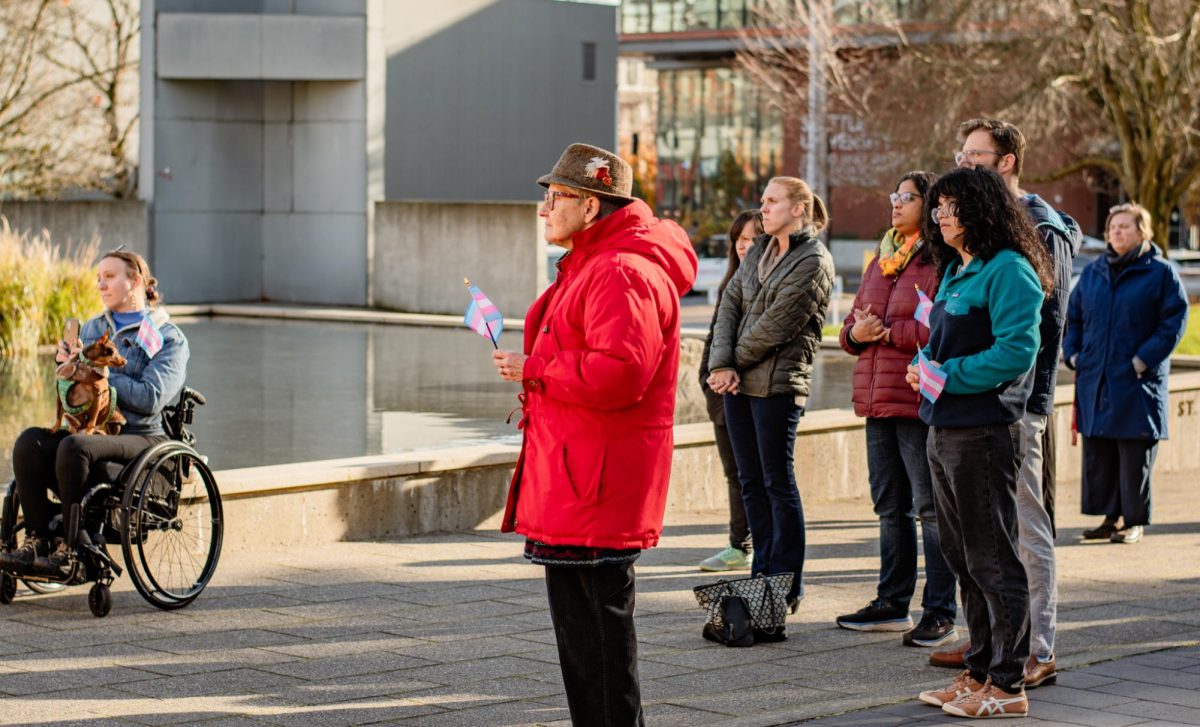
This is a time to recognize that this is not an isolated incident and find opportunities to support the trans community around you. It is more important than ever to be not only an ally to your transgender friends and neighbors, but a loud, vocal opponent against transphobia and hate. Words, thoughts and prayers are not nearly enough. Direct your energy towards your representatives: call, email or mail a letter and make it abundantly clear that you will not stand for hate. Educate your friends and family if they espouse transphobic rhetoric, even (and especially) when it’s subtle or subconscious. We cannot get used to this. We cannot continue to normalize irreversible harm and death.
Local organizations that provide support and resources for queer people are vital to the safety of our community. Ingersoll Gender Center helps transgender individuals navigate gender affirming care, healthcare and housing. Planned Parenthood of Washington provides accessible gender affirming care for trans individuals. Seattle’s LGBTQ+ Center and Lambert House provide similar and more youth-focused resources. Lavender Rights Project focuses on providing legal, financial and social support for Black trans women. Peer Seattle focuses on substance abuse recovery resources for queer individuals.
Seattle U’s Meaningful Opportunity for Student Access, Inclusion and Community (MOSAIC) Center provides on-campus resources for queer Seattle U students through their Pride Link in SCN 390. Counseling and Psychological Services offers free mental health care to Seattle U students by appointment, with urgent care hours between 10-11 a.m. and 2-3 p.m. in PAVL 120. Telehealth appointments are available through TimelyCare 24/7.