

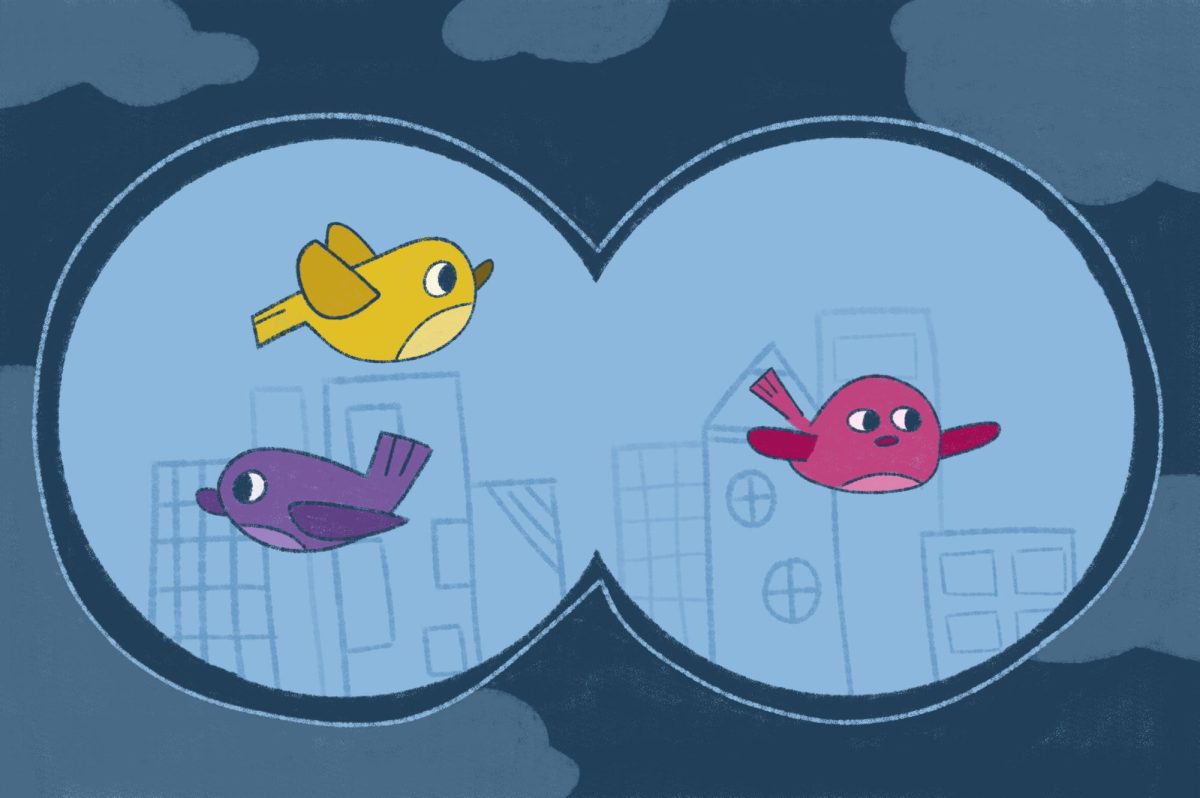
Birds are ubiquitous around Seattle University’s campus. Plants, trees, buildings and even lawns are fair game for our avian neighbors—they will live anywhere and everywhere they can. Unfortunately, they die here too: the floor-to-ceiling windows that characterize buildings like Casey, Sinegal and the Student Center are known to cause bird strikes, many of which are fatal.
However, that doesn’t have to stay the case. Seattle U is working with Birds Connect Seattle (BCS), an urban conservation nonprofit, to survey bird strikes on campus as part of BCS’s Seattle Bird Collision Monitoring Project. The project uses volunteers to collect data on where and when birds are injured or killed in the city. BCS uses the data to identify risk factors for collisions and advocate for bird-friendly urban development.
Seattle U Facilities doesn’t use pesticides anywhere on campus, providing a food- and shelter-rich oasis for native birds. A variety of birds can be seen around campus: dark-eyed juncos, American robins, black-capped chickadees and a number of small songbirds can be spotted nearly everywhere. During bird migration season (roughly March to May), sparrows, warblers and other birds can also be seen as they pass through the Seattle area. These migrations are no small event: the night of April 18, an estimated 8.5 million birds passed through Washington.
“We are right in the middle of the city, and it’s a pretty harsh environment for birds to be in because they need trees to perch in and build their nests in, and they need insects to eat,” Associate Professor of Biology at Seattle U, Rebecca Hartley, whose research focuses heavily on birds, said. “We have more diversity here, I think, than in the middle of downtown. Our grounds crew keeps the gardens here in organic ways; they don’t spray chemicals, and that’s really good. I feel like we have a pretty good habitat here.”
The largest contributor to bird strike deaths and injuries is glass that can’t be differentiated from its surroundings. Older buildings, such as Garrand Hall, are mostly safe since they have small windows, and the decorative glass of Lemieux Library’s windows makes them visible to birds, but not every structure on campus is so safe. The Casey Atrium, the front of the Student Center and almost all of Sinegal Center are extremely hazardous for migratory and non-migratory birds.
“I had to document a dead bird behind the Casey building,” Lynda Emel, a volunteer with BCS, said. “The poor thing. I did one pass of the atrium, and you know it’s not that big–it doesn’t take very long to do that. When I came back the other way, there was a poor, dead sparrow.”
Volunteers working on the Seattle Bird Collision Monitoring Project with BCS document bird strikes all over Seattle. They walk around buildings and observe the environment and the structure itself. When they find a deceased bird or evidence of a strike, they photograph it and record relevant information about the scene.
Volunteers will be on campus every morning until May 29, surveying buildings and looking for evidence of bird strikes around Casey, Sinegal and the Student Center. Some volunteers are Seattle U students who signed up through the Center for Community Engagement, which partnered with BCS for Earth Month. Others are community members, like Emel, who want to help birds in Seattle.
BCS has taken flight when it comes to advocating for bird safety. In 2025, they convinced the Seattle Asian Art Museum to add bird-safe film to its building, which is mostly windows. They’ve helped halt or relocate the development of pickleball courts, the noise of which can disrupt bird activity, in Seattle’s Magnuson and Lincoln parks; testified against anticoagulant rodenticides, which can poison native wildlife; and advocated for a number of environmental protections on the city and state levels.
“The Seattle Asian Art Museum installed a bird window collision deterrent on one portion of the back side of the museum, and we’ve only collected one season of data but just by treating one side of the building, it looks like they’ve achieved a 60% reduction in collision events,” Josh Morris, BCS’s conservation director, said. “That’s tentative at this point, but the point there is that this is a problem that can be treated.”
BCS will use the data they collect to continue to advocate more effectively for bird safety around Seattle. Morris has spoken with Seattle U Facilities and the Institute for Environmental Justice and Sustainability about protecting birds on campus by adopting bird-safe building standards in future buildings, though retrofitting existing buildings poses some logistical challenges.






Joshua Morris
Apr 24, 2026 at 10:58 am
Thank you for writing about our project! Seattle University is a great community partner of our urban conservation work.