
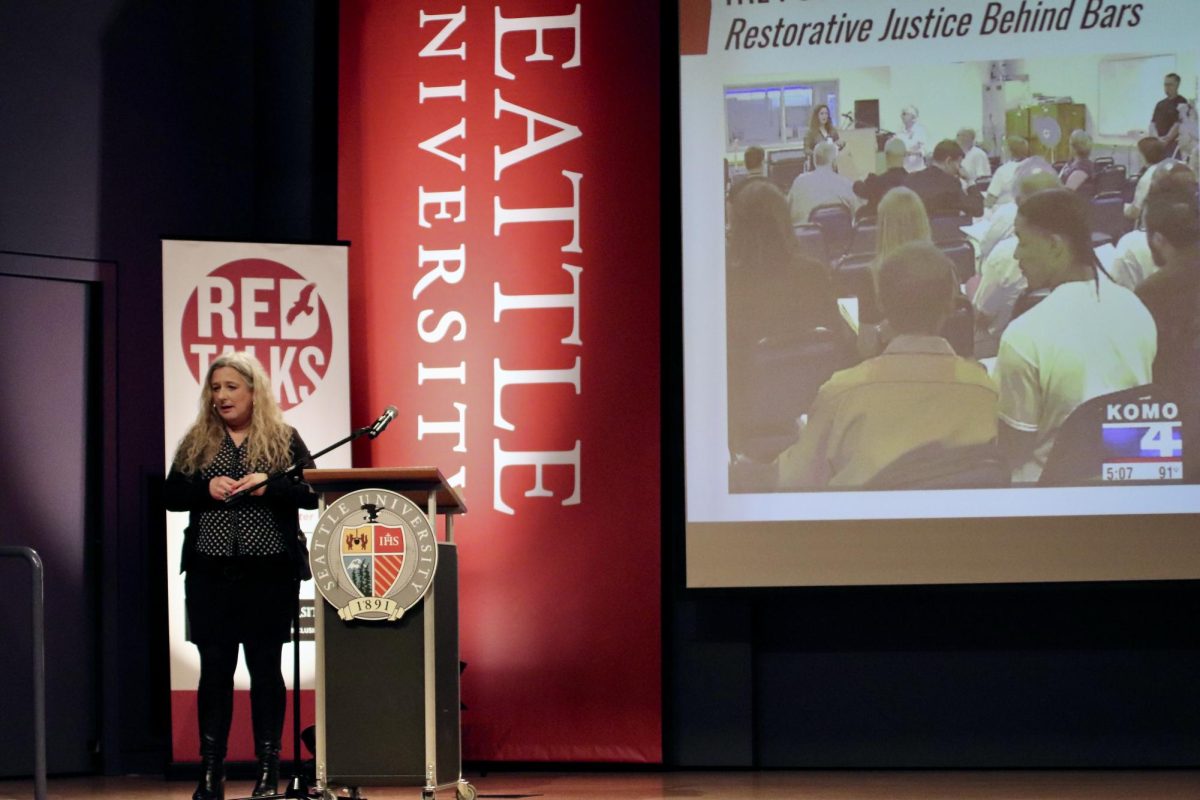
Jacqueline Helfgott, a criminal justice professor and director of Seattle University’s Crime and Justice Research Center, hosted her Red Talk Feb. 24, titled “How Prison Education Restores Justice.” A few minutes into Helfgott’s talk, an unidentified individual wearing all black, including a hood and a black medical mask obscuring most of their face, began passing out edited versions of the event’s poster to audience members.
The posters had text in marker scrawl reading “Wants Border Patrol on Campus,” with an arrow pointing towards a photo of Helfgott. Additional text stated, “Practice What you Preach, Helfgott.”
The criminal justice department, as well as administration more broadly, has faced student backlash in recent weeks after an invitation to the department’s career fair was extended to the Customs and Border Protection Patrol Office of Accountability. The invitation has since been declined.
Provost Shane Martin was present at the talk to introduce Helfgott and witnessed these events.
“At Seattle University, we’ve affirmed the right for peaceful protest within the guidelines that are provided,” said Martin. “My concern is that [it] was disruptive. The message on the fliers seemed to be focused on another issue that was not the issue being spoken about.”
When asked about community backlash to Border Protection’s invitation to the career fair, Martin emphasized that the Department of Homeland Security oversees a range of agencies, including the Federal Emergency Management Agency and the Transportation Security Administration and Immigration and Customs Enforcement (ICE), as well as Border Protection.
“There [were] rumors that the university had invited ICE to come recruit students, which was just not correct, but it’s complicated, and I understand that in this environment people are angry, they’re upset, they’re fearful and they have a lot of feelings about what’s happening,” Martin said.
Neither Martin nor Public Safety had any additional information about the individual’s affiliation or identity.
“I think the message that was suggesting Dr. Helfgott wants Border Patrol on campus. I don’t believe [that] is accurate,” said Martin.
Helfgott’s talk highlighted an ongoing initiative by the Seattle U Crime and Justice Research Center to develop a Seattle U bachelor’s degree program in Social and Behavioral Sciences at the Monroe Correctional Complex. This program, known as Seattle University Prison Education for Rehabilitation and Re-entry (SU-PERR), involves collaboration between Seattle U and the Washington State Department of Corrections.
The research center has received a grant from the Raskob Foundation to conduct a feasibility study for the program. This year, Helfgott and others are working to find faculty and staff interested in teaching in the program and are having discussions with the inmates about details of the program. A final report on the program’s feasibility will be completed by the end of the year.
President Eduardo Peñalver declined to comment on the fliers handed out at the event, instead expressing his excitement for the SU-PERR program.
“Such a program would be very much aligned with our Jesuit mission of extending the scope of educational opportunity to people on the margins,” he wrote in an email to The Spectator.
Along with discussing the SU-PERR initiative, Helfgott’s talk focused on the ways in which prison education reduces recidivism and benefits both inmates and their communities, with a focus on the impact of artwork in prisons.
“Prison art reminds me that people are complicated, that a person is much more than the worst moment of their lives and the person is much more than the worst harm that they’ve caused,” Helfgott said during her talk, discussing a mural painted by a man who spent his entire adult life in prison.
When Helfgott was asked about the contents of the fliers alleging her support for Border Patrol on campus, she pointed The Spectator to a Criminal Justice Department statement, but did not add any further comment.
“My focus during the Red Talk was on my talk on How Prison Education Restores Justice and the SU-PERR initiative,” she said in an email to The Spectator.
Earlier in her career, Helfgott facilitated art programs at the Bellefonte County Prison for the Pennsylvania Prison Society. Much of her career has involved providing artistic education opportunities in prisons.
Helfgott discussed her experience leading a restorative justice program called Citizens, Victims, and Offenders Restoring Justice at the Washington State Reformatory, in which offenders, victims and community members were brought together to discuss principles of restorative justice. Helfgott has also taught a class at Seattle U titled Restorative Justice Behind Bars, including both incarcerated and non-incarcerated students.
Martin emphasized the significance of Helfgott’s work in the area of prison education throughout her decades-long career.
“I realize there is a temptation to lump everything together, and if someone is upset about a professor’s work in one area, they want to transfer that to all of their areas. The Red Talk had a particular focus, and that’s what I was focused on at the Red Talk,” Martin said.