
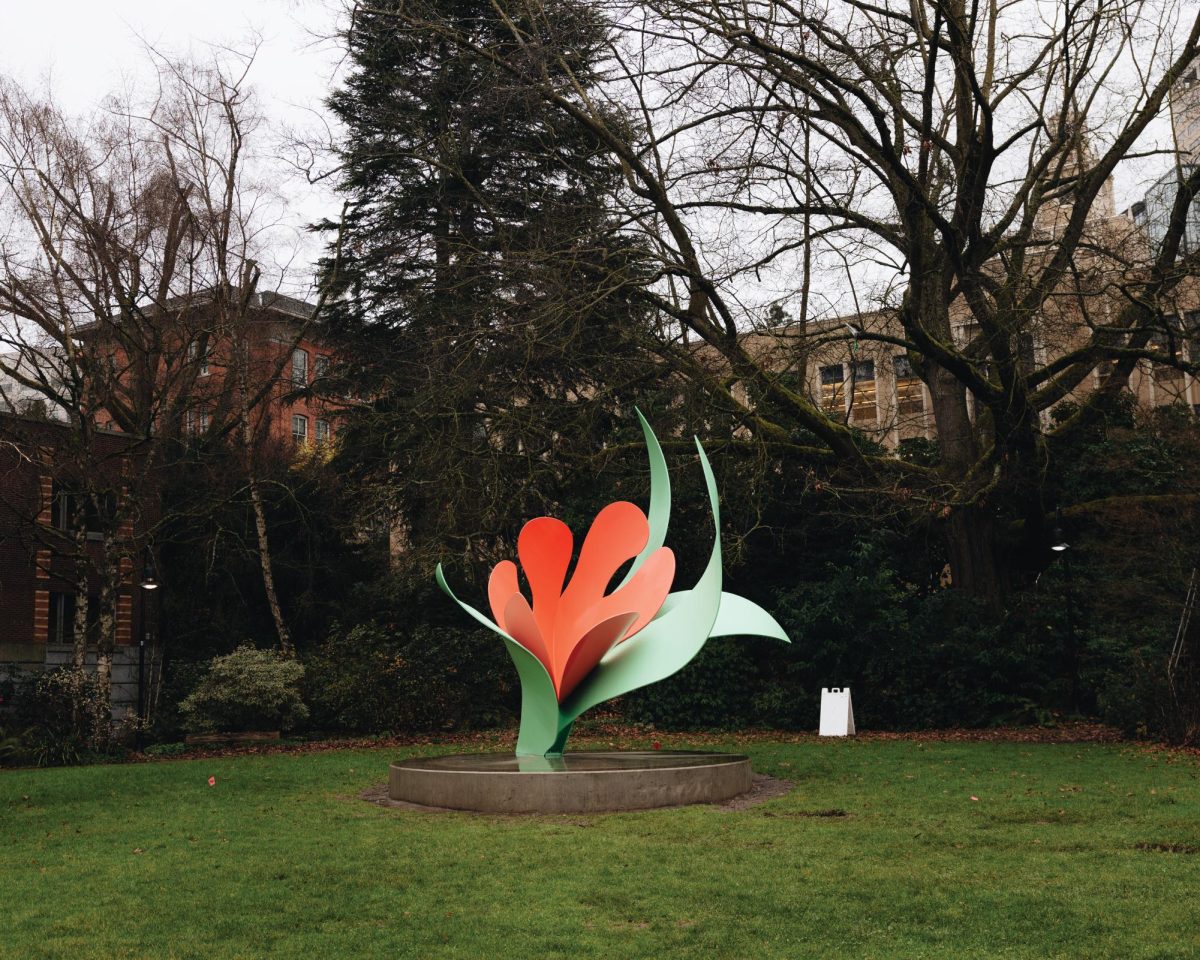
For the second time this year, a piece of Seattle history has become a part of campus. The 120-year-old F.X. McRory clock arrived at Seattle University in the fall of 2025, bringing a piece of Pioneer Square to the upper mall. Now, the Seattle Tulip, a sculpture that sat downtown for over three decades, was installed on the Union Green the week of Feb. 9, causing a temporary closure of the walkway in front of the Fine Arts Building
The sculpture was commissioned in 1988 by Wright Runstad & Company for their building that stands at 999 Third Avenue. This decision was made to comply with the City of Seattle’s 1973 law, which requires that one percent of the construction budget for certain buildings be allocated for artwork. Wright Runstand & Co. chose Tom Wesselmann, an American painter and multimedia artist, to create a sculpture to stand just outside the building’s doors.
It resided there until 2019, when it was removed to accommodate renovations and never reinstalled. The Tulip was in storage for years, until recently, when the building’s owners and an anonymous group called Friends of the Tulip donated the sculpture and financed its installation on campus.
“Since the sculpture had been in storage for so long and there were no plans to bring it back, we wanted to find somewhere where it could be enjoyed again,” Colleen Duffy, the building’s senior property manager through Perform Properties, said.
Decades before it was considered for a university campus, the floral sculpture was an idea of Wesselmann’s. When he was commissioned for the tulip, he was no stranger to the art world, having risen to fame in the late 1950s as a painter and collage artist. Although not as well known as his contemporaries, such as Andy Warhol and Roy Lichtenstein, Wesselmann was one of many artists who processed the aftermath of World War II and spoke to the rise of American consumerism through Pop Art. Pop artists used images and concepts from popular culture—billboards, comics, advertisements and more—to create works that challenged traditional notions of what art should look like.
“They were all trying to speak to the zeitgeist of a post-war America,” Kenneth Allan, an associate professor in the Visual Arts department, said. “Like many other pop artists, Wesselmann was making these totally degraded works from a fine art perspective, and demanding that he be taken seriously intellectually.”
In the 1960s, his series Great American Nudes—a collection of 100 provocative and controversial works that depict women’s bodies in exploration of an increasingly progressive social climate—brought Wesselmann into the spotlight. He held solo galleries in New York City and continued to create series like Still Lifes, Seascapes, Smokers and Mouths throughout the 1960s and well into the late 1970s.
By 1988, when Wright Runstad & Co. commissioned him, Wesselmann had transitioned out of the spotlight and began creating more sculptural pieces, preferring steel and wood for his galleries (though he continued to paint until his death in 2004).
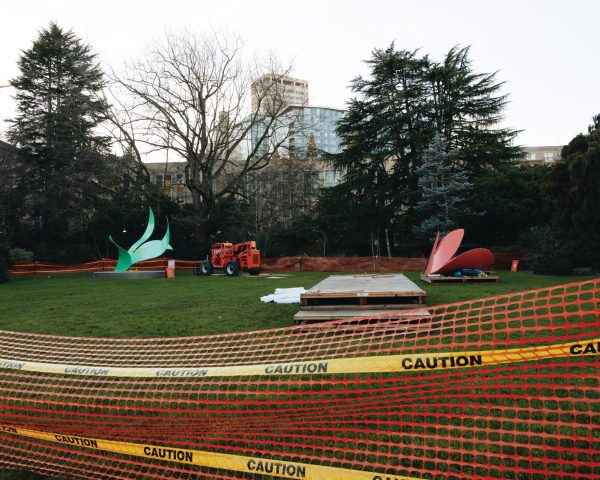
Before the sculpture could be installed on the Union Green, a team of people, including Seattle U’s art department, construction workers and the facilities team, worked to ensure its arrival would go smoothly. It was a nearly two-year process, according to Seattle U’s curator Fr. Josef Venker, who picked the spot where the sculpture now stands. Once the spot was picked, preparations were undergone to prepare the sculpture and location for the big move. For much of the fall quarter, a section of the Green was fenced off as a foundation was installed, and all five tulip pieces were cleaned and repainted.
In February of 2026, the freshly painted tulip pieces were brought to campus alongside a crane and a team of construction workers, who installed them one by one over the course of four days, despite a mishap on the final one.
“On the third day, they were ready to install the flower, but the metal had bent after so long in storage,” Venker said. “They had to spend a whole day bending it back into shape.”
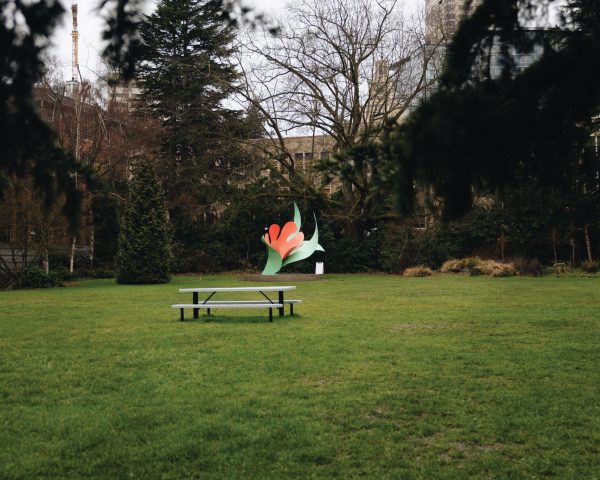
Now, the Seattle Tulip stands proudly on the southwest corner of the Union Green, its cheerful red flower and twisting green leaves a welcome addition to campus. A dedication ceremony will be held March 5 in Pigott Auditorium, making the installation official.
“We hope it can bring some joy to Seattle University’s campus,” Duffy said.