
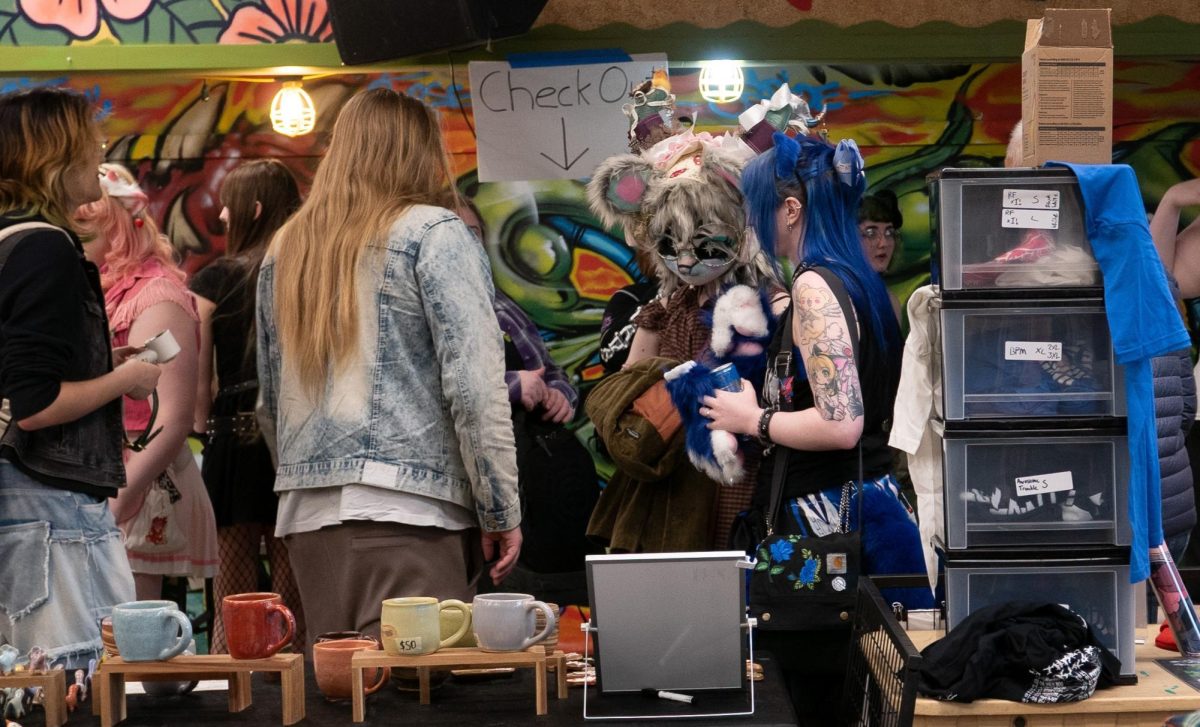
Capitol Hill’s Quality Flea Center housed Furswap May 10, drawing 1,520 people and 65 vendors over the span of five hours, the same weekend as the popular furry event Furry Weekend Atlanta. In this colorful venue, attendees, often with animal masks, fluffy neon-colored ears and a matching tail, browsed local artists’ vendor stands, danced to energetic electronic music and drew collaboratively on large sketchpads.
Furswap is a free-to-enter, recurring event run by the Impact! Foundation, an organization that primarily hosts raves across the Seattle area. However, their mission extends to supporting all types of artists, especially those whose styles don’t quite fit in with the mainstream.
“A lot of people will vend at our other events, but the problem is it’s a nightclub, there’s very limited capacity,” Evelyn “Eximious” Shulga-Morskoy, co-founder of the Impact! Foundation, said. “It naturally made sense to have an event dedicated to the people, the artists in the community.”
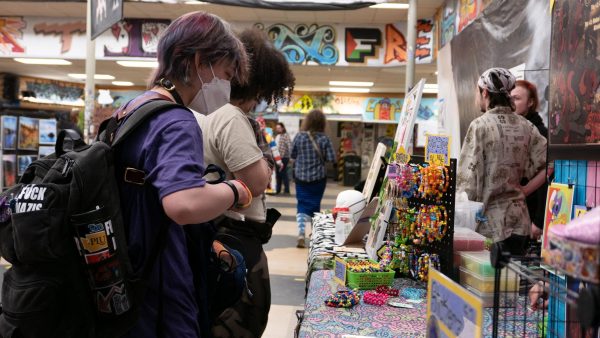
Vendors at this event enjoyed a relatively low barrier to entry, with a standard eight-foot table only costing $35. To maintain this accessible rate while also ensuring the event’s sustainability, the organizers collect 6.5% of artists’ revenue past their initial table fee.
“[Furswap] is honestly one of the biggest boons to my income every year. I think I pulled home, like, $8,000 from Furswap last year,” Harley Ride, an artist who tabled at the 18+ section, said.
Ride recounted financial difficulties in finding a place at similar events. Artist alleys at conventions often charge heftier fees for a vendor table.
“Some conventions are starting [at] $200 and above, for example, Sakura-Con, so I can’t really penetrate into that sort of market,” Ride said.
This sentiment is central to why Impact! hosts these events. Shulga-Morskoy acknowledged the difficulty of finding trustworthy organizations to work with in the creative industry.
“We live in a world that is kind of trying to rip you off constantly,” Shulga-Morskoy said. “Most things or places that you go to are kind of scummy, and you have to constantly navigate this mental minefield of not getting scammed or not giving your money to a bad person, just to exist in society now.”
Along with the progressive nature of the tabling fee, artists are able to collect substantial revenue from the event. Ride found the previous Furswaps to be a major contributor to her finances during her recovery from an injury.
“I’m about to finally settle the debt that I was in,” Ride said. “I had some taxes over the last couple of years that I haven’t paid just because I was injured in 2024.”
This lower rate also allows people who are new to vending or have unconventional art forms to find their audience. Among the items on sale were hand-made clay dinosaur figures, zines with animal-centric mythology, upcycled hats with colorful ears on top and an endless number of original illustrations.
“It brings me a lot of joy to have space for people who would be nervous vending at something that wasn’t explicitly furry, for them to come here and feel safe vending,” Emma Hare, organizer of Furswap, said. “You can make risky art and sell your risky art at Furswap, where you’re not sure if it’s going to land for people, but it probably will with the right eyeballs.”
Hare also recognized that Furswap, being a furry-focused event, made it more inviting for people of queer identities.
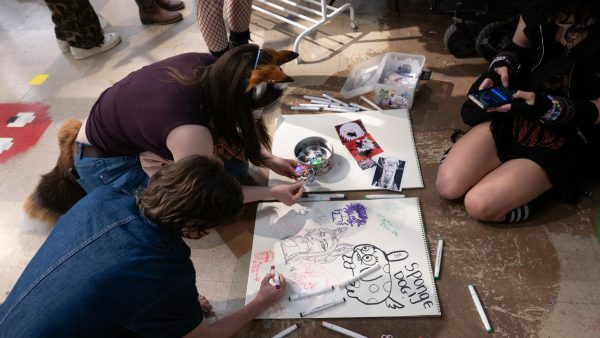
“When I’m reviewing artists, I’m looking at portfolios and deciding on who in our batch of applicants is going to be accepted to this Furswap. I don’t look at whether they’re queer or not,” Hare said. “This just happens to be this queer, because I feel like queer people make some really interesting art.”
Also in attendance were therians, a term for those who identify as partially or fully animal. Shimi, a 62-year-old therian, found that events like Furswap, while not explicitly for therians but closely related in the community, make it possible for people to live true to their identities.
“It’s high time that we stop apologizing for our existence. We are therian, we exist, and we’ve existed long before language,” Shimi said.
The Seattle furry community brought contagious positivity to the event, with constant dancing to the live DJ’s performance, and nonstop chatting amongst vendors and attendees. A vendor that goes by Mitt in the community expressed appreciation for the in-person community he found at Furswap after recently moving to Seattle.
“It was a lovely first experience. The attendees were very kind and very generous—really a true testament to the furry community,” Mitt said. “It’s a really great place just to be able to immerse yourself around other creative people. It’s hard to go in there and not smile.”
If you find yourself looking for a crowd you can howl with, Impact! hosts a Furswap every three months, with the next one happening in August.

![Peggy, Mink and Bladee Make Good on Threats to Drop Music [REVIEW]](https://seattlespectator.com/wp-content/uploads/2026/05/unholytrio-review-web-1200x900.png)