
Teal ribbons adorn backpacks and jeans throughout the month of April as a symbol of solidarity for survivors of sexual assault. First officially observed in 2001, this month marks the 25th annual Sexual Assault Awareness Month (SAAM). At Seattle University, several groups and offices across campus have aimed to create space to uplift survivors and educate the community on available university resources.
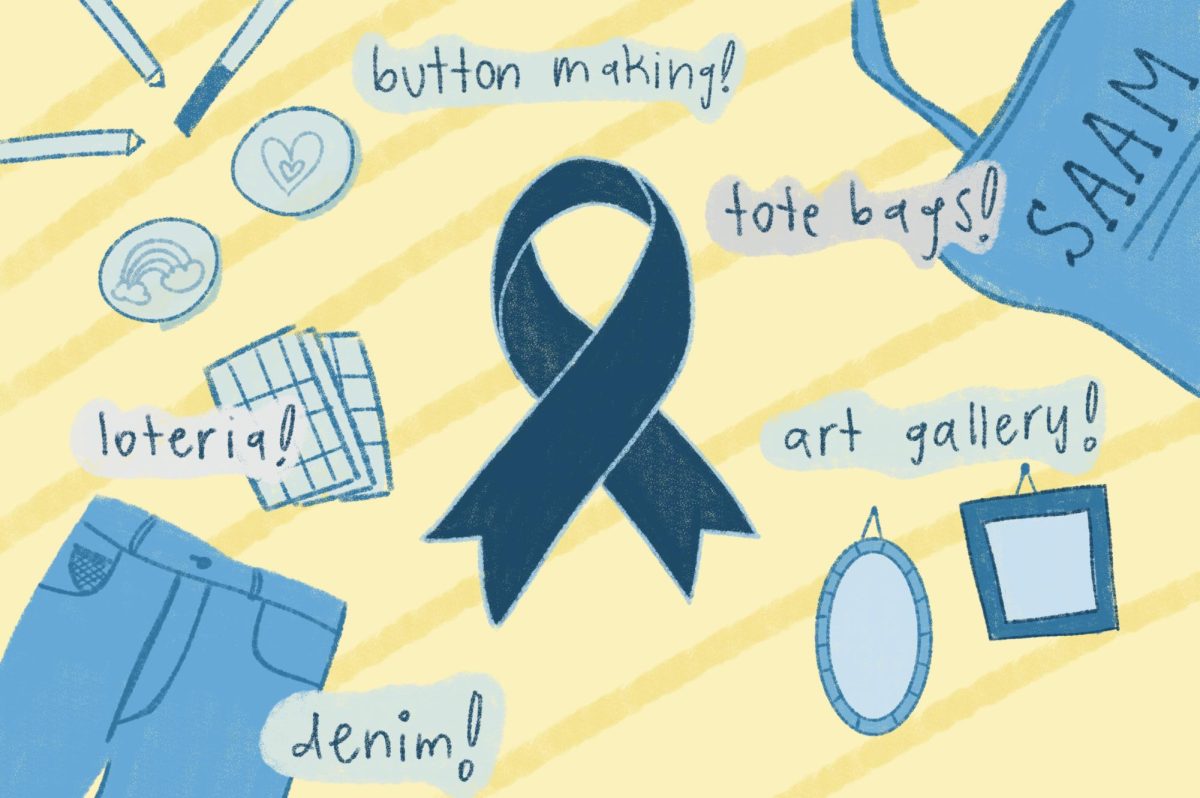
Leading the charge was the office of Wellness and Health Promotion (WHP), who hosted multiple events throughout the month. These events included collaborations with various clubs and student organizations across campus, combining education with opportunities to create art or connect with peers. Events included Yoga for Healing with UREC, Lotería for Awareness with MECHA and a tote bag making workshop hosted at the Makerspace. Workshops and panels on supporting survivors and general awareness also took place throughout the month.
WHP events culminated with Denim Day April 29, where peer health educators distributed information against a denim backdrop doubling as a photobooth. The day is observed on the last Wednesday of every April, dating back to 1999, and was founded by the Los Angeles-based advocacy organization Peace Over Violence.
Denim Day began in the late 90s in protest against a shocking Italian Supreme Court decision that overturned a rape conviction on the basis of the victim’s tight jeans, arguing that the jeans must have required assistance to remove.
“The justice decided that since the woman probably had to take off the jeans, that implied consent, which obviously is not what we know consent to be. So the very next day, the women of the Italian Parliament showed up to work wearing denim in support of survivors,” Elyse Vincent, graduate program coordinator for WHP, said. “That sort of kick-started the movement, which was then picked up and expanded by Peace Over Violence.”
Denim, alongside the color teal, has become a symbol of solidarity and support. Teal, Vincent explained, was selected as a representation of strength, hope and resilience. The WHP created and distributed over 900 teal ribbon pins to offices across campus for passersby to pick up and wear.
Many of these pins can be found in the Fine Arts building, where WHP’s fourth annual “Healing Through The Arts” showcase is on display until April 30. The gallery is made up of writing and visual art submitted by students, faculty and staff, and contains interactive elements, including a guestbook where visitors can share messages of support for those impacted by sexual violence.
“One great thing about the showcase is that even though all of us in the office are mandated reporters and we have to report any disclosures of sexual assault, when someone’s submitting art to us that talks about their experience, we consider that confidential so we can create a safe space where people are able to talk about whatever they’d like to talk about without fear,” Eden Crisler, a third-year forensic psychology major and peer educator for WHP, said.
The showcase’s goal, Vincent explained, is to demonstrate the power of witnessing. Visitors were encouraged to simply leave a tally mark on a piece of paper to show they were there, representing the strength that exists in the number of supporters.
“Witnessing is an opportunity to be seen by someone else, which can be really healing and restorative,” Vincent said. “Art and expression can be really poignant ways to process those emotions, whatever they may be; anger, grief, frustration, hope.”
The WHP wasn’t the only group seeking to observe SAAM: the Intersectional Feminism Club marked their first anniversary April 27 by inviting students to create denim patches to wear for Denim Day later that week.
“We wanted to create a safe space for students to come in and ask questions about sexual assault awareness month and about Denim Day in particular,” Lily Bergeron, a fourth-year strategic communications major and social media coordinator for the club, said. “It was important for [the] Intersectional Feminism Club to have this meeting on campus, because unless you’re actively seeking out answers for questions or resources and whatnot, you don’t get them on campus as easily. Our mission is to not make people feel ashamed for searching out those questions. That’s the reason the club was created in the first place.”
Students seeking additional information or support have access to confidential resources through Counseling and Psychological Services, the Student Health Center and more. The Office of Institutional Equity is also available for reporting all instances of harassment, discrimination and sexual misconduct.