

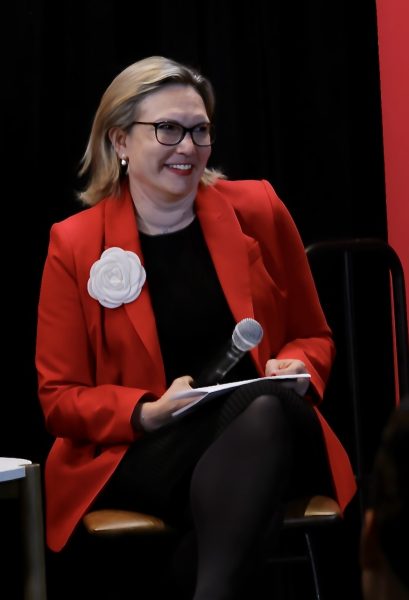
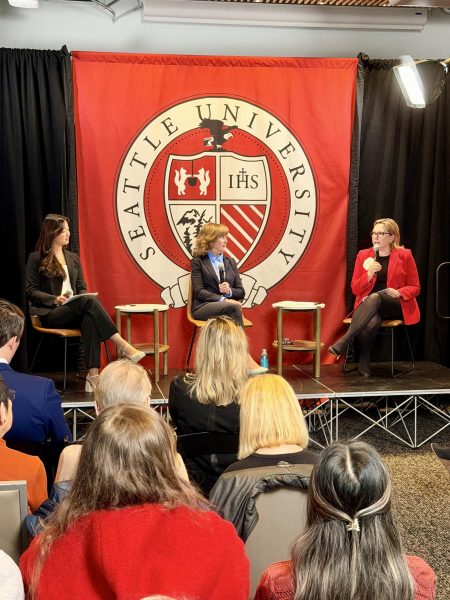
Last week, Seattle University welcomed the Consul General of Finland, Minna Laajava. Representing her nation as the happiest country in the world, Laajava came to campus to talk about why Finland has been ranked the happiest for eight consecutive years, and what other nations can learn from them.
The event was hosted as part of the Department of Public Affairs and Nonprofit Leadership’s Conversations program, a long-running series that brings public figures to Seattle U to discuss civic and global issues. It was also held in collaboration with the Department of International Studies. The discussion was facilitated by Joni Balter, professional-in-residence at Seattle U, and Seattle U student moderator Naho Umitani.
According to Balter, the conversation was designed to broaden the program’s typical political focus.
“We talk about politics, mostly, and public affairs issues,” Balter said. “It seemed like everybody needed a little jolt of happiness. Finland is the happiest country in the world, at least until March, so we wanted to hear from them. And yet we still managed to talk about public and social policy.”
The ranking is released annually in March by the World Happiness Report. Finland has been consecutively ranked number one since 2018. The ranking comes from surveys in which residents are asked to evaluate their lives overall, not their mood on a given day.
Umitani, an economics and public affairs major, said the opportunity aligned directly with her academic interests in social policy. She wants to pursue a career in law and focus on policy that safeguards civil liberties.
“They typically select one public affairs student to serve as the student moderator,” Umitani said. “The talk about social happiness and welfare policy really fit my background.”
Throughout the conversation, a central question emerged: what does happiness actually mean?
Rather than presenting a formula for personal joy, the Consul General emphasized that Finland’s ranking is often misunderstood. Finnish happiness does not refer to constant cheerfulness or outward positivity; rather, it reflects stability and confidence in society.
She described happiness as a precondition for well-being: trust in institutions and a belief that society supports individuals throughout their lives.
Central to that trust is what she called an “infrastructure for happiness.” Finland combines a market economy with strong public services, including universal healthcare, public education, subsidized childcare and parental leave. These systems, Laajava explained, reduce anxiety about economic instability.
High taxes help fund those services, but, according to Laajava, many Finnish citizens view them as worthwhile because the benefits are visible in everyday life. Paying taxes is widely seen as a civic responsibility that supports schools, healthcare and social stability.
The Consul General also noted that Finland ranks highly in studies measuring whether strangers return lost wallets, a small example of broader social reliability. While Finland is not without crime or economic challenges, she said, there is a general societal expectation that institutions and citizens act responsibly.
The conversation also focused on education, another area where Finland is frequently cited as an international model. Finnish children are not required to know how to read before first grade, and school days include frequent breaks. Teachers are required to hold master’s degrees or higher, and the profession carries strong social respect.
The Consul General shared a personal example. One of her children learned more rigorous academic skills early in France, while another began learning later in Finland’s system. By eight years old, she said, both were performing at the same level.
The Finnish approach prioritizes childhood and well-being over early academic pressure. Students spend time outdoors, begin formal academics later and still achieve strong learning outcomes.
Graduate Psychology student Maila Ylikortes, an international student from Finland, attended out of curiosity about how her home country would be represented.
“I was curious how my country is represented in an official event,” Ylikortes said. “The question of what makes Finland a happy country is something I think about, too.”
She added that she was particularly interested in hearing about Finland’s national security preparedness, a topic less commonly discussed than education or culture.
Security and resilience formed another major theme of the talk. Finland shares a border with Russia and recently joined NATO. Despite growing anxiety around Russia’s imperialistic aims, the country continues to report high levels of life satisfaction.
The Consul General connected this to the Finnish concept of “sisu,” a cultural idea often translated as perseverance, courage and endurance. Children are given independence early, including walking to school on their own, which she said builds confidence and responsibility over time.
She also described Finland’s “comprehensive security” model, which involves not only the military but cooperation among citizens, media, businesses and government institutions during crises. Happiness, she suggested, does not come from ignoring risks, but from confidence that systems and communities will function when challenges arise.
For Seattle U students navigating academic pressure and an uncertain future, the conversation offered a different perspective on happiness. Rather than an emotional state, the Finnish model presents happiness as predictability: reliable education, accessible healthcare and trust in public institutions. Security creates confidence, and that kind of certitude, more than optimism, may be what allows a society to feel happy.