
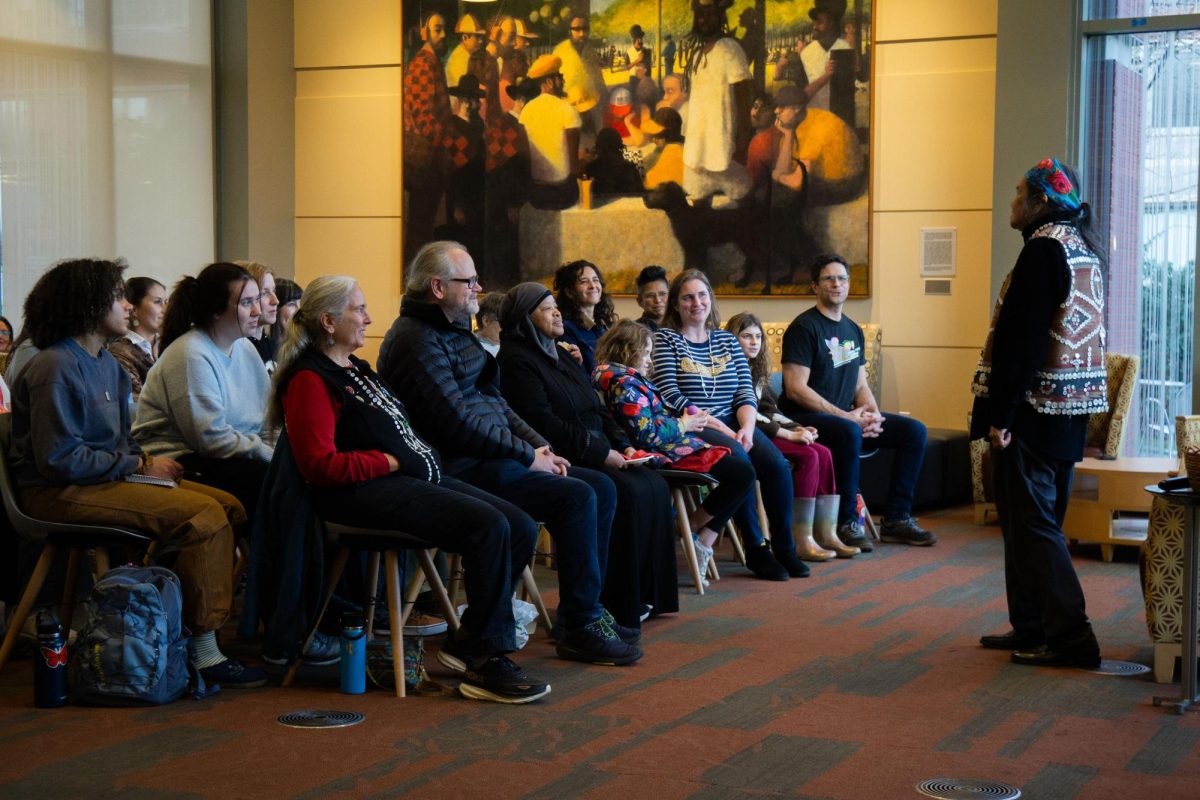
The Byte Café inside the Lemieux Library no longer resembled a place for coffee and studying. Tables were moved aside, and rows of chairs faced the front of the room, transforming the café into a small auditorium as students, faculty and community members gathered for a storytelling presentation.
The event was part of the Lushootseed Speaker Series hosted by the Indigenous Peoples Institute (IPI) and Lemieux Library, featuring Tulalip tribal member and master storyteller Johnny Moses.
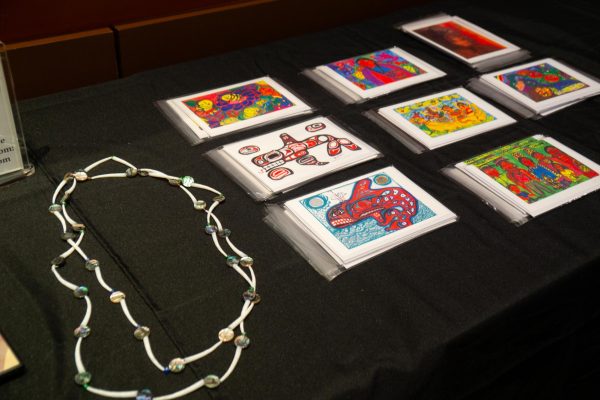
Moses entered wearing a flowered bandana, layered beaded necklaces and a handmade vest fastened with shell buttons. Holding a hand drum, he began beside Jill La Pointe, senior director of Seattle University’s IPI, opening the session with a song before addressing the audience.
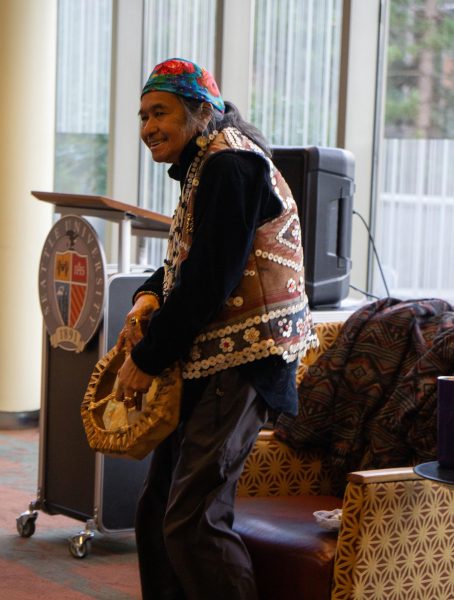
Instead of beginning with a lecture, Moses invited participation. He asked the audience to repeat a phrase together: “I’m listening… I think.” He demonstrated the words in several Coast Salish native languages spoken throughout the Salish Sea region and parts of Vancouver Island.
“I am from many many tribes, that’s why I tell stories in several native languages,” Moses said. “Most traditional people, in the olden days, learned at least two or three languages. It was important to learn your neighbor’s language, to learn how to communicate.”
Over the 90-minute presentation, Moses combined movement, humor and sound to animate traditional stories. He crouched low, widened his eyes and recreated animal noises while telling stories involving figures like the crow and the octopus. In other moments, he mimicked a slug’s slow movement, and later transformed into a flea using only his hands and voice. Audience members laughed, repeated Lushootseed words aloud and leaned forward in their seats.
Throughout the session, Moses introduced vocabulary connected to the natural world, naming animals, plants and trees while emphasizing that language and environment are inseparable. Call-and-response chanting encouraged participation and turned storytelling into a shared experience rather than a performance.
The stories carried lessons. In one story, a woman by the name of Lady Louse gets lost in the dust cleaning her longhouse, while in another, a clever crow warns against believing one knows everything. Across the narratives, a recurring idea appeared: in Indigenous worldviews, the earth itself is alive and humans exist as only one part of a larger living system.
Moses explained that storytelling serves as both a tool for education and cultural preservation. Raised by his great-grandparents, whom he described as orators, he was told from a young age that he would carry their stories forward. He also referenced encounters with settlers and missionaries, placing the stories within historical memory and cultural survival.
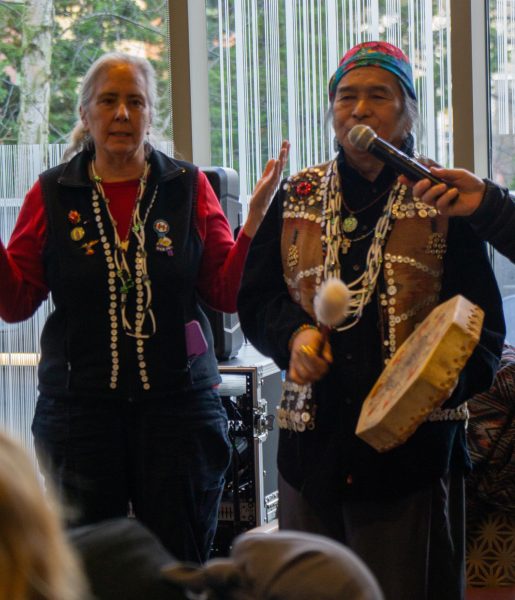
“Listening and participating is the way you learn in the Native tradition,” Erick Wardisko, a member of the Red Cedar Circle (a group dedicated to preserving the culture of native communities on the Northwest coast), who attended with his family, said.
La Pointe said the speaker series aims to support Native students and educate the broader campus community. She explained that winter holds particular significance in many Native traditions as a spiritual time for gathering and passing stories and songs between generations. Storytelling, she said, historically served as a primary form of teaching values, history and environmental knowledge.
The Lushootseed language originates from Coast Salish communities throughout the Puget Sound region, including Duwamish, Snohomish, Tulalip and Snoqualmie peoples. Like many Indigenous languages, it declined following colonization and assimilation policies, but is now being revitalized through education and community programs. By presenting storytelling alongside language, the event connected cultural practice with language preservation.
The event also drew alumni and community members. Mary Tappert, a 2007 Seattle U sociology graduate, attended with a group that said they had followed Moses’ storytelling for years. Seattle U sits within the traditional homelands of Coast Salish peoples, making the presentation locally relevant beyond its performance aspect. The event allowed students to encounter regional Indigenous traditions, not as historical material in a textbook, but as living knowledge shared directly by a cultural practitioner.
Organizers plan to continue the Lushootseed Speaker Series through future events hosted by the Indigenous Peoples Institute. These programs are free and open to all students.