
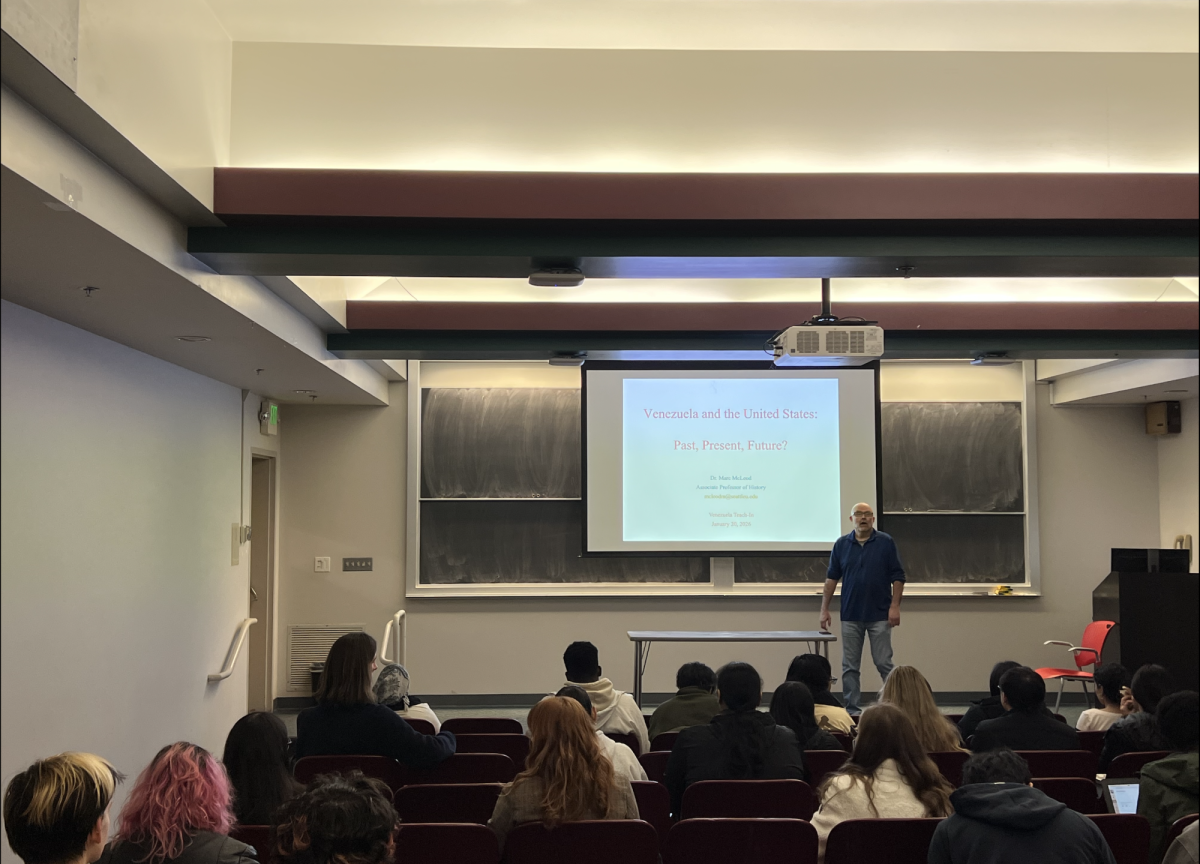
Tensions between the United States and Venezuela have been rampant following the abduction of Venezuelan President Nicolas Maduro and his wife by the American military Jan. 3. In light of these events, the History Department held a teach-in on Venezuela in Bannan 107 this past Thursday, Jan. 20, offering students and faculty an opportunity to better understand the roots of the ongoing crisis. Professor Marc McLeod, an expert in Latin American history who recently did a Q&A on Venezuela for the Spectator, led the teach-in.
McLeod opened the teach-in by emphasizing the importance of situating Venezuela’s current political and economic situation within its history. McLeod noted that Venezuela was “an outlier” within Latin America during much of its colonial period, as it was sparsely populated and economically marginalized.
“That all changed with the emergence of oil,” McLeod said. “It’s all about oil.”
McLeod explained that by the 1920s, Venezuela was the world’s largest oil exporter, which brought immense wealth but also long-term economic dependence. Eventually, oil came to dominate nearly every aspect of Venezuelan life and created a phenomenon referred to as “dependent development” by scholars.
The former Venezuelan oil minister, Juan Pablo Perez Alfonso, is often referred to as the “Architect of the Organization of the Petroleum Exporting Countries (OPEC).” OPEC is an international organization made up of major oil-producing countries that work together to coordinate and regulate oil production and pricing. Venezuela was among one of the founding members in 1960.
“[There was] a great line that Perez Alfonso once said, he wrote a pamphlet on this in 1976, the very same year that the oil industry was nationalized. He referred to the oil industry as ‘excremento de Diablo,’ the excrement of the devil… his book is [titled] We Are Sinking in the Excrement of the Devil,” McLeod said.
Much of the teach-in covered the rise of Hugo Chavez, the penultimate Venezuelan president, and the political movement he enacted known as the Bolivarian Revolution in the late 1990s. Throughout his presidency, Chavez used oil profits to fund social programs that targeted poverty and inequality, which earned him widespread support among working-class Venezuelans.
“This worked well when oil prices were high,” McLeod said, “96% of Venezuela’s foreign exchange earnings in 2012 were based on oil exports.”
At the same time, Chavez was centralizing political power, relying heavily on military power and gradually weakening democratic norms. After Chavez’s death in 2013, these trends intensified when Nicolas Maduro, Chavez’s handpicked successor, became president amid economic decline, hyperinflation and growing political unrest.
“Many of these crises had begun to appear under Chavez, but they only became more pronounced and exacerbated under Maduro’s reign,” McLeod said. “Always, there had been elements of authoritarianism and they became even more central after 2013.”
The consequences of this political and economic collapse have become far-reaching, as Venezuela is now facing one of the largest migration crises in the world. More than eight million people have left the country over the past 25 years due to political repression and shortages of food and medicine.
The second half of the teach-in focused on the current conflict and diplomacy between Venezuela and the United States. McLeod traced this back to the United States formally recognizing opposition leader Juan Guaido as Venezuela’s interim president in 2019 after Maduro’s regime received global accusations of election fraud. The United States support for Guaido was part of a broader strategy to force Maduro out of office through economic sanctions and diplomatic pressure.
Fourth-year International Studies and Public Affairs major Ella Ohlson attended the teach-in because she felt overwhelmed by contradictory coverage of Venezuela.
“In the last few weeks, there’s been a lot about Venezuela in the news, and there’s only so much I can do with my own research,” Ohlson said. “Especially not being able to know what is biased and what’s not.”
Ohlson reflected on how the historical context helped clarify long-term patterns while also raising new questions and concerns about United States policy.
“It left me a little bit confused thinking about the fact that the current sitting president in Venezuela was a part of Maduro’s government,” Ohlson said. “Because imagine if someone came and kidnapped Trump and then worked only with J.D. Vance.”
Fourth-year International Studies and Spanish major Abby Fitzwater also attended the teach-in and echoed Ohlson’s concerns, noting that even though recent actions by the United States are troubling, this isn’t the first instance of American intervention in Latin America.
“Putting it in context with other actions that the U.S. has done, like with Noriega in Panama, it’s not a new occurrence, but I think this is a new age with what Trump is doing,” Fitzwater said. “It’s very interesting and confusing that they’re choosing to work with the [Venezuelan] Vice-President who was once a part of [Maduro’s] regime, when they took him out of power for a reason.”
Even with these questions raised, both students highlighted that the teach-in itself didn’t create confusion; instead, they pinpointed contradictions within the United States’ foreign policy that, standing alone, are hard to make sense of.
The teach-in did not end with definitive answers pointing to the future of Venezuela and its relations with America, but that uncertainty added to the purpose of the conversation. McLeod’s ability to ground current events with historical context encouraged students and faculty to critically examine political power and the United States’ role in shaping political outcomes beyond its borders.