

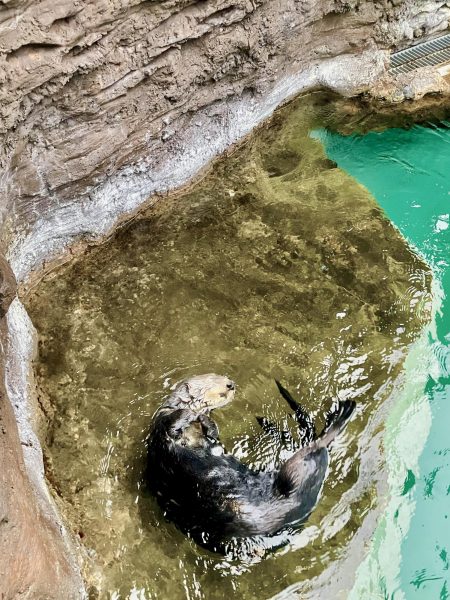
The Seattle Aquarium’s first and only southern sea otter has just splashed down in the city, and she’s already making waves. Ruby, hailing from the Monterey Bay Aquarium in California, started swimming alongside the aquarium’s two northern sea otters Mishka and Sekiu Nov. 20, turning the duo into a floating family of three.
Despite some differences, southern and northern sea otters can coexist because both species are located along the west coast. Northern sea otters are found off the coasts of Washington and British Columbia, and southern sea otters are found off the coast of California.
This adorable addition to the sea otter exhibit originated from the Monterey Bay Aquarium in California. As the smallest sea otter rescue that Monterey Bay has ever seen, Ruby came in at just 1.9 pounds when she was found at one month old. Ruby tried her best at solo-living but was found too dependent on humans for food, leading the aquarium to deem her unreleasable.
1995 marked the start of Seattle Aquarium’s research program, focused initially on sea otter physiology. Ever since the program began, the research has branched out to all corners of marine life and oceanic systems. Now the program tackles projects such as Puget Sound kelp and Hawai’i coral reef ecosystems. These projects all center on three main priorities: climate resilience, sustainable seas and clean seas. Seattle Aquarium doesn’t do this alone; it is a community effort through cultivated partnerships between non-profits, businesses and Washington state federal agencies. The aquarium also collaborates with local Western Washington tribes, including the Muckleshoot Tribe.
Emily Malone, public relations specialist for the Seattle Aquarium, took The Spectator on a tour of the sea otter exhibit to learn more about Ruby and her peers.
“We wanted to make sure this was the right fit for Ruby, and Monterey Bay actually reached out to the Seattle Aquarium because they knew that we had Mishka and Sekiu, two older females that are independent, and that seems to have done the trick,” Malone said. “Ruby was initially part of the surrogacy program at Monterey Bay, and due to a variety of factors, Monterey thought it would be a better fit with two older females.”
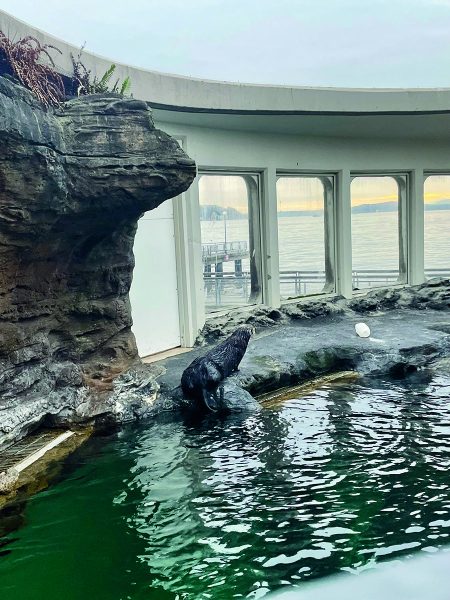
The sea otter exhibit has deep water cluttered with mussels and clams that the three otters snack on throughout the day. There is also an underwater viewing section of the exhibit where the otters can be seen playing and diving. Tall rock walls line the exhibit with greenery scattered around them. A hole in one of these walls connects two areas, both of which have platforms for the sea otters to lounge.
Next to the habitat are plaques with information on the sea otters, including the origins of their names: Mishka, meaning “little bear” in Russian, and Sekiu, being an indigenous word meaning “quiet waters.”
Ruby can be seen playing with ice on the rocky shores or swimming around with the frozen snacks provided by Seattle Aquarium staff members.
Ryan O’Shea, a Seattle local, took their visiting family members from Indiana to the Seattle Aquarium to see Ruby.
“We came because we have a visitor here, and we think this is one of the places that represent Seattle the most, plus we haven’t been here since the new extensions were built,” O’Shea said.
The expansion O’Shea refers to is the Aquarium’s Ocean Pavilion, which opened in August of 2024. The Pavilion houses over 5,000 different plant and animal species, transporting visitors to the underwater world of the Indo-Pacific. It joined the already existing exhibits and displays at Pier 59 and 60.
Pier 59’s focal point is fish tanks in varying shapes and sizes and displays of research currently underway at the Aquarium. Fish tanks came in multitudes of shapes and sizes such as the arch-shaped jellyfish tank , which allows visitors to go through the tank itself.
Pier 60 of the Aquarium focused more on lush landscapes where the birds and mammals’ habitats resided. Some exhibits have two layers to them: one above ground, and one to see the seals and sea otters swimming below.
“I love the experience here, how you can touch some of the sea urchins on the inside; I love all the little displays that explain the different animals,” Amanda Mills, a first-time visitor to the Seattle Aquarium, said.
Interested in meeting Ruby for yourself? The Seattle Aquarium’s visiting hours are 9:30 a.m. to 6:00 p.m. at Pier 59 and the new Ocean Pavilion, and tickets range from $30 to $45. During the month of December, the Diving Santa event will be ongoing, where guests can find Santa swimming among the fish and coral.