

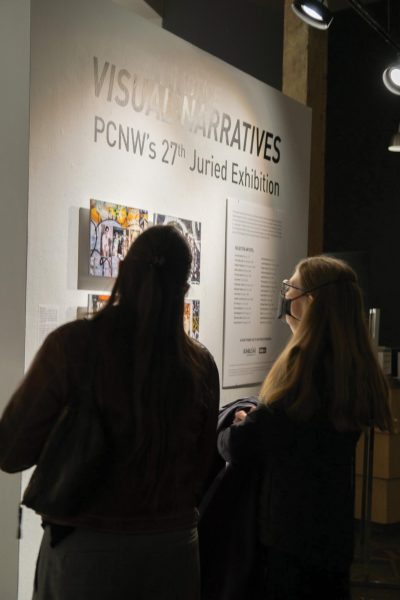
Standing inside the Photographic Center Northwest (PCNW), you’ll be surrounded on all sides by a diverse array of images clustered together in groups of three or four. To your right, large grayscale portraits seem to follow you with unmoving eyes. To your left, colorful landscapes invite you to wander through each frame. Each series of photos is unique; each sequence uses the medium to tell a story, or, in the words of the gallery itself, a visual narrative.
Currently on display is “Visual Narratives,” the PCNW’s 27th annual juried exhibit, inviting amateur and professional artists alike to submit their work for a chance to have it shown at the gallery. This year’s prompt included a new challenge to artists: rather than submit one photo, applicants could submit up to 10 in order to tell a cohesive narrative.
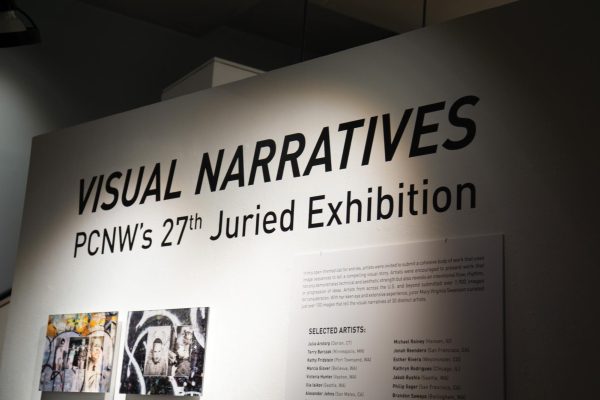
This left juror Mary Virginia Swanson with over 1,900 photos to select from, a process she discussed during her artist talk and gallery reception Nov. 14. Swanson drew on her experience as a publisher and curator to select pieces that were not only visually striking, but cohesive and enhanced by being part of a sequence.
A total of 30 artists were selected to show just over 100 photographs, with cash prizes awarded to first, second and third place winners. While the majority of submissions came from Washington state, others traveled as far as the East Coast, or, in the case of first-place winner Ilia Iaikov, a whole different country.
Iaikov left Russia in 2022, citing persecution for his anti-war beliefs. His collection, titled “Toward the Sun,” documents his experience immigrating to Seattle. In one of his four pieces, a hand reaches out, touching a glass windowpane separating it from an endless stretch of city. Another depicts a bedsheet with the New York skyline draped over a simple, wooden bedframe, stirring nostalgia in the viewer.
“The war with Ukraine started in February 2022, and I was still there, and I was thinking about leaving Russia, where to go, and one of my thoughts was to get a student visa,” Iaikov said. “I was really interested in photography, and I had my friend who was living here in Seattle. I researched what kind of places are there to go and study, and I came across this center and I saw the call for entry. I’m not thinking of myself as a good photographer or something, but the story came out really bright. So it’s just a story, and I wanted to share it.”
Iaikov’s use of vivid color contrasts with second-place winner Michael Sobel’s black and white film portraits, though both collections tell a story of community. Sobel has spent the past four years capturing a junkyard on Lopez Island, a small island in the Salish Sea. His series “Take It or Leave It” provides a glimpse into the lives of visitors to the dump and the objects they find.
“I’ve been visiting Lopez Island for over 20 years and gotten to know the community and their struggles with waste disposal and consumption. I really began to feel like it was a metaphor for our planet Earth, of the challenges of recycling and ecology and reuse,” Sobel said. “I was so impressed because they’ve developed a system for recycling and reusing useful stuff that has not met its life expectancy. They have a special shed called Take It or Leave It, it’s like a gigantic Goodwill, except everything is free. One visitor told me the price is right and the return policy is even better.”
While traditional photographs dominated the exhibit, artists like third-place winner Charlotte Niel didn’t shy away from including multimedia elements in their work. In her collection “Forget Me Not,” Niel embroiders flowers atop old family photos to bring her mother’s struggles with dementia and loss of eyesight to life. In each photograph, no matter how obscured by fabric or thread, Niel ensures the eyes are visible.
Each grouping of photos tells a unique, personal story, enhanced by the thoughtful artist statements provided alongside them. Having worked at the PCNW for five years, Administrative Associate Jake Alexander has seen firsthand how the decision to display collections, rather than single images, has impacted the way viewers interact with the gallery.
“I think because the show is pretty diverse, people are having individual interactions with each of the works…What you see when people come in is there’s a little bit more time you have to spend with each artist, they have some supplemental information that gives the viewer more of an understanding of where the work is coming from,” Alexander said.
“Visual Narratives” can be viewed at the PCNW until Dec. 14, 2025, at no cost.


![Peggy, Mink and Bladee Make Good on Threats to Drop Music [REVIEW]](https://seattlespectator.com/wp-content/uploads/2026/05/unholytrio-review-web-1200x900.png)