

Glowing screens display soft light that flashes against sky as forest and water scenery twist along the side of the Frye Art Museum. The body of artist Camille Trautman appears to be both part of and apart from nature in selections from their ongoing series “The North American LCD.” Trautman’s body is partly hidden beneath LCD screens that reflect the environment while displaying bits of skin, movement and reflection. The resulting images feel ethereal, resembling echoes of a space caught between the natural and digital worlds.
The North American LCD, Trautman’s first solo museum exhibition in their hometown, opened Oct. 15 and is currently on display at the Frye Art Museum through April 12, 2026. The Duwamish artist was born in Seattle and uses digital technology and long exposure photography to explore transformation, identity and connection to place. The project started out as a personal journey during their gender transition.
“I was thinking about my own body and how I felt sort of alien from it at first,” Trautman said. “I was focusing on what was going on screens instead of the real world. The project became a way to find my own place to figure out how I fit into the landscape.”
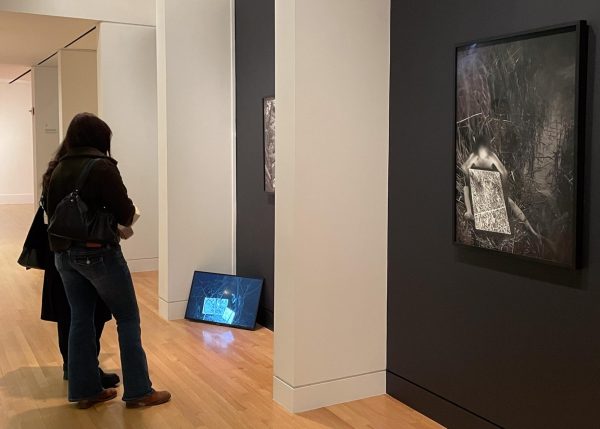
In every picture, Trautman is shown holding or standing close to an LCD screen that shows bits of what is around them. The result is a combination of body and environment where digital light and natural forms meet. Trautman described how the idea evolved over time. They transitioned from using an old LCD screen indoors to taking it outdoors into more natural locations using a battery pack.
While Trautman was attending graduate school in Tucson, Ariz., they began experimenting with desert settings, which show how the series initially took shape. However, once Trautman returned to the Pacific Northwest, the project took a deeper turn. A new level of connection to the land and the work was brought by the change in scenery and emotional tone. The series’ emotional core was marked by one key image captured close to Sun Lakes-Dry Falls in Eastern Washington.
“It was really windy that evening,” Trautman recalled. “I got the LCD screen close to the water and stuck my foot in. It felt like the image had more risk to it than the earlier ones.”
Jordan Lee was one of several attendees at the Frye, who was fascinated with the way Trautman’s artwork combined digital and natural pictures. He claimed that the contrast between artificial light and natural scenery felt both familiar and unsettling, showing how technology affects daily life. According to Lee, the images convey the feeling of being both connected and distant, a balance that feels profoundly modern.
“The first thing I noticed was the mix of calm landscapes and glowing screens,” Lee said. “It felt like something we see every day on our phones, but turned into something more thoughtful.”
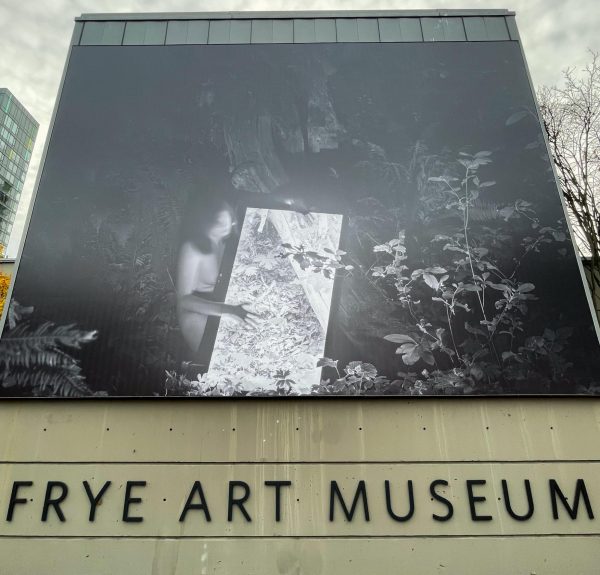
Maria Gonzalez, another attendee of the exhibit, was also fascinated, but focused more on the work’s personal significance. She claimed that the way Trautman’s body appeared to blend in with the surroundings and create a subtle tension between visibility and concealment drew her in.
The entire production revolves around the connection between visibility and transformation. In one image, the edges of Trautman’s body are erased by the LCD’s light against the fog and shadow. In another, the screen mirrors water so perfectly that it’s difficult to tell the difference between reflection and reality.
According to Trautman, the story of Narcissus, who fell in love with his reflection, had a significant impact on their work. Instead of looking at the water, they turned to face the glow of the screen, redefining reflection as curiosity rather than desire.
Their collaboration with the Frye started around a year ago, following a Zoom meeting between Trautman and Assistant Curator at the Frye Alexis L. Silva. They met in person and started organizing the exhibition when Trautman traveled to Seattle for Thanksgiving. For Trautman, the exhibition aligns with their early experiences of discovering art as a young visitor to the Frye.
“It really does mean a lot to me,” Trautman said. “Going to the Frye as a teen is kind of what got me thinking about art in a new way. It’s amazing to come back to that same space now.”
To Silva, The North American LCD represents the type of project they are most excited about: one that combines place, identity and technology while being accessible to the community. Since joining the Frye three years ago, Silva has focused on curating exhibitions that amplify underrepresented voices and challenge visitors to see art as part of everyday life. They discovered the importance of curating as a means of community care and storytelling while working at the Wing Luke Museum in Seattle’s Chinatown-International District.
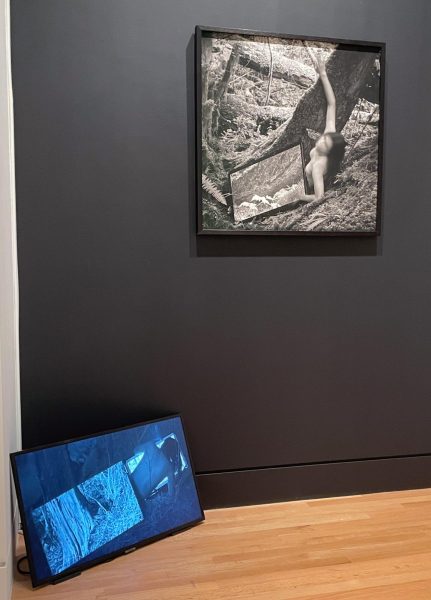
As part of the Boren Banner Series, which features artists with Pacific Northwest backgrounds, Silva collaborated closely with Trautman to bring The North American LCD to the Frye. Silva decided to exhibit Trautman’s pieces on the exterior in order to reflect the series’ themes of transformation and visibility. It reinforced the museum’s dedication to accessibility and representation by allowing the artwork to face the city directly and be visible to anybody walking by.
When Silva first saw Trautman’s artwork through the Seattle-based Indigenous creatives collective yəhaw̓, they were drawn by the way Trautman combined the landscape with personal identity through the use of light and reflection. They saw a type of quiet power, the capacity to make the invisible visible in Trutman’s photography.
“What really drew me in was how Camille’s work resists easy categorization,” Silva said. “It’s grounded in the land, but it also speaks to what it means to exist through digital mediation.”
The Frye was established in 1952 as the first free art museum located in the First Hill neighborhood in Seattle. The North American LCD’s public and free exhibition at the museum reflects the accessibility that motivated Trautman as a young artist.
Trautman is already planning ahead as the exhibition goes on; their next project will investigate how legal systems have shaped the ways people understand ownership and connection to landscapes. The North American LCD captures the very feeling of seeing oneself—not just in light, but in motion—between the light of screens and the quiet of the outdoors.

![Peggy, Mink and Bladee Make Good on Threats to Drop Music [REVIEW]](https://seattlespectator.com/wp-content/uploads/2026/05/unholytrio-review-web-1200x900.png)