

The beginning of October marks the start of Filipino American History Month (FAHM). With more than four million people in the United States identifying as Filipino, there’s no lack of community, especially in cities like Seattle, a city that over 100,000 Filipinos call home.
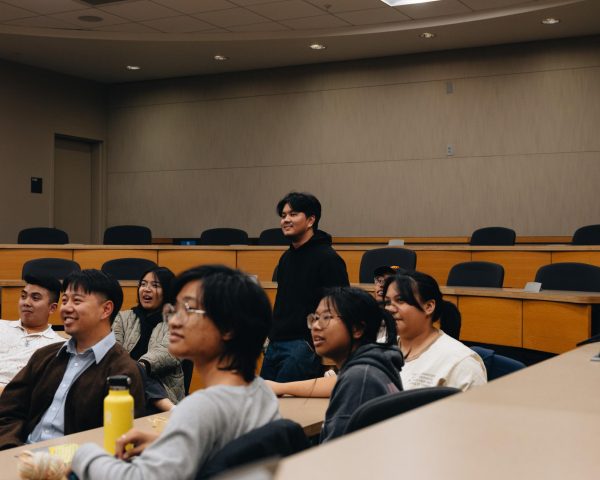
That core value of community was displayed right here at Seattle University, where the United Filipino Club (UFC) and its members celebrated FAHM with their Oct. 16 event “Our Stories, Our Dreams: FAHM Gathering.”
Beginning with an introduction to what FAHM is, attendees learned the history of how Filipinos first arrived in the United States and how FAHM came to be. This was followed by an intense game of FAHM Jeopardy, with a group of Filipino alumni emerging victorious, and a short share around where individuals told the stories of how their families made their way to the U.S., all while sharing a platter of a classic Filipino dish, lumpia.

“I think it’s important to spread our culture together,” Alexis Tabile, a fourth-year nursing major, said. “Being Filipino, I feel like we’re always very proud of it.”
This sentiment of pride and celebration of the Filipino culture was on full display with students and faculty. Ariana Upson, a first-year nursing major, was one of those people who attended FAHM to learn more about her personal identity and culture.
“I decided to come to this event because I wanted to broaden my [horizons],” Upson said. “Especially being someone who’s mixed, it was really like a big step forward…[to] embracing the Filipino [culture].”
In the midst of the celebrations and joy, Filipinos are also acutely aware of how the political moment is negatively affecting their communities, families and everyday life. Across the country, Filipinos are among minority groups that are seeing a stark increase in deportations, raising anxieties and insecurity for many.
Recently, in early March, Lewelyn Dixon, a lab technician at the University of Washington, was detained by ICE agents in Seattle after visiting family from the Philippines, and held at the Northwest ICE Processing Center, formally known as the Northwest Detention Center (NWDC), in Tacoma for three months before being released. She is a green card holder and had a non-violent conviction in 2001.
Stories like these have fueled activism among the youth and students. Vince Dela Cruz, a second-year biology major and the UFC’s social justice and politics chair, has been an outspoken advocate for the justice of immigrants detained by ICE, and was pushed even further to speak out for those affected by unjust detainments and deportations after hearing Dixon’s story.
“After learning about [Lewelyn Dixon,] I learned about even more people who were wrongfully detained in the detention center, which pushed me to go to events, [make flyers], and eventually make a speech for a rally here at [Seattle U],” Dela Cruz stated. “No person deserves to be detained for trying to make a living for their family.”
The recent FAHM event aimed not only to celebrate Filipino culture but also to provide insight into what students are experiencing on campus.
“Another goal for me as [SJPC] is to show light on what is currently happening to students here on campus,” Dela Cruz declared. “This FAHM event is to show how our history is important, and connecting with others is a great step towards it. This month gives light for Filipinos to learn their history and to look deep into how…[their families] eventually arrived here.”
Though the Filipino community has been grappling with the effects of the Trump administration’s extreme anti-immigration policies, it hasn’t stopped Seattle University students from celebrating their culture and having pride in their nation.
Benjamin Ebalobo, a fourth-year nursing major and current president of the UFC, has been proudly celebrating FAHM by participating in his culture.
“I’m eating a lot of Filipino food,” Ebalobo said,“I’m singing a lot of songs…and I’m cooking for my family and my roommates.”
Heritage months, such as FAHM, serve not only as a celebration of cultural identity but are also important in connecting community members within that culture. The “Our Stories, Our Dreams: FAHM Gathering” was a prime opportunity for many kababayan, a word for fellow countrymen in the Filipino language Tagalog, to connect and come together as one.
“[Filipinos hold a lot of the] same values…we hold family so highly…[and] we’re always so hospitable. It’s always easy to break the ice with another Filo,” Jacob Cadddali, fourth-year political science and public affairs double major, said.
Some students spend the month engaging in their favorite aspects of their culture.
“I feel connected to other kababayan through my culture in celebrating it. Whether it be a huge gathering, [talking] about family history, or even just eating Filipino food,” Dela Cruz shared.
Community is an essential part of Filipino culture, and these students have upheld that value in a spectacular display of connection, love and “bayanihan.” The UFC has been committed to keeping Filipino culture alive and thriving for over 80 years at Seattle U. This event was just a small display of a broader, yet tight-knit, and loving community.