

30 years ago, the previous owner of the Seahawks threatened to sell or move the franchise after plans to build a new Mariners Stadium and refit the Kingdome for football collapsed under financial strain. Two years later, state voters approved a special funding package for a new Seahawks Stadium.
With former Seahawks owner Paul Allen leading the campaign, it was mandated that the new venue be designed with the capacity to host international soccer matches. Now, in 2026, eight years after Allen’s death, Seattle will be hosting six World Cup matches this June. These matches are expected to bring hundreds of millions of dollars to Seattle; the economic impact on the region will be huge. In light of this, the Albers School of Business and Economics discussed the role of the sports industry in shaping the economy and reputation April 23.
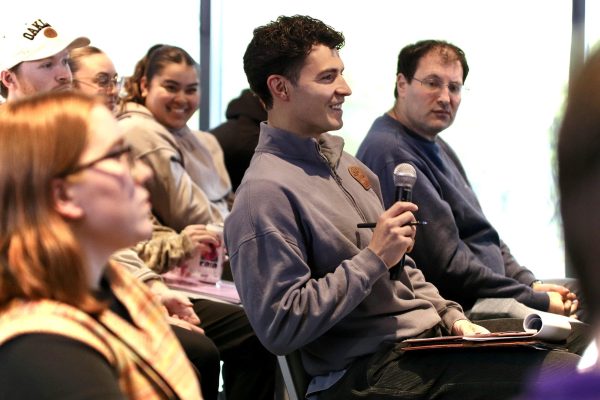
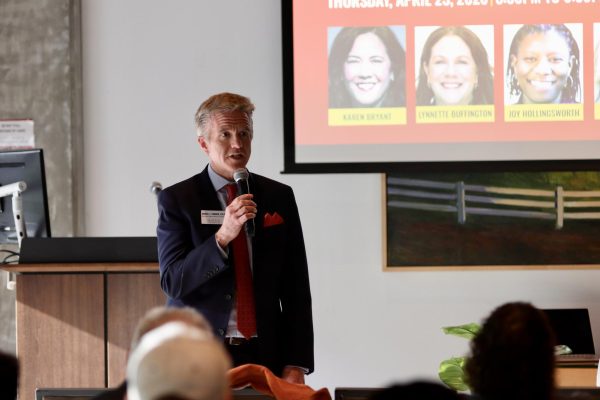
Pamela Quadros, chief operating officer of the Seattle Sports Commission, Joy Hollingsworth, Seattle city council president, and Lynette Buffington, chief of staff at the Seattle Metropolitan Chamber of Commerce, took part in the final Albers Executive Speaker Series of the academic year. The panel was moderated by Karen Bryant, sports advisor and founder of Suite J Consulting.
(Justin Hartshorn)
Seattle sports are having a cultural moment right now, with Seattleites buzzing in support of their teams. The Seahawks’ Super Bowl win, their first since 2014, had the entire city swarming the streets in celebration. The victory was followed by their Super Bowl Parade. In a single day, the parade generated $16 million for the city.
Large-scale events bring an influx of tourists, increase hotel bookings, transportation use and spending at local businesses, all of which contribute significantly to the city’s earnings. The highly anticipated 2026 FIFA World Cup is projected to generate around $929 million for King County across the six matches being hosted in Seattle.
When it comes to financing and organizing big events, Washington does not have a strong sports historical mark on the United States map compared to other states with large metropolitan areas.
“When you are competing for an NFL draft or a World Cup,” Quadros said. “You’re competing against organizations that have the support of their state, where they will write a check for $20 million.”
In order to stay competitive, Seattle must rely more on partnerships, planning and utilizing its existing facilities. The speakers stressed that in spite of this, Seattle has managed to establish itself as a powerful host city by making strategic investments in public facilities and venues, such as Climate Pledge Arena, Lumen Field and T-Mobile Park.
Large events draw more people to the city, but Seattle and local businesses alike must plan accordingly. During the Seahawks’ Super Bowl Parade, an estimated 750,000 to 1 million fans gathered in downtown Seattle. A key element to the parade’s success was its ability to allow people to use public transportation while maintaining safety regulations. The panel emphasized that successful sporting events involve coordination between several city departments..
(Justin Hartshorn)
“[The] Seattle Department of Transportation helped set up the barriers. They swept 10,000 pounds of trash from the parade, and then they were able to get 4th Avenue back online right before traffic came out so people could get downtown or out of downtown [to] wherever they were going,” Hollingsworth said. “We have the G-Line with Madison. They use Sound Transit. There weren’t a ton of complaints where people were talking about, ‘Oh, it was a traffic jam,’ because we had such great public transit options for people to get downtown.”
To help small businesses better benefit from large events, the Seattle Metropolitan Chamber of Commerce has worked to provide them with resources and training. This includes helping companies in changing their services, marketing, plans and hours to accommodate customers. Businesses need to plan around sporting event days if they want to see extra profits.
“Just because the foot traffic is in front of your business,” Buffington said. “It is on you to bring them across the threshold.”
The Albers Executive Speaker Series gave a thorough rundown of how sports affect Washington’s culture and economy. In just a few months, Seattle’s economic planning will be put to the test with the FIFA World Cup coming to town, bringing hundreds of thousands of sports fans to the streets of the Emerald City.